

Hiring Adelaide Civil Contractors a Practical 2026 Guide
You're often ready to build before the site is ready to support the build.
That's the point where many Adelaide projects slow down. The plans look settled, the budget feels close, and then substantive constraints show up in council conditions, stormwater requirements, sewer connection issues, driveway grades, retaining needs, or utility authority comments that no one dealt with early enough.
For homeowners, that can turn a straightforward extension into a redesign. For developers, it can put subdivision timing, service approvals, and holding costs under pressure. For commercial clients, it can delay access, drainage, pavement, and essential service works long before the internal fit-out starts.
Good Adelaide civil contractors solve those problems before they become expensive. The right contractor doesn't just move dirt. They help make the block buildable, serviceable, compliant, and durable.
Your Project Needs More Than Just a Builder
A lot of clients first think about civil work when excavation starts. By then, the easy decisions are already behind you.
The harder decisions sit underneath the building. Finished levels, falls, access, sewer invert depths, stormwater discharge points, retaining heights, and service corridors all affect whether the design can be delivered cleanly. If those issues are left too late, the job usually pays for it in redesign, variation claims, and delays.
In South Australia, civil construction isn't a side trade. It's a substantial specialist sector. The CITB South Australian workforce profile reported that civil construction accounted for 9,892 workers, or 21.1% of the state's construction workforce in South Australia's industry profile, which reinforces that it operates as a distinct discipline rather than a minor part of general building (CITB workforce and skills profile).
What civil contractors actually change
A capable civil contractor influences whether your project can:
- Drain properly: Water has to go somewhere legal and reliable. If the site falls the wrong way, or if detention is required, that needs solving before slabs and pavements lock everything in.
- Connect to services: Sewer, water, power, communications, and stormwater aren't just paperwork items. Their location and capacity shape the entire build sequence.
- Use the land efficiently: On sloping or constrained sites, retaining, cut and fill, and access design often determine how much usable area you really have.
- Pass approvals with fewer surprises: Engineers, surveyors, hydraulic designers, and civil contractors work best when they're aligned early.
Practical rule: If council, your engineer, or a utility authority has placed conditions on levels, drainage, access, or services, you're already in civil territory.
Why early engagement usually saves money
Clients sometimes treat civil input as an added consultant cost. In practice, late civil input is what gets expensive.
The pattern is predictable. Architectural plans get advanced before enough attention is paid to site grades or service constraints. Then someone discovers the driveway won't work, the stormwater can't discharge as assumed, or the retaining solution is bigger than expected. The design can still proceed, but now every correction comes after other decisions have been made.
That's why experienced Adelaide civil contractors are valuable early. They help test whether the site can support the design you want, not just whether the design looks good on paper.
Understanding the Scope of Civil Construction Services
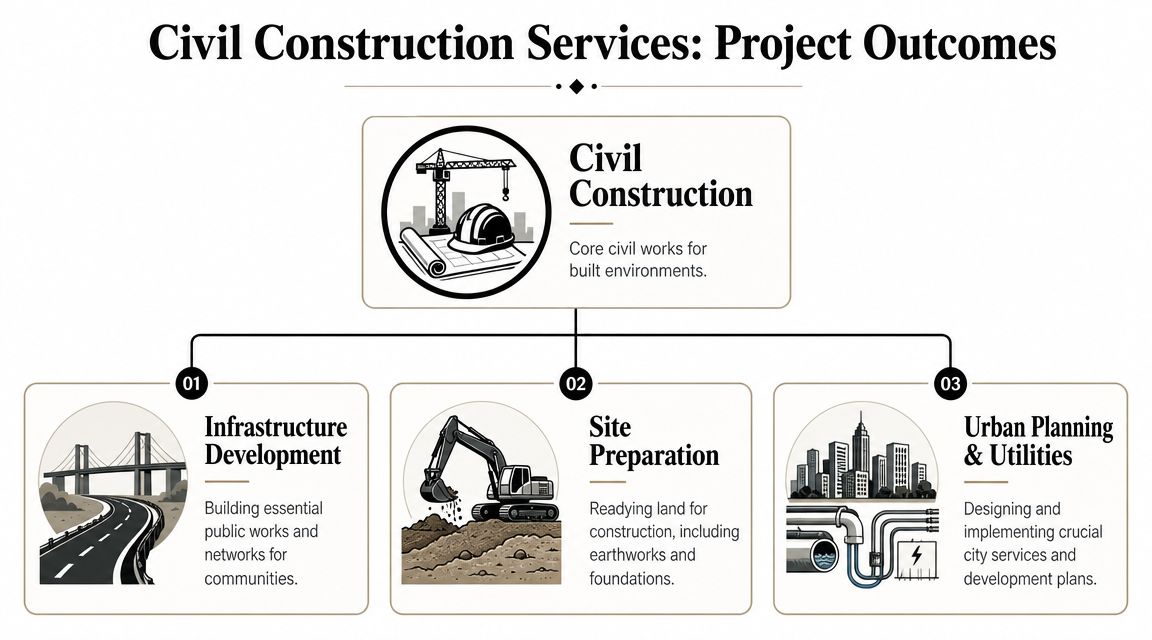
Civil work covers far more than excavation. On a live project, it's the layer that makes the site stable, compliant, and serviceable before and during construction.
Earthworks and site shaping
Earthworks set the geometry of the whole job. That includes cut and fill, pad preparation, subgrade treatment, batters, access routes, and the basic level relationships between the building, driveway, external paving, and drainage.
What works is earthworks tied directly to survey data and finished design levels. What doesn't work is rough excavation based on assumptions, then trying to fix falls and clearances later.
A proper starting point is reliable site information. If you're still at the pre-construction stage, this overview of what a site survey is is useful because it shows why levels, boundaries, and features need to be resolved before civil design gets too far.
Retaining walls drainage and services
Retaining isn't just about holding back soil. It changes loads, drainage behaviour, access widths, fence interfaces, and how usable your outdoor space becomes.
Stormwater and drainage are even more critical. Adelaide sites can look straightforward in dry weather, then expose every weak point once runoff starts moving across hard surfaces. Contractors need to design for where water enters the site, how it travels through it, and where it can leave lawfully. Service trenching then has to work around those systems without creating conflicts between sewer, water, power, communications, and future maintenance access.
Cheap trenching is expensive if it has to be reopened because no one coordinated depths, crossings, or authority requirements.
Adelaide conditions change the brief
For Adelaide homeowners and developers, especially on coastal or higher-exposure sites, the issue isn't only first cost. Contractors often need to adapt designs for stormwater, corrosion, and erosion risk, which is a more demanding exercise than basic earthmoving alone, as reflected in local civil contracting commentary on resilient site works in South Australia (AR Contracting Services overview).
That's where many quotes can mislead. Two contractors may both price drainage or retaining, but one may be allowing for a short-life solution that only gets the job through today's approval. The other may be allowing for more durable materials, better detailing, and maintenance access that protects the asset over time.
For commercial clients, the same principle applies inside broader project planning. If you're also planning your office fit out, it helps to treat external civil works, access, stormwater, and services as part of the fit-out pathway rather than a separate issue. A fit-out can be ready on paper while the site outside still isn't.
When to Engage an Adelaide Civil Contractor
The right time isn't when the excavator turns up. It's when the site starts dictating the design.
That might happen when your planner flags drainage conditions, when your survey reveals tighter level constraints than expected, or when service authority feedback shows the block can't be connected as readily as the estate listing suggested.

The Angle Vale lesson
Adelaide's growth corridors make this very clear. In Angle Vale, the South Australian Government directed $59 million toward water and sewer upgrades to help expedite housing delivery, showing that infrastructure capacity can be a primary constraint on development timing, not just land supply or builder availability (South Australian Government announcement on Angle Vale upgrades).
That matters because many clients still assume the sequence is simple. Buy the site, finalise the design, appoint the builder, and connect the services. In growth areas, it often works the other way around. Utility capacity, approvals, and servicing strategy can determine whether the development is feasible at all, or whether it sits waiting for upgrades outside the site boundary.
Common trigger points
You should usually bring Adelaide civil contractors into the conversation when any of these apply:
- Subdivision or multi-dwelling intent: If the project relies on new services, road interface changes, stormwater systems, or utility coordination, civil input shouldn't wait.
- Sloping or awkward land: Sites with retaining, difficult access, or split-level outcomes need civil and survey thinking tied together from the start.
- Council conditions are getting technical: Once conditions mention detention, discharge, crossover upgrades, service relocation, or engineered retaining, the build has moved beyond standard trade coordination.
- Commercial access and paving matter: Warehousing, offices, hospitality, and mixed-use projects often need civil works before occupancy pathways are clear.
The earlier a contractor can test assumptions against the site, the fewer late-stage surprises you carry into tender and construction.
Different clients hit this point differently
A homeowner usually feels the need for civil input when DA conditions become more detailed than expected. A developer usually feels it during feasibility, when servicing costs and utility sequencing start affecting the margin. A commercial client often notices it when external access, parking, drainage, or authority works threaten the opening date.
The jobs are different, but the pattern is the same. The project stalls where the design meets the ground and the utilities.
How to Vet Your Contractor and Avoid Red Flags
Civil work can fail subtly at first. A quote can look organised, the site can look busy, and the paperwork can still be thin where it matters most.
That's why vetting isn't admin. It's project risk control.
One broad industry benchmark often quoted is sobering. A construction industry source notes that only 17.2% of construction companies remained in operation after 20 years, implying an approximate 83% failure rate over that period, with weak tracking, poor systems, and project performance issues identified as recurring causes (construction company failure discussion).
That doesn't mean every contractor is high risk. It does mean you shouldn't confuse a competitive price with a stable operation.
Start with the non-negotiables
Before discussing personality or presentation, check the basics.
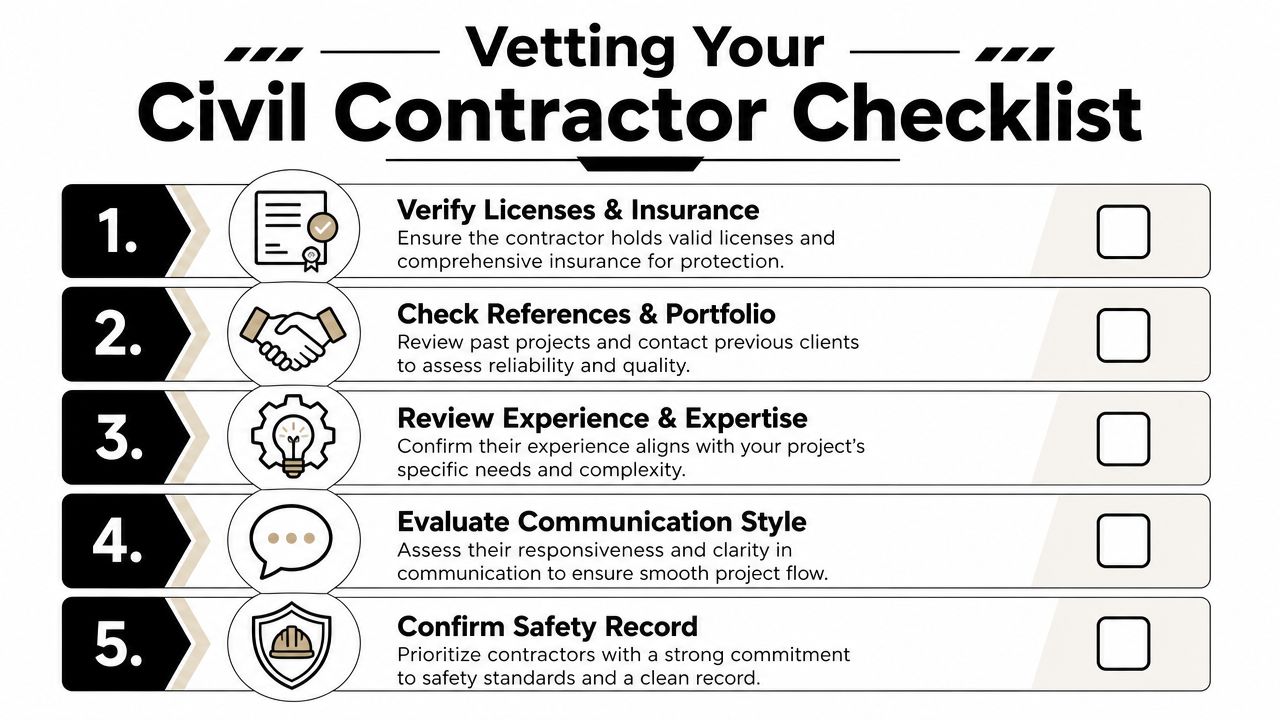
- Licensing and registrations: Confirm the contractor holds the right current credentials for the work they're offering.
- Insurance currency: Sight current Certificates of Currency for relevant cover such as public liability and, where design responsibility exists, professional indemnity.
- Scope alignment: Make sure the contractor is pricing the full civil scope, not selectively excluding difficult parts and leaving them to emerge later.
- Relevant project history: Look for completed work with similar access conditions, service complexity, retaining demands, or authority interfaces.
Ask questions that reveal systems
A polished sales process can hide weak delivery discipline. The better questions are specific.
Ask how they track variations, who manages authority coordination, how site levels are verified before works begin, and what happens if survey information conflicts with the engineering drawings. Ask who you'll deal with once the contract is signed. Ask how often programme updates are issued and what format they use for documenting changes.
A useful companion piece before those conversations is this list of questions to ask a custom home builder. Even though it sits in a residential context, many of the same due diligence habits apply when civil and building scopes overlap.
Watch for this: If a contractor can explain plant and materials in detail but gets vague about documentation, approvals, or change control, that's not a small gap.
Red flags worth taking seriously
Some warning signs show up early if you know what to listen for.
| Red flag | Why it matters |
|---|---|
| Vague allowances | They often become variation pathways once site realities emerge |
| Pressure to sign quickly | Good operators don't need urgency to replace clarity |
| No clear programme logic | If sequencing isn't defined, utility and authority delays will land on your budget |
| Poor document control | Old drawings, unclear revisions, and missing inclusions create disputes fast |
| Overconfidence about approvals | Approvals aren't guaranteed just because someone says they've “done heaps of these” |
Good contractors don't promise that nothing will change. They show you how change is identified, priced, approved, and recorded.
Navigating Costs Contracts and Council Approvals
Civil pricing varies because the site does. Two blocks of similar size can produce very different costs once levels, soil behaviour, retaining, stormwater pathways, authority requirements, and access constraints are properly understood.
That's why early desktop budgets are useful, but they're not enough to rely on for contract decisions. A cheap figure attached to incomplete information is usually just deferred cost.
What drives the price
The biggest cost influences are usually practical, not mysterious:
- Ground conditions: Rock, unstable fill, wet areas, and poor founding conditions change plant, labour, disposal, and programme.
- Levels and geometry: Steeper sites and tight finished level requirements often mean more retaining, more detailed setout, and more constrained sequencing.
- Drainage complexity: Legal discharge points, detention requirements, and downstream limitations can change the whole external design.
- Utility coordination: New or upgraded service connections often involve approvals, inspections, lead times, and trenching conflicts.
- Access: Tight suburban sites can be slower and more plant-restricted than a larger open parcel.
A civil quote only means something if the assumptions are visible. If the assumptions are hidden, the price is only provisional, even when the heading says fixed.
Contract model matters
In Adelaide, experienced contractors working on government and utility-style projects often use structured delivery models such as design and construct, early contractor involvement, alliance, and construct-only. Team Civil, an Adelaide contractor established in 1993, publicly notes these delivery approaches and its work with tier-one design firms to optimise design and reduce site works, which is a useful local benchmark for reducing rework and improving cost certainty on more complex jobs (Team Civil delivery models).
For smaller private projects, the choice usually comes down to a traditional tender process versus a more integrated fixed-price or design-and-construct path.
Tender Process vs. Fixed-Price Contract Comparison
| Factor | Tender Process | Fixed-Price / Design & Construct |
|---|---|---|
| Design responsibility | Client team usually completes more design before pricing | Contractor often contributes to design development and buildability |
| Price visibility | Can help compare multiple bids against the same documents | Can improve clarity if scope and assumptions are genuinely integrated |
| Risk of gaps | Higher if drawings are incomplete or site information is poor | Lower when contractor pricing is tied to coordinated design inputs |
| Variation exposure | Often rises when latent issues or omissions appear after award | Can be reduced, but only if exclusions and assumptions are clearly written |
| Best suited to | Well-documented projects where competitive tendering is the priority | Projects where buildability, sequencing, and authority coordination need earlier input |
Neither model is automatically better. Tendering can work well when the design is mature and the site is well understood. Design and construct is often stronger when the site still needs practical resolution and the client wants fewer handover gaps between consultant intent and site delivery.
If you're comparing broader trade procurement methods across a commercial project, this guide to selecting commercial contractors is a useful cross-check because many of the same procurement risks show up outside civil as well.
Council and authority approvals need buildable documents
A lot of approval delays happen because drawings satisfy the design brief but don't yet satisfy the site.
Councils and authorities want workable information. That can include levels, drainage intent, retaining details, service pathways, access geometry, and engineering documentation that matches what will be built. If these pieces are fragmented, the approval process drags because each reviewer is responding to a different version of the job.
That's why the contract and approval process need to be read together. If your contractor is engaged too late, they may inherit drawings that are hard to price and harder to deliver. If they're engaged appropriately, they can help identify what needs resolving before formal approvals and final costing lock in.
A practical reference point is this guide on what to look for in a building contract. The same discipline applies to civil scope. Look closely at exclusions, latent conditions, authority fees, provisional items, programme assumptions, and variation procedures before signing.
Your Partner for Integrated Project Delivery
A project can look straightforward on paper, then stall the moment SA Water servicing, stormwater discharge, or access geometry is tested against the actual site. That happens often in Adelaide's growth corridors, where development yield depends as much on utility capacity and civil coordination as it does on the building design.

Heavy and civil engineering construction sits at the top end of the sector in labour value, with wages and salaries per employee reported at $132,900 nationally in the ABS construction industry overview, which reflects the technical skill and capital intensity involved in this work (ABS Australian construction industry overview).
That cost profile is part of why fragmented delivery creates problems. If the surveyor, engineer, builder, and civil contractor are all working from slightly different assumptions, the client ends up carrying the coordination risk. On Adelaide sites, that usually shows up in three places first. Service connection strategy, finished levels, and drainage outfall.
The better approach is integrated project delivery. Early coordination lets the team test whether the proposed build can be serviced, whether authority requirements match the design intent, and whether the civil sequence supports the construction programme instead of disrupting it. For infill and multi-dwelling work, that can be the difference between a feasible site and a redesign after money has already been spent on drawings and approvals.
Templeton Built is one Adelaide firm working in that space, providing design and construction services across residential, commercial, and development projects where site conditions and building scope overlap. That kind of partner adds value when civil works are tied directly to authority responses, retaining strategy, access design, and the practical question every developer asks early. Can this site be delivered without avoidable rework?
Good coordination does not make a difficult block cheap. It does make the risks visible earlier, which is usually where actual savings are found.


Leave a Reply