

Asbestos Removal Adelaide: Your 2026 Expert Guide
You've found the house you want to improve. Maybe it's a bungalow in a leafy Adelaide suburb, maybe a solid brick family home with a dated kitchen, tired bathroom, and a backyard begging for a better connection to the living area. The renovation ideas come quickly. Open up the floorplan, add a master suite, rework the laundry, replace the old eaves, freshen the exterior.
Then someone says the word asbestos.
That moment is common. It doesn't mean the project is in trouble, and it doesn't mean you need to panic. In older Adelaide homes, asbestos is often part of the renovation conversation. The primary issue isn't whether it exists. The crucial issue is whether it's identified early, managed properly, and removed in a way that protects everyone on site and keeps the renovation moving in the right order.
That Renovation Dream and the Asbestos Question
A typical scenario goes like this. A family buys an older home because it has character, a good block, and enough potential to justify the work. They start planning the fun parts first. A larger kitchen, better natural light, more storage, improved flow to the outdoor area. Then demolition planning begins, and questions come up about the old bathroom linings, eaves, fencing, or ceiling sheets.
That's usually the first point where asbestos becomes real.
From a builder's perspective, this isn't unusual or dramatic. It's one of the early constraints that needs to be dealt with before structural changes, service upgrades, or cosmetic improvements can happen safely. In practical terms, asbestos removal adelaide work often sits right near the front of the programme because other trades shouldn't be working around unidentified or disturbed asbestos-containing materials.
Homeowners also find that asbestos affects more than the work zone itself. If parts of the house need to be cleared for testing, strip-out, or removal access, it helps to think about temporary storage and household logistics early. A useful planning resource is this guide on unit types and costs, especially if furniture, keepsakes, or appliances need to be moved out of affected rooms.
There's another reason to deal with it upfront. Renovations on older homes already involve sequencing challenges. You may be balancing approvals, selections, engineering, and builder availability. If asbestos is discovered late, it can interrupt all of that. If it's addressed early, it becomes a manageable enabling step, much like site prep or service disconnection.
For homeowners renovating period or older post-war homes, a broader strategy for the whole building helps. If you're thinking beyond a single room and want to understand the right order of works, this guide on how to renovate an old house is a sensible starting point.
The smoothest projects aren't the ones with no surprises. They're the ones where known risks are identified before demolition starts.
Identifying Asbestos Risk in Your Adelaide Home
Most homeowners don't need to become asbestos experts. They do need a clear mental model of what may be risky and why some materials are more dangerous when disturbed.
The simplest distinction is between non-friable and friable asbestos.
The biscuit and flour comparison
Think of non-friable asbestos like a biscuit with the fibres bound tightly into it. The material is more solid and stable while it remains intact. Many older cement products fall into this category. The risk rises when someone cuts it, drills it, snaps it, sands it, or lets it deteriorate over time.
Think of friable asbestos more like loose flour. It can release fibres far more easily because the material isn't tightly bound. That's why friable material is treated with a much higher level of control.
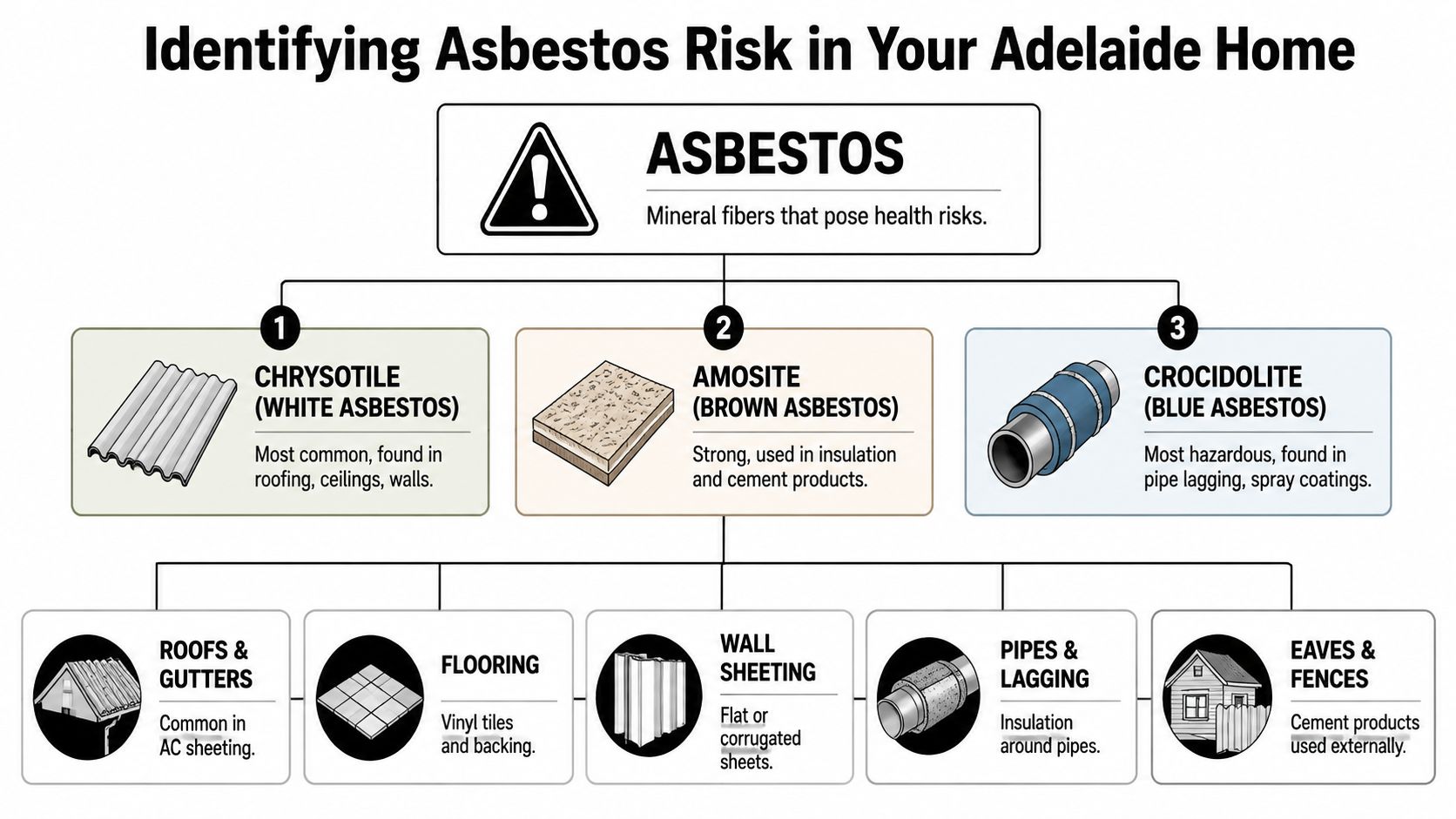
In Adelaide homes, bonded asbestos can show up in places owners don't expect. Common examples include:
- Eaves and soffits where older cement sheet products were widely used
- Wall sheeting in laundries, bathrooms, wet areas, and service spaces
- Vinyl flooring and backing in older kitchens or utility rooms
- Ceilings and external cladding in dated additions or outbuildings
- Fences and ancillary structures such as sheds or detached utility areas
Friable material is less likely to be a casual DIY discovery, but it can appear in older insulation products, pipe lagging, or deteriorated materials that have broken down over time.
What homeowners should actually do
The mistake is trying to confirm it by eye and then poking at it. Age of the house, material appearance, and location can all raise suspicion, but they don't give certainty. What works is treating suspicious material as suspect until a qualified professional assesses it and, where needed, testing confirms what it is.
A practical homeowner checklist looks like this:
- Stop the disturbance if you're about to cut, remove, or demolish the material.
- Take note of the location and whether the material is intact, cracked, flaking, or water-damaged.
- Keep others out of the area, especially children, visitors, or unrelated trades.
- Arrange professional assessment before any strip-out continues.
If you're concerned specifically about older floor finishes, this reliable asbestos tile testing info gives a useful overview of why flooring can be deceptive and why proper confirmation matters.
If a material might contain asbestos, the safest assumption is simple. Don't disturb it until it's been properly assessed.
Where builders get caught out
The trouble spots on renovation jobs are often the areas people think are minor. An old splashback lining behind tiles. A patch wall in a laundry. A detached shed that “just needs to come down.” These are the moments when bonded material can shift from low-risk and undisturbed to a removal issue.
That's why a pre-demolition survey matters. It gives the renovation team a map of what can stay, what needs control, and what must be removed before the rest of the work begins.
Navigating South Australian Asbestos Regulations
Homeowners don't need to memorise legislation, but they do need to understand the framework well enough to ask the right questions and reject shortcuts.
In South Australia, the licensing rules are clear. SafeWork SA states that a licence is required to remove more than 10 m² of non-friable asbestos-containing material. Class A licence holders can remove all asbestos-containing materials, including friable asbestos, and Class B licence holders can remove any amount of non-friable asbestos. SafeWork SA also notes that air monitoring is a mandatory requirement in South Australia for both friable and designated quantities of non-friable asbestos removal, and that PCBUs commissioning asbestos removal at workplaces must ensure the monitoring is carried out and communicated according to SafeWork SA asbestos requirements.
What Class A and Class B mean in real life
For a homeowner, the licence classes aren't abstract categories. They affect who can legally do the work on your site.
| Licence class | Practical meaning for your project |
|---|---|
| Class A | Can remove all asbestos-containing materials, including friable asbestos |
| Class B | Can remove non-friable asbestos-containing materials |
| No licence | Not suitable for work above the legal limit for non-friable material, and never for friable asbestos |
That matters because the renovation site doesn't care whether an operator is cheap, available next week, or recommended by a mate. If the material and quantity require a licence, then the work must be done by the right licence holder.
Why the 10 m² threshold matters
The 10 m² threshold is where many homeowners get confused. They hear that small amounts can sometimes be handled differently and assume that means asbestos is a casual demolition item. It isn't.
That threshold is a legal dividing line, not a signal that asbestos is harmless below it. The broader issue is project control. A renovation often involves multiple suspected locations across different rooms and external elements. Once you aggregate the work, the scope can quickly move into licensed removal territory.
There's also the matter of documentation and downstream approvals. If your renovation requires formal approvals, it helps to understand how compliance fits into the broader process. This overview of how to get a building permit gives useful context for how regulated construction tasks sit inside the larger job.
Practical rule: If anyone on site is guessing about licence class, material type, or whether air monitoring applies, the job isn't ready to start.
What doesn't work
What doesn't work is hiring a demolition crew first and hoping they “sort it out.” What doesn't work is partial strip-out around suspect material. What doesn't work is assuming that because a sheet looks solid, the rules don't apply.
The right approach is slower at the front end and smoother across the whole renovation. That's usually the better trade.
The Safe Asbestos Removal Process Step-by-Step
When homeowners haven't seen a professional asbestos job before, the process can feel opaque. In reality, it follows a controlled sequence. Good operators don't improvise. They prepare the site, control exposure, remove the material carefully, clean down thoroughly, and verify the result.
A pre-removal plan should sit alongside the rest of the construction planning, especially where demolition, temporary access, and site logistics overlap. Good early coordination on site preparation for construction helps prevent avoidable clashes between removal work and later trades.
Step 1 and Step 2
The first steps happen before anything is removed.
A worker without an asbestos removal licence may remove up to 10 m² of non-friable asbestos, but friable asbestos must never be removed without a Class A licence. Safe Work Australia also notes that on renovation sites, pre-demolition surveys are vital, and professionals isolate work areas and use wet-method controls where practicable to suppress airborne fibres and reduce cross-contamination to adjacent occupied spaces in the How to Safely Remove Asbestos code of practice.
That means the job usually begins with identification, scope confirmation, and area isolation. Barricades, signage, restricted access, and work-zone separation are part of getting the site under control before disturbance starts.

Step 3 through Step 5
Once the work zone is established, the removal team focuses on controlled handling.
- Worker protection means proper PPE, not just a disposable mask from the hardware shop.
- Wet methods are used where practicable because moisture helps suppress airborne fibre release.
- Careful dismantling matters more than speed. Breaking sheets recklessly creates a bigger contamination problem than taking them out whole where possible.
- Packaging must be secure and clearly managed so waste leaves the site without spreading contamination through driveways, shared access points, or other parts of the property.
From a builder's point of view, this is where sequencing counts. You don't want plasterers, electricians, or cabinet installers trying to work around active containment. The area should be treated as out of bounds until the removal process is complete.
To see the process visually, this short walkthrough is helpful:
Step 6 through Step 8
The final stages are what separate professional removal from rough strip-out.
After the asbestos-containing materials are removed, the area is decontaminated. Workers clean the space using methods suited to asbestos control, and all tools, surfaces, and access paths are checked. Waste is then taken for lawful disposal rather than mixed in with ordinary demolition debris.
The last checkpoint is the one homeowners should never skip. An independent clearance process confirms the area is safe to hand back into the renovation programme. That clearance is what allows the next trade to enter with confidence.
Clearance isn't a formality. It's the point where the controlled asbestos job ends and normal building work can resume.
What works and what doesn't
What works is treating asbestos removal as a separate, properly managed package within the renovation. Clear boundaries. Correct licence class. Proper isolation. Deliberate removal methods. Independent verification at the end.
What doesn't work is trying to save time by blending asbestos work into general demolition. That usually creates more delay, not less.
Understanding Asbestos Removal Costs and Timelines
Most homeowners ask two practical questions straight away. What will it cost, and how long will it take?
The honest answer is that asbestos removal adelaide pricing depends on scope, material type, site access, and how much control the work zone requires. A straightforward external removal is a different exercise from an internal strip-out in a lived-in home where rooms must be isolated and protected.
What drives cost
A local example helps on one part of the equation. The Adelaide Hills Recycling Centre in Woodside accepts residential and commercial asbestos loads and lists disposal at $1.50 per kg, with published details including 28 Henry Street, Woodside SA 5244, opening hours of 8am to 4pm Monday to Friday and 8am to 12pm Saturday, plus prior phone notification before arrival, as noted by the Asbestos Safety and Eradication Agency reference. The same source notes that asbestos was widely used as a building material until it was banned in the 1990s, and that it kills more than 4,000 Australians each year.
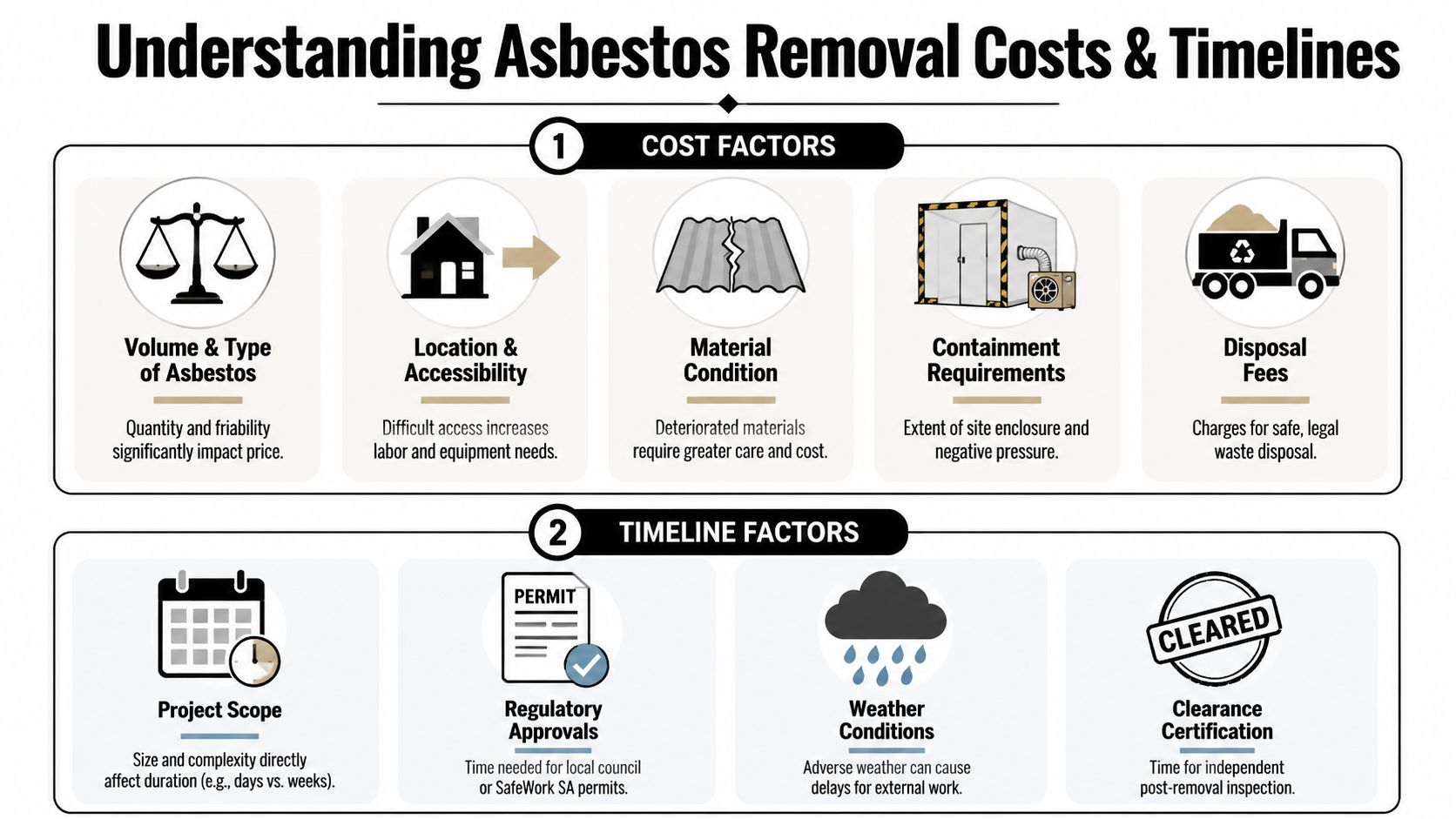
Disposal is only one line item, though. The bigger variables are usually:
- Material risk level. Friable material needs tighter controls than bonded material.
- Accessibility. Eaves at a simple single-storey edge are different from tight roof cavities, confined wet areas, or difficult rear access.
- Condition of the material. Deteriorated products usually demand more care.
- Containment requirements. Internal removals can involve more setup, more protection, and more cleaning.
- Programme impacts. If removal has to happen before structural, plumbing, or electrical work, that affects the broader sequence.
What affects timeline
Asbestos removal rarely sits on its own. It sits between assessment and renovation works. That means timing depends on more than the actual day of removal.
A realistic programme may need space for:
| Project stage | Why it affects timing |
|---|---|
| Assessment and scope confirmation | The team needs to identify where suspect material sits in the demolition area |
| Removal booking and setup | Licensed contractors and any required controls must be scheduled |
| Removal work | The active work zone may stop other trades entering that area |
| Clearance and handover | The area needs to be verified before normal work resumes |
For homeowners, the best budgeting mindset is this. Don't treat asbestos as an optional extra or an annoying add-on. Treat it as an early enabling cost and a programme item that protects the rest of the renovation from more expensive disruption later.
How Templeton Built Integrates Removal Into Your Renovation
The biggest difference between a removal-only mindset and a builder's mindset is coordination.
A removalist looks at a defined asbestos scope. A builder has to think about the whole sequence around it. That includes access, demolition staging, protection of retained parts of the house, the order of trades, and whether the family is living on site during part of the works.
Early identification changes everything
On well-managed renovation jobs, suspect asbestos isn't left until the excavator arrives or the bathroom demo starts. It's raised during the early planning phase when existing building fabric is being reviewed. That lets the team consider where testing or specialist input is needed before the programme is locked in.
The benefit isn't just safety. It's design certainty.
If an extension, opening, re-roof, wet area rebuild, or service upgrade touches older materials, the builder can sequence those tasks properly instead of reacting mid-project. That reduces avoidable stop-start conditions on site.
One project, multiple moving parts
Integrating asbestos removal into a renovation means coordinating more than the licensed removal itself. It often involves:
- Survey and scope planning so demolition zones are understood before trade bookings are finalised
- Specialist engagement with the right licence class for the material involved
- Site logistics such as access routes, temporary fencing, isolated work zones, and protection of unaffected areas
- Renovation sequencing so carpenters, sparkies, plumbers, and plasterers only enter after the area is cleared
- Paper trail control so approvals, records, and handover information stay organised
This project-level view matters most in lived-in homes and staged renovations. If only one part of the property is under construction, poor asbestos planning can contaminate spaces that were meant to remain functional.
The cleanest renovation sites usually come from disciplined sequencing, not from rushing the demolition phase.
Why homeowners feel less stress with proper coordination
Homeowners don't want to manage five separate specialists and work out who is responsible when something shifts. They want one organised process.
From a builder's perspective, asbestos management is successful when it feels uneventful to the client. The issue is identified. The licensed specialist is engaged. The work area is controlled. Clearance is obtained. The rest of the renovation proceeds.
That's the practical standard to aim for. Not drama. Not fear. Just good project management.
Frequently Asked Questions About Asbestos in Adelaide
Can I test for asbestos myself with a kit
Homeowners can buy kits, but the practical risk is in the sampling itself. If you don't know what you're cutting, how to isolate the sample point, or how to avoid contaminating the area, you can create the very problem you were trying to avoid. For renovation planning, professional assessment is usually the safer path.
What if asbestos is found in the soil around my home
Stop digging in that area and keep others away until it's assessed. Soil contamination changes the scope because it's no longer just a sheet or lining removal issue. It becomes a site management issue that needs proper advice before landscaping, trenching, or footing work continues.
Does home insurance cover asbestos removal
That depends on the policy and the reason the asbestos issue has arisen. Some homeowners assume general building cover automatically applies, but policy wording matters. The sensible move is to ask your insurer for a written explanation of what is and isn't covered in your specific situation.
How do I check whether a removalist's licence is valid
Ask for the licence details and verify them through the appropriate South Australian channels before work starts. Don't rely on a logo on a ute, a line in a quote, or a verbal assurance. You want the licence class to match the material and scope on your job.
Is bonded asbestos always safe if I leave it alone
Not always, but intact bonded material that remains undisturbed is a different risk profile from damaged or actively demolished material. The key issue is condition and future work plans. If the renovation will cut, remove, drill, or expose it, then “leaving it alone” usually isn't an actual scenario.
Should asbestos removal happen before I finalise my renovation contract
It should at least be investigated early enough that the likely scope is understood. If asbestos is only discovered after demolition starts, pricing and timing can shift at the worst possible moment. Early identification gives you cleaner budgeting and a more reliable programme.
Can other trades work nearby during removal
They shouldn't be working inside or through the controlled removal zone. Good site management separates asbestos work from general construction activity. Once the area has been properly cleared and handed back, the next trade can enter safely.
What's the biggest homeowner mistake
Starting demolition based on suspicion, assumptions, or optimism. If the house is older and the materials are questionable, pause first. The short delay at the start is usually far cheaper than a contaminated site and a disrupted renovation.
If you're planning a renovation, extension, or rebuild and want experienced guidance that treats asbestos management as part of a well-run project rather than a last-minute problem, Templeton Built can help you approach the job in the right order. A coordinated builder-led process makes it easier to identify risk early, protect your home properly, and keep the renovation moving with confidence.


Leave a Reply