

Builders & Developers: The Complete Australian Guide
You've got the block, the sketch, and the quote, and now the question is which professional owns the mess in front of you. In Australia, people toss around builders and developers as if they're interchangeable, but they're not. One executes the work. The other carries the opportunity, the approvals, the finance, and the risk.
For a small renovation, a custom home, or a development site with approvals hanging over it, choosing the wrong lead can blow out time, money, and sanity. The smarter move is usually not picking one label over the other. It's choosing the right integrated model, where feasibility, approvals, delivery, and handover sit under one roof.
| Dimension | Builder | Developer |
|---|---|---|
| Ownership | Delivers the build as a service | Owns the project outcome and often the asset risk |
| Funding | Works from client-paid budgets | Secures capital and carries finance exposure |
| Approvals | Manages site-level permits and build compliance | Drives entitlements, planning, and council approval strategy |
| Execution | Runs trades, safety, quality, and site delivery | Coordinates the broader project from concept to completion |
| Project scope | Focused on construction delivery | Focused on opportunity, feasibility, and return |
Why the Builder and Developer Distinction Matters
A lot of people only learn the difference after they've hired the wrong person. A homeowner with an empty block thinks they need a builder, then discovers the site still needs feasibility work, design coordination, and approval management. A would-be developer thinks they need a developer, then realises the job is already approved and all they really need is a builder who can execute without drama.
That distinction matters because the two roles solve different problems. A builder turns drawings into a finished structure, manages trades, site safety, sequencing, and quality. A developer identifies the opportunity, assembles the deal, funds the acquisition, manages consultants and approvals, and carries the market risk if the numbers or timing change.
Think in terms of ownership versus execution
The cleanest way to separate them is this. Builders execute. Developers own the risk and the upside. On a live project, that difference affects who answers for delays, who absorbs finance pressure, and who gets hurt if planning drags on or costs move.
That's why the conversation is often confused in the first place. In day-to-day speech, people collapse the terms because both roles touch the same project. In practice, though, the responsibilities are different enough that a project can go wrong if you hand the wrong person the wrong job.
Practical rule: if the work is already approved and the main problem is delivery, you need a builder. If the project still needs to be made viable, you need a developer-minded partner, or someone who can do both.
For Australian clients, that distinction is especially useful because housing work is rarely just about “building”. A knockdown-rebuild, a major extension, or a medium-density site usually has moving parts before anyone picks up a hammer. Once you understand who owns which part of the chain, you stop paying for the wrong capability.
Builders vs Developers Core Roles and Responsibilities
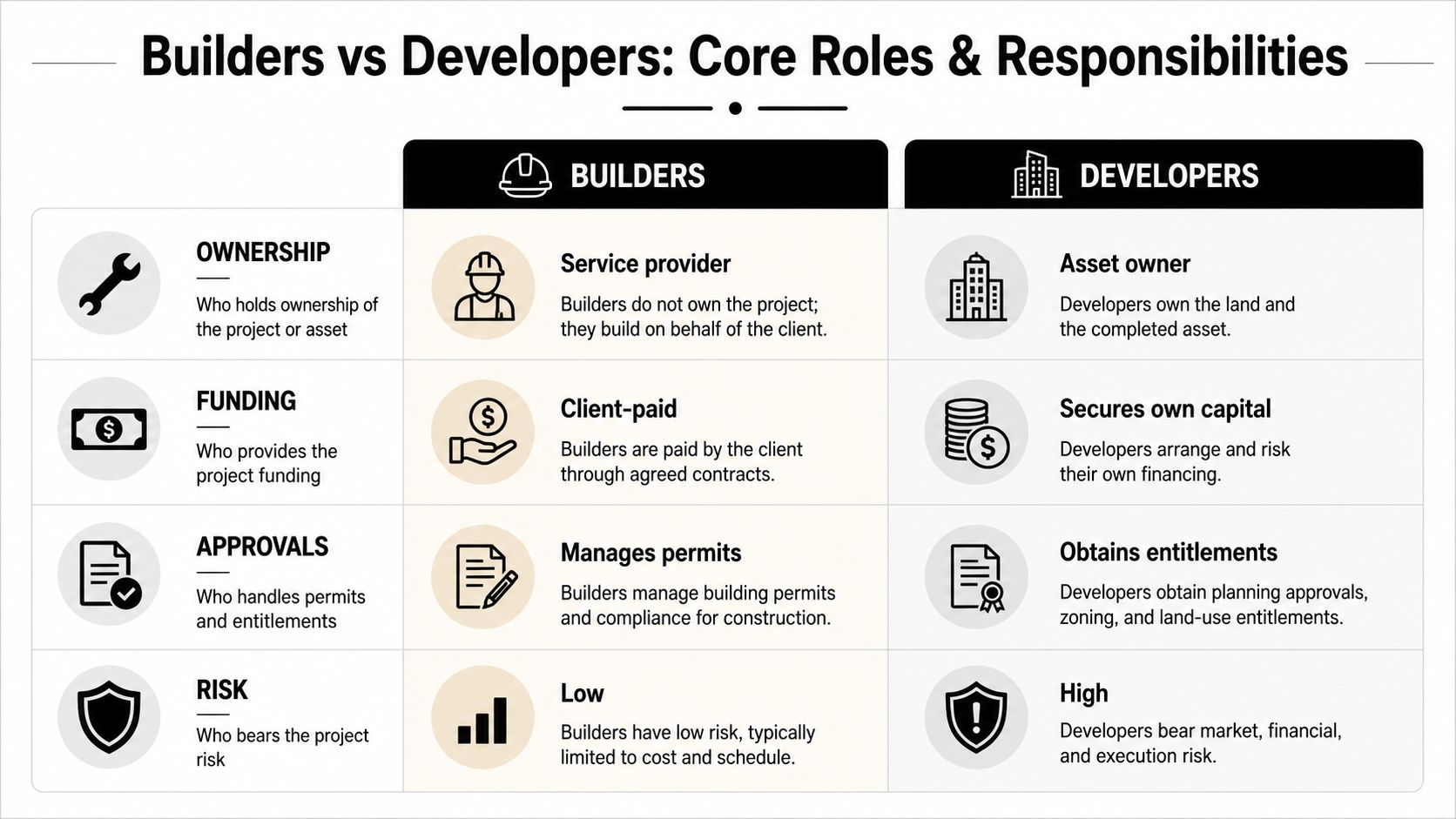
| Dimension | Builder | Developer |
|---|---|---|
| Ownership | Service provider delivering construction | Asset owner or project principal |
| Funding | Paid from client contract or progress claims | Raises or commits capital for the project |
| Approvals | Works within permits and construction compliance | Secures planning entitlements and approval pathway |
| Risk | Mainly delivery, quality, safety, and warranty risk | Market, finance, approval, and timing risk |
| Scope | Physical construction only | End-to-end project formation and delivery |
A builder is the person or company turning the plans into a finished product. They line up trades, sequence the work, manage site safety, check workmanship, and keep the job moving. Their job is execution, not speculation.
A developer sits earlier in the chain. They assess the site, work through feasibility, coordinate the consultant team, pursue approvals, and decide whether the project stacks up financially. They're making the call on whether the project should exist in the first place.
The easiest way to remember it is this. The builder asks, “How do we construct this properly?” The developer asks, “Should this be done at all, and if so, under what structure?”
What each role controls on a real project
On a standard residential job, the builder controls the site from mobilisation to handover. That includes materials, labour, quality assurance, and the practical decisions that keep the project safe and compliant. If a wall is out of square or a trade sequence is wrong, that lands on the builder's desk.
The developer controls the broader commercial picture. They carry the land, the approvals, the design risk, and the finance decisions. If the numbers stop working, the approvals stall, or the market changes, that pain sits with the developer.
This is why builders and developers often need each other, but not always in the same form. A builder can operate as a delivery contractor on a straightforward renovation. A developer can be the project principal on a subdivision or bespoke build where the opportunity needs to be assembled before construction starts.
One project, two jobs, different liabilities. Confusing those liabilities is how clients end up blaming the wrong person for the wrong failure.
The language matters because it changes how you brief the market. If you want construction only, ask for a builder. If you need land, approvals, finance strategy, and build delivery, ask for a developer-led team or an integrated partner that can handle both sides.
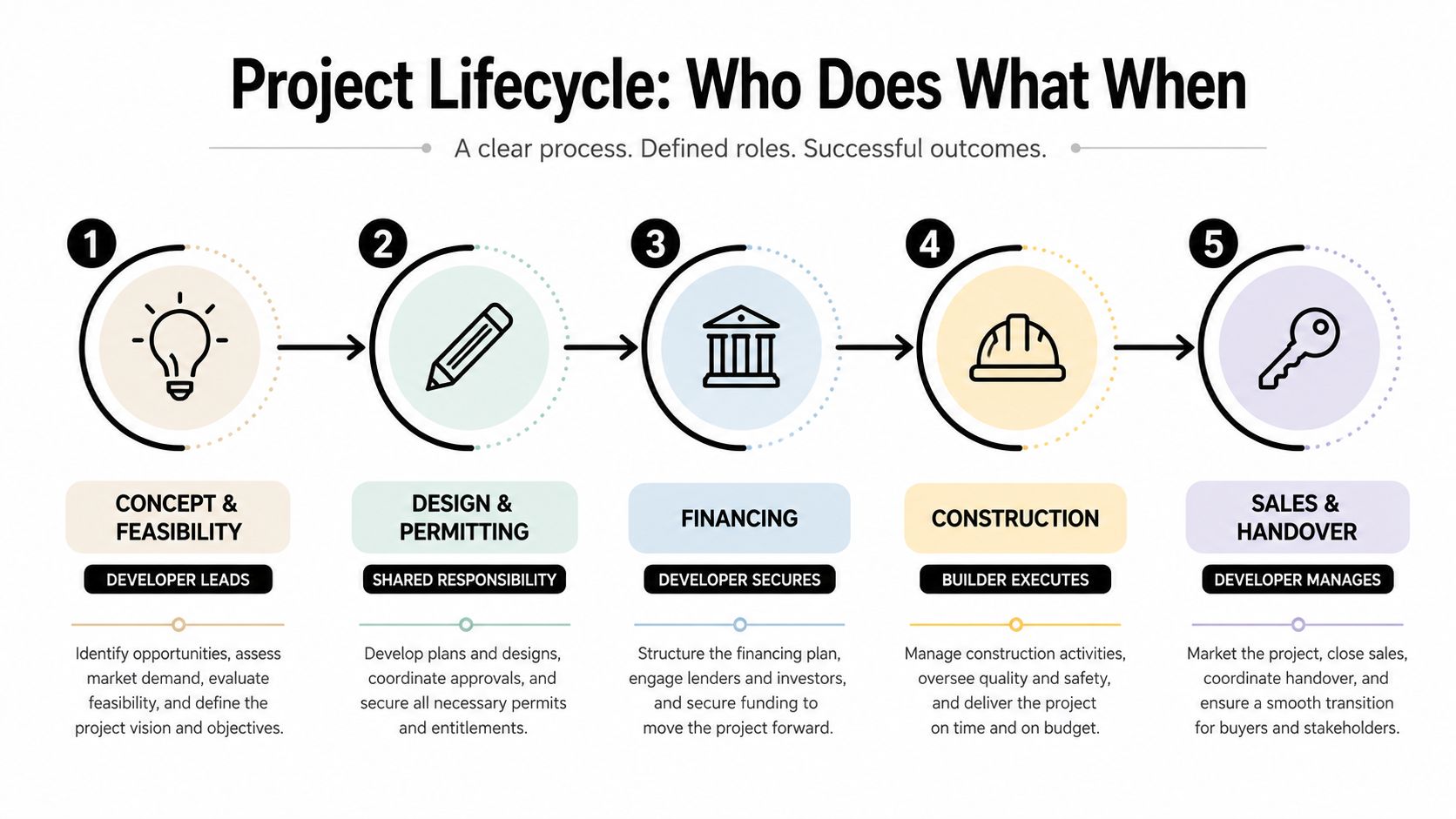
Project Lifecycle Who Does What When
A project doesn't fail all at once. It slips in stages, usually because the wrong person owned the wrong phase. The clean way to manage builders & developers is to map responsibility against the project lifecycle, not against job titles alone.
Feasibility and design set the tone
Feasibility belongs mostly to the developer side. That means site analysis, budget modelling, approval risk, and deciding whether the land or idea is worth pursuing. If this stage is weak, every later stage carries the cost.
Design sits in the middle. The developer usually brings in the architect and consultants, while the builder should be reviewing constructability, sequencing, and cost risk before the design is locked in. If the builder enters too late, you often pay for elegant drawings that are hard or expensive to build.
For a plain-language explanation of the approval side, see what a development application actually involves.
Approvals, finance, construction, handover
Approval work is usually developer territory. It involves council liaison, planning submissions, and managing the pathway to entitlement. In a genuine integrated model, the builder is still important here because good constructability advice can reduce redesign and prevent approval decisions that create site headaches later.
Construction is the builder's domain. Trade scheduling, quality control, and site coordination either hold together or fall apart here. If someone says they are a builder but can't control trades or communicate progress clearly, you're not buying a capability, you're buying a problem.
Handover is where the two roles overlap again. The builder delivers the finished asset, and the developer closes out the project commercially, whether that means settlement, occupancy, or the next stage of the deal. If you're clear about that handoff point early, you avoid the classic blame game where everyone argues over who was supposed to solve the final issues.
A good project team knows exactly when feasibility ends and construction begins. If that line is blurred, budget and schedule drift with it.
The sequence matters because each stage creates the next one's constraints. If approvals are rushed, construction suffers. If feasibility is weak, finance becomes fragile. If the builder is brought in too late, the design may already be locked into an expensive path.
Choosing the Right Partner for Your Project Type
Different projects need different levels of integration. A straight renovation doesn't need the same setup as a site that still has approval risk, financing exposure, and market timing hanging over it. The right call depends on complexity, approval risk, budget certainty, and timeline pressure.
Homeowners and families
If you're renovating a kitchen, adding a room, or extending a family home, a strong builder is often enough. You still need good design advice and clear scope, but you don't need a developer unless the project is structurally or commercially complex. For these jobs, the danger is usually not lack of “development”, it's poor sequencing, weak scope definition, and surprise extras.
Bespoke custom homes
Custom homes sit in the middle. You may start with a builder, but the smartest choice is often a partner who can handle design coordination and construction together. That cuts the chance of drawings that look good on paper and turn ugly on site.
Property developers
If the end game is return on investment, lot yield, or a multi-dwelling project, you want end-to-end capability. Feasibility, approvals, consultant management, and construction all affect whether the deal works. A pure builder can be too narrow and a pure developer can be too detached from build reality.
A useful self-check is simple:
- If the project is already approved and defined, a builder is usually the right lead.
- If the site still needs viability tested, you need developer-level thinking.
- If you want one point of accountability, integrated delivery is the cleaner option.
- If you're sensitive to delays, choose the team that can manage both the pre-build and build phases.
The wrong choice usually shows up in the quote stage. A cheap build price means little if the project needs redesign, extra consultants, or repeated approval changes before construction can even start.
Cost and Risk: What Each Role Carries
The biggest mistake clients make is comparing builder quotes without comparing the full risk picture. A low build price can still be the expensive option if the design is incomplete, approvals are shaky, or the project keeps shifting through variations. Good benchmarking looks at time, cost, and quality together, because that is where schedule slippage and rework show up on real projects.
Where the money really sits
A builder's cost base is visible on site. Labour, materials, subcontractors, site supervision, and contract margin are the obvious components. The hidden problem is that the cheapest quote may rely on assumptions the client has not noticed yet, which can trigger painful variations once the job starts.
A developer's cost base is wider. Land, consultants, approval work, finance, holding costs, and market exposure all sit upstream of the build. If any of those pieces shift, the whole project can be put at risk before the builder even starts.
Risk moves with the role
Builders carry delivery risk. If trades fall behind, materials are late, or workmanship is poor, the builder is the one expected to fix it. Developers carry market and capital risk. If demand softens, approvals drag, or finance tightens, the developer wears the consequence.
Bottom line: the more moving parts a project has, the less useful a single “build price” becomes. What matters is whether the partner can hold the pre-construction risk before it turns into site variation.
Many industry frameworks describe performance benchmarking as comparing outcomes like time, cost, and quality against reference standards, and that is the right lens here. It forces you to ask whether the team can deliver what they have priced, not just whether the number looks attractive on paper. For Australian projects, that discipline matters even more in fragmented markets where many firms are small, capacity is tight, and coordination failures cost real money.
The practical recommendation is blunt. Do not hire on price alone. Hire for the amount of risk you are asking one party to carry, and make sure that risk matches their capability. If a project still needs feasibility work, the cheapest builder quote is usually the wrong starting point. If the design is fully settled, compare apples with apples and push hard on execution certainty.
Templeton Built's feasibility study process sits in that pre-construction zone where many projects either become viable or get shelved. That is the stage where significant money is saved.
How Templeton Built Bridges the Builder-Developer Divide
The integrated model works because it removes the gap between “can we do this?” and “let's build it”. Templeton Built operates across that gap by pairing design coordination, construction delivery, and project-level accountability under one team, which is exactly what clients need when a project can't afford handoffs that break down.
What integrated delivery looks like
For homeowners, that means renovations, extensions, and custom homes can be shaped from concept through to handover without the usual chain of disconnected consultants and finger-pointing. For developers, it means feasibility, DA work, and construction management sit in the same conversation, so the project doesn't get re-litigated every time a new phase begins. For commercial clients, it means fit-outs are managed with the same practical focus on scope, cost, and delivery.
That is the value of an integrated builder-developer model. One team sees the whole job, not just the part it was hired to protect.
Templeton Built describes its design-build construction process as an end-to-end approach, and that's the right way to think about the model. The point isn't branding. The point is fewer gaps between estimate, design intent, approvals, and the finished build.
Why that matters in practice
Separate hires create seams. One consultant draws, another prices, another manages approvals, and the builder inherits the risk later. An integrated team reduces that friction because the people shaping the project are also accountable for delivering it.
That doesn't mean every project must use one firm for everything. It means the client should be honest about the cost of fragmentation. If your site is simple, separate hires may be fine. If your project is exposed to approvals, complexity, or tight margins, integrated delivery usually gives you a cleaner path.
Templeton Built's in-house design and construction approach makes this especially relevant for clients who want one accountable partner instead of three or four disconnected ones. It's a practical model, not a slogan.
Frequently Asked Questions About Builders and Developers
Can a homeowner work with both a builder and a developer on the same project? Yes, and on complex jobs that's often the right structure. The developer side handles feasibility, approvals, and project setup, while the builder handles the actual construction. On a straightforward renovation, that split is usually unnecessary. On a difficult site, it can be the difference between a viable project and a stalled one.
Is an integrated service more expensive than hiring separately? Not necessarily. The upfront quote may look higher if one partner is carrying more of the pre-construction work, but that comparison misses the core issue. Separate hires often create extra consultant fees, redesign cycles, delay risk, and scope gaps. The better question is whether the total project cost is lower once you include time, rework, and approval drag.
How long should approval-to-handover take? There's no honest universal answer, because project type drives the timeline. A small, straightforward residential job is very different from a custom home with design changes or a development with planning risk. The right benchmark is not a fantasy timeline, it's whether your team can explain the sequence, the dependencies, and the risks before you sign.
Clients get into trouble when they treat budget size as the only decision filter. Scope, complexity, and approval exposure matter just as much. If you want the cleaner outcome, choose the partner who can own the weak points before they turn into site problems.
If you're weighing a renovation, a custom home, or a development site and want one team to handle the hard parts properly, Templeton Built can step in at feasibility, approvals, design coordination, and construction. Visit Templeton Built to talk through a project that needs clear accountability from the first conversation to handover.


Leave a Reply