

Hire a commercial builder adelaide for your project
Hiring a commercial builder in Adelaide means you're stepping into a construction scene that’s not just busy—it's booming. The city's economic engine is firing on all cylinders, sparking a wave of new projects everywhere you look, from slick retail fit-outs to massive infrastructure works. For a business owner ready to build, this creates a competitive and exciting landscape.
Understanding Adelaide's Commercial Building Market

Before you even think about shortlisting builders or looking at quotes, you need to get a feel for the unique dynamics of Adelaide's commercial construction industry. This goes deeper than just knowing who builds what. It’s about understanding the economic currents that shape everything—material costs, labour availability, and project timelines. Right now, a huge amount of investment from both the public and private sectors is shaping the game.
Adelaide is in the middle of a significant economic upswing. And that’s not just a hunch; the numbers back it up. South Australia is actually leading the country in real economic growth, with activity sitting 8.4% above the long-term average. You can see this strength reflected directly in the building sector.
While the rest of the country saw a dip, non-residential building work in SA shot up by 7.3% year-on-year. That’s a stark contrast to the national decline of 3.9% in the same period, as noted in the Slattery National Market Update from March 2025.
Key Market Influences
So, what’s fuelling this growth? A few key things are heating up the market, which means demand for a skilled commercial builder in Adelaide is through the roof.
- Major Infrastructure Projects: We're talking about huge undertakings like the new Women’s and Children’s Hospital and the ongoing development at Lot Fourteen. These projects don't just create jobs; they soak up specialised construction talent and resources.
- Private Sector Confidence: You only need to look at the skyline to see the private investment pouring in, from the $400 million Keystone Tower to countless new hotels and high-rises. This kind of confidence makes the competition for the best builders fierce.
- The Regulatory Maze: Every build has to navigate local council rules and planning approvals. Knowing how to get a building permit in Adelaide isn't just a box to tick; it's a critical early step where a good local builder's experience becomes invaluable.
So, what does all this mean for your project? A hot market has its upsides and its challenges. On one hand, you have a deep pool of experienced builders to choose from. On the other, their schedules are likely packed. Material costs can swing with demand, and finding skilled trades can be a real battle.
This is why you can't just jump in. You need a solid plan. Being well-informed from the start helps you set a realistic budget, map out an achievable timeline, and—most importantly—ask the right questions when you start the hunt for your building partner.
Getting Clear on Your Project Scope and Budget
Every great commercial build begins long before a shovel ever hits the dirt. The foundation isn't concrete; it's a crystal-clear vision, a detailed project scope, and a budget that’s grounded in reality. Just telling a builder you need a "200 square metre retail space" is only the beginning of the conversation. To find the right commercial builder in Adelaide, you need to get into the nitty-gritty.
Let's start with how the space will actually be used. Are you planning a restaurant fitout in Norwood? That means thinking about commercial-grade kitchens, specialised exhaust systems, and a specific workflow from the pass to the tables. Or maybe it's a new warehouse in Wingfield? Suddenly, the conversation shifts to high-clearance roller doors, heavy-duty flooring that can handle forklifts, and logistical access for trucks. Every single one of these details shapes the project's complexity and, of course, its final cost.
From a Rough Idea to a Builder-Ready Brief
The goal here is to turn your broad concept into a set of concrete, actionable requirements. Why? Because a vague brief will only ever get you vague quotes, and that's a surefire recipe for budget blowouts down the track. You need to document everything.
- Your Must-Haves vs. Your Wish List: Make two lists. One has your absolute non-negotiables—the things the project can't succeed without. The other has the "nice-to-have" features you’d love if the budget stretches. This gives your builder immediate clarity on where to focus the spending.
- Think About Workflow: How do people need to move through this space to be effective? An office needs a smart mix of collaborative zones and quiet spots for focused work. A medical clinic, on the other hand, needs a precise, logical flow from the reception area to consultation rooms and back again.
- Plan for Tomorrow: Where do you see your business in five years? Will you need to expand? It’s far cheaper to design for future scalability now than it is to rip everything apart and start over later.
As you map all this out, don't forget the regulatory side of things. Details like adhering to specific construction site signage requirements are crucial for compliance and will factor into your initial setup costs. This is the level of detail that an experienced Adelaide builder will be looking for to know you're serious.
Putting Together a Realistic Adelaide Budget
Your budget is much more than just the figure you pay the builder. One of the most common traps business owners fall into is forgetting about "soft costs." These are the less obvious expenses that can easily add another 20-30% on top of your total project spend. A properly structured budget needs to account for everything.
Hard Costs are what most people think of—the tangible, physical parts of the build:
- Labour and all the different trades
- Raw materials like steel, concrete, and timber
- Site preparation and earthworks
- Internal fixtures, fittings, and finishes
Soft Costs are the equally essential (but often forgotten) services and fees:
- Architectural and engineering design work
- Council applications, permits, and approval fees
- Specialist consultant reports (think geotechnical or environmental)
- Insurances and any legal fees
If there’s one part of your budget you absolutely cannot skip, it's the contingency fund. I always advise clients to set aside at least 5-10% of the total construction cost. This is your safety net for the unknowns, like discovering challenging soil conditions once excavation starts or dealing with a sudden spike in material prices.
To give you a clearer picture of what to expect in the local market, here’s a rough guide to commercial construction costs in Adelaide.
Sample Project Cost Estimates in Adelaide (Per Square Metre)
This table offers a starting point for your budget discussions, showing typical per-square-metre rates for various commercial projects. Remember, these are estimates and the final cost will depend on your project's specific requirements, site conditions, and the quality of finishes you choose.
| Project Type | Low-Range Cost (per m²) | Mid-Range Cost (per m²) | High-End/Specialised Cost (per m²) |
|---|---|---|---|
| Basic Warehouse/Industrial Shell | $1,500 – $1,900 | $2,000 – $2,500 | $2,600+ |
| Standard Office Fitout | $1,800 – $2,400 | $2,500 – $3,200 | $3,300+ |
| Retail Space (e.g., Shopfront) | $2,200 – $2,800 | $2,900 – $3,800 | $4,000+ |
| Medical/Healthcare Clinic | $3,000 – $3,900 | $4,000 – $5,500 | $5,600+ |
| Hospitality (Cafe/Restaurant) | $3,200 – $4,200 | $4,300 – $6,000 | $6,100+ |
The good news is that building in Adelaide often gives you a real financial edge. The average cost for commercial projects here tends to be more favourable than in the eastern capitals. For example, a mid-range office fitout might come in around $3,200 per square metre in Adelaide, whereas you could be looking at closer to $4,500 for something similar in Sydney. This difference often comes down to more competitive labour rates and material supply chains here in South Australia.
Using local data like this is the key to creating a budget that is both ambitious and achievable.
How to Properly Vet Adelaide Builders
Finding the right commercial builder is probably the single most important decision you'll make for your entire project. This isn’t a task you can knock over with a quick Google search and a few phone calls. It demands a serious, methodical vetting process. You’re not just hiring a contractor; you’re looking for a partner—someone with proven expertise, financial stability, and a communication style that actually works for you.
The Australian construction industry is massive, projected to be worth a staggering $521.2 billion by 2025. With more than 452,000 construction companies out there, Adelaide has no shortage of options. That’s precisely why a robust vetting process is non-negotiable.
This infographic breaks down the core elements of project planning, which directly feeds into how you should be assessing potential builders.
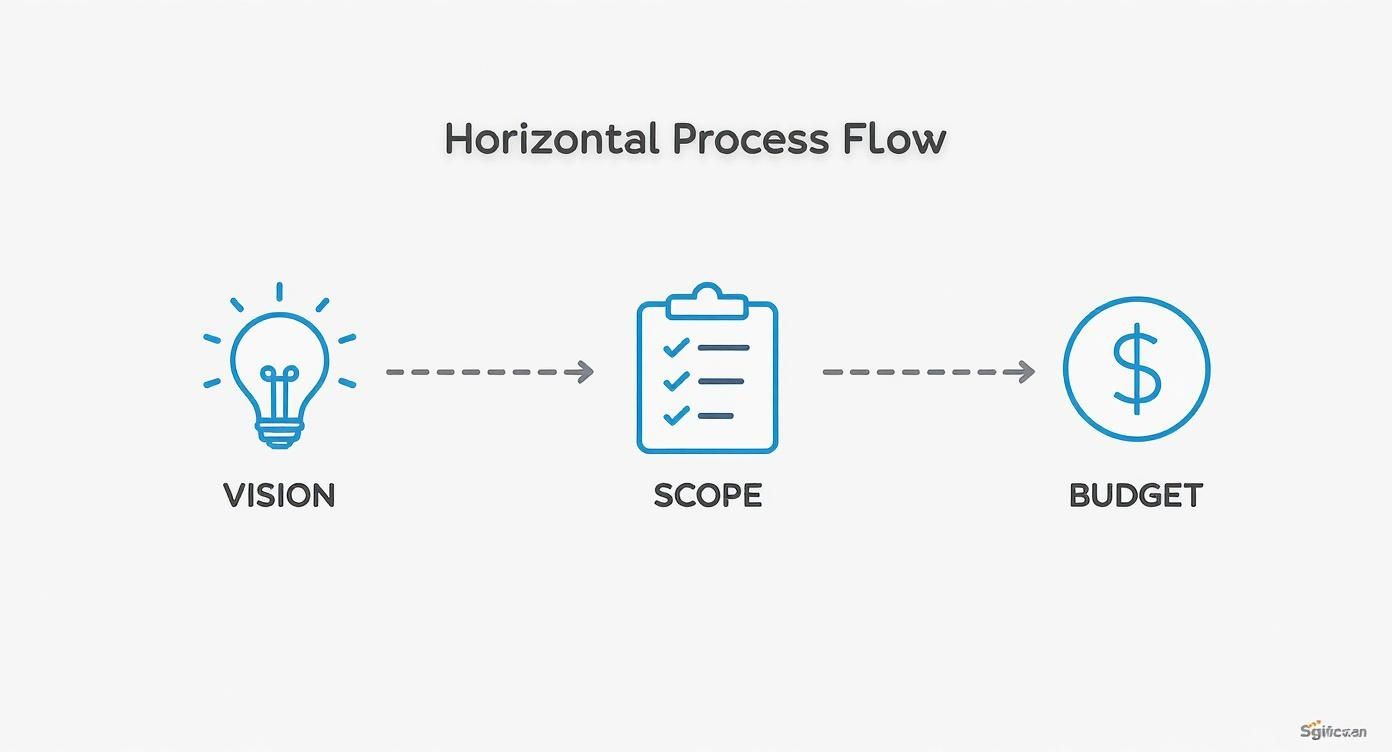
When you have a crystal-clear vision, scope, and budget, you can ask the right questions and accurately gauge if a builder’s experience truly aligns with what you need.
Verifying Credentials and Experience
First things first, you need to look past the polished website and glossy brochures. It’s time to confirm that a builder is properly licensed, fully insured, and has a real track record of completing projects similar to yours. Don't just take their word for it—do your own homework.
- Check Their Licence: Jump onto the Consumer and Business Services (CBS) public register. You need to confirm their builder’s licence is current and valid for commercial work here in South Australia.
- Request Insurance Certificates: Ask to see copies of their Public Liability Insurance and an up-to-date Certificate of Currency for their workers' compensation. Any legitimate builder will have these documents ready to go without any fuss.
- Analyse Their Portfolio: Look for projects that mirror yours in scope, complexity, and industry. A team that excels at trendy hospitality fit-outs might not be the right choice for a highly specialised medical facility. A strong portfolio shows relevant experience, not just a long list of jobs.
A builder's portfolio should tell a story. You're looking for consistency in quality, a clear attention to detail, and proof they can handle the specific challenges your project will throw at them. If their past work doesn't get you excited, they’re probably not the right fit.
Assessing Safety and Reputation
A builder’s attitude towards safety is a direct reflection of their professionalism and how they run their business. It's crucial to confirm their commitment to Work Health and Safety. Look for strict adherence to Australian WHS compliance and don't be shy about asking about their safety record.
Beyond the paperwork, you need to get a feel for their reputation in the real world. That means actually speaking with their past clients. A confident builder will happily provide a list of references.
When you call, ask about the entire experience—the communication, how they managed the budget, and what happened when unexpected problems cropped up. These candid conversations are where you'll find the most valuable, honest insights. This detailed approach is what it takes to choose from the best commercial builders in Adelaide and find a true partner for your vision.
The Critical Questions You Need to Ask Potential Builders
Once you have a shortlist of potential builders, the interview stage is where you can truly separate the seasoned professionals from the rest. This isn’t the time for softball questions like, "Are you experienced?" You need to dig much deeper to understand how a commercial builder in Adelaide really handles the pressures of a complex project.
The answers you get will paint a vivid picture of their problem-solving skills, their commitment to transparency, and ultimately, whether their team is the right fit for yours. Think of this as the start of a crucial business partnership—you need to know exactly who you're getting into the trenches with.
Technology and Communication Protocols
First, let's talk about the systems they have in place to keep everything organised and on track. Vague answers here should set off alarm bells.
- "What project management software does your team rely on?" You're listening for specific names like Procore or Buildertrend. A great follow-up is asking how you, the client, will get access or receive updates from their system.
- "What's your standard rhythm for communication?" A professional outfit will have a clear process. They might outline weekly site meetings with minutes sent out within 24 hours, fortnightly progress reports, and a dedicated contact person for day-to-day questions.
- "How do you handle change orders and variations?" The process needs to be locked down and transparent. They should be able to walk you through a formal system for submitting a variation, clearly outlining the impact on cost and timing, and requiring your written sign-off before any extra work begins.
A builder’s answers here show you just how organised and transparent they really are. A team that relies on casual phone calls and text messages is a recipe for miscommunication and expensive mistakes. You need a partner who documents everything.
Problem-Solving Under Pressure
Now it’s time to move from process to performance. Use hypothetical scenarios—based on real challenges that pop up all the time in the Adelaide market—to see how they think on their feet.
Here’s a fantastic one to try: "Tell me about a time you ran into a major supply chain delay on a recent Adelaide project. What was the problem, how did you keep the client in the loop, and what did you do to minimise the damage to the schedule and budget?"
Their response will tell you everything. A top-tier commercial builder won't just point fingers at suppliers. They’ll talk about proactive solutions—like sourcing alternative materials from their network, re-jigging the construction schedule to work around the hold-up, and keeping the client fully informed with honest, regular updates.
This is how you get a real insight into their capabilities. It helps you find a builder who doesn’t just put up walls, but also builds trust and can navigate the inevitable bumps in the road that come with any significant commercial project.
When you're meeting with a few different builders, it can be tough to keep track of who said what. A simple comparison table can be a lifesaver, helping you make a clear, objective decision.
Builder Evaluation Checklist Key Areas to Compare
| Evaluation Criteria | Builder A | Builder B | Builder C |
|---|---|---|---|
| Years in Business (Adelaide) | |||
| Portfolio of Similar Projects | |||
| Client References (Contacted?) | |||
| Project Management Software | |||
| Communication Plan Clarity | |||
| Change Order Process | |||
| Supply Chain Problem Example | |||
| Key Personnel Experience | |||
| Initial 'Gut Feeling' |
Using a checklist like this ensures you’re comparing apples with apples. It moves the decision beyond just a gut feeling and grounds it in the practical details that lead to a successful project.
Analysing Quotes and Avoiding Hidden Costs

Getting a few quotes back is an exciting moment in any project. It feels like things are finally moving. But this is where you need to switch from visionary to detective, because the cheapest quote is almost never the best one.
More often than not, a surprisingly low price is a warning sign. It often means crucial elements have been left out, only to pop up later as costly variations that blow your budget. To really get a feel for what’s on offer, you need to sit down and compare each tender, apples-to-apples.
A professional commercial builder in Adelaide will never just send a single figure. You should receive a detailed breakdown that lets you see exactly where your money is going—preliminaries, demolition, structural work, finishes, and services. If one quote is miles cheaper than the others, it’s up to you to figure out what's missing.
Decoding Builder Jargon and Allowances
Commercial building quotes are notorious for their industry-specific language, and some terms can hide significant cost variables if you're not across them. You need to pay special attention to anything labelled as an 'allowance', as this is a common area where budgets come unstuck.
Here’s what to look out for:
- Prime Cost (PC) Items: These are essentially placeholders for things that haven't been selected yet, like specific light fittings or tapware. The builder has put an estimated cost in the quote, but if your taste is more expensive than their allowance, you’re the one covering the difference.
- Provisional Sums (PS): This is a builder’s best guess for work that can’t be fully costed upfront. Think excavation, where no one knows for sure what’s under the ground until the digging starts. If the work ends up being more complex or time-consuming, that extra cost is passed on to you.
Vague descriptions like "Site Works – $15,000" should set off alarm bells. A thorough quote will specify what that figure actually covers—excavation, soil removal, temporary fencing, sediment control, and so on. Any ambiguity in a quote is rarely in the client’s favour.
For larger, more complex projects, getting a quantity surveyor involved can be a game-changer. They act as a project's cost expert, and you can learn more about what a quantity surveyor does to see if one is right for your build.
Key Takeaway: A transparent quote from a professional builder will be just as clear about what’s excluded as what’s included. Keep an eye out for common exclusions like council application fees, new utility connection costs, and landscaping.
Identifying Potential Red Flags in Tenders
A quote tells you more than just the price; it’s a window into the builder’s professionalism and processes. A super optimistic timeline, for instance, might look good on paper, but it could mean the builder hasn't grasped the project's true complexity or plans to cut corners.
Finally, take a hard look at the proposed payment schedule. Payments should always be tied to real, verifiable progress on site—like the slab being poured or the frame reaching completion—not just arbitrary dates on a calendar. If a builder is demanding a huge upfront deposit that exceeds the legal limit, it could be a sign they have cash flow problems.
By taking the time to properly dissect each quote, you can look past the headline number and make a confident decision based on real value and transparency.
Answering Your Adelaide Commercial Build Questions
Jumping into a commercial build for the first time? It's natural to have a lot of questions. Getting the right answers upfront is the difference between a smooth project and a stressful one.
Let’s tackle some of the most common queries we get from Adelaide business owners. Think of this as a quick guide to help you make those crucial early decisions with a bit more confidence.
How Long Does a Commercial Build Take in Adelaide?
This is always the first question, and the honest answer is: it really depends. The size and complexity of your project are the biggest factors.
A straightforward interior fit-out for a shop or an office? You could be looking at a timeline of around 3-4 months. But if you're talking about a new-build from the ground up—say, a standalone retail building or a small warehouse—it’s more realistic to plan for 9-15 months. That covers everything from the first sketches to getting the keys.
Adelaide has its own quirks that can influence timelines, too. Securing council approvals, discovering unexpected ground conditions during excavation, or waiting on specialised materials can all add time. A good commercial builder in Adelaide won't just give you a vague estimate; they'll provide a detailed construction schedule with clear milestones so you know what to expect.
Should I Hire an Architect and Builder Separately?
This is a big one, and it really comes down to your preferred way of working. There are two main approaches here, and neither is better than the other—it's about what’s right for your project.
- The Traditional Path: You hire an architect first. They work with you to draw up a full set of plans, and then you put those plans out to tender with a few builders. This gives you a lot of control over the finer design details.
- The Design & Construct Model: You hire one company to handle the whole thing, from the initial idea right through to the final build. This integrated approach can seriously simplify communication and often speeds things up because the design and building phases can overlap.
The best choice really hinges on how complex your build is and how involved you want to be in the day-to-day management.
Changes are an inevitable part of any build. The key isn't to avoid them, but to manage them through a clear, agreed-upon process that protects everyone involved.
When something unexpected crops up or you have a new idea, it’s handled through a formal 'variation'. This process should be clearly spelled out in your contract. The builder will outline the change, give you a clear cost breakdown, and won't proceed until they have your written sign-off.
So, how do you budget for these moments? Smart planning. Always build a 'contingency sum' into your budget from day one. This is typically 5-10% of the total project cost and acts as your financial buffer for any surprises.
Finally, make sure your contract is a standard industry document. Here in Australia, good builders use contracts from organisations like Master Builders Australia (MBA), with something like the AS 4000 series being common for commercial work. These are drafted to be fair to both parties. If a builder is pushing a custom contract or seems hesitant to use a standard one, that’s a major red flag.
Ready to get answers tailored to your specific project? The team at Templeton Built has the local expertise and transparent processes to guide you from concept to completion. Let's discuss your vision and build something remarkable together. https://templetonbuilt.com.au


Leave a Reply