

Construction Site Management: Adelaide Builders Guide
You've probably got the quote in front of you right now. The drawings are moving, the contract is nearly ready, and someone's telling you the build will be “managed properly” once work starts. That's the moment to ask the blunt question, because construction site management is what decides whether your project feels controlled or becomes a series of expensive apologies.
On an Adelaide job, the first signs of weak management are rarely dramatic. They show up as a trade turning up before the area is ready, a missed inspection slot, material dumped where no one can use it, or a neighbour complaint that should've been prevented the day before. Small misses like that don't stay small for long.
Good site management doesn't just keep the site tidy. It protects your budget, your programme, your relationship with the street, and the quality you thought you were paying for.
A Day That Showed Why Site Management Matters
The trouble started before breakfast. A carpenter was already set up in one part of the site, then the tiler arrived early and needed the same work zone, while the delivery for the next stage was left where nobody could safely move it. By mid-morning, the inspection the builder needed wasn't ready, so it slipped, and once that happened the rest of the week started unravelling.
That's what weak construction site management looks like in real life. It's not one giant failure, it's three or four small coordination misses that land on your programme at once, then get explained away as “just how building goes”. It isn't.
For a homeowner, that can mean a renovation dragging out while your kitchen stays unusable. For a family doing a custom build, it means trades tripping over each other and finishing work being rushed. For a small developer, it means every delayed decision starts chewing through margin.
Practical rule: If the site team can't explain what happens today, what happens next week, and what depends on an inspection, they're not managing the site, they're reacting to it.
The client's stake is simple. You're not paying for activity, you're paying for sequence, control, and certainty. A well-run site protects the move-in date, keeps neighbours onside, and stops easy mistakes from turning into variations and rework. An unmanaged site does the opposite, then asks you to fund the fallout.
That's why I'd rather see a builder with a tight programme and disciplined site control than one with a glossy portfolio and vague answers. The project that looks calm from the street is usually the one being run properly behind the fence.
What Construction Site Management Actually Covers
Construction site management is the integrated job of planning, coordinating, and controlling everything that happens on a building site so the project finishes safely, on programme, and to specification. It's not a title. It's a working system, and when that system is weak, you'll see it everywhere, from access gates to final defects.
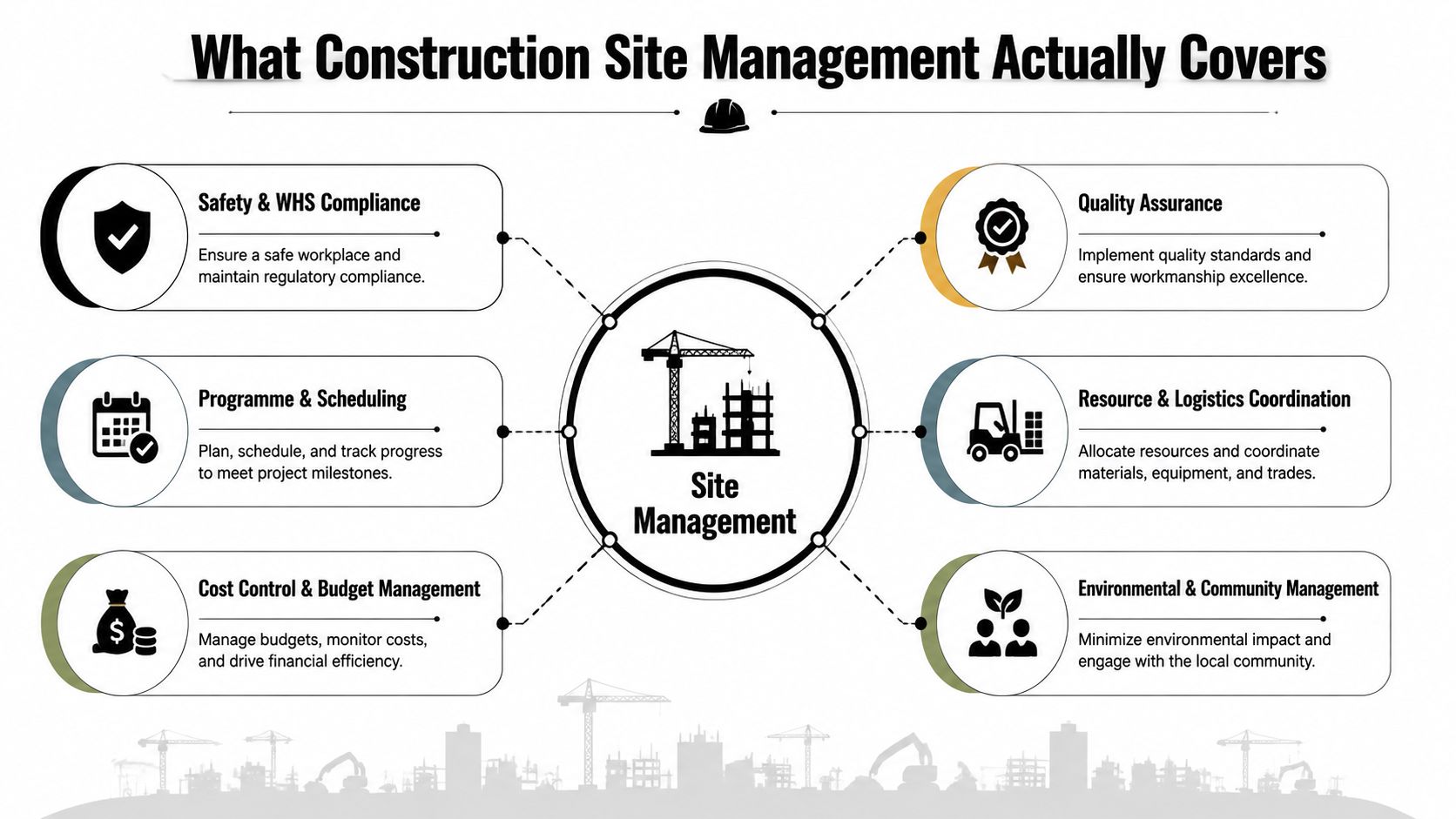
The core responsibilities you should expect
- Site setup and layout. The builder should know where deliveries go, where waste goes, and how people move through the site. On a renovation, that might mean keeping a narrow access path open for a family still living in the home.
- WHS and safety. The site manager should brief trades, control hazards, and keep the work area compliant. If roofing and framing overlap, they need to manage that interface, not hope everyone “uses common sense”.
- Programming and sequencing. Work must happen in a logical order. If brickwork turns up when roof work is still blocked, that's a management failure, not bad luck.
- Cost control. Materials, labour, and changes need tracking. If a variation isn't written down, it isn't controlled.
- Quality assurance. Work should be checked before the next trade covers it. If a defect is hidden behind plaster, you're paying to find it later.
- Subcontractor coordination. Trades need to be scheduled so they don't collide. That means someone owns the daily call on sequence.
- Permits and inspections. Inspections need to be lined up at the right stage. A missed hold point can freeze the job.
- Risk and environmental management. Dust, runoff, waste, noise, and site drainage all need control, especially on tighter Adelaide blocks.
The practical takeaway is simple. If the person running your site can't talk clearly about these eight areas, they're not really controlling the build. They're hoping the build controls itself.
The Adelaide Regulatory and Operational Environment
Adelaide sites don't run on good intentions, they run on approvals, safety duties, and site controls that have to be respected every day. Australian construction has a serious compliance load, and the site management plan is the document that turns that load into day-to-day rules for layout, access, reporting, waste, dust, runoff, and material handling. That matters because the plan is what keeps the site lawful, insurable, and workable.
In practice, the legal and operational environment pushes the builder to manage more than the structure itself. The principal contractor carries work health and safety duties, and each trade has obligations too. Local council requirements add another layer, especially around access, noise, staging, and inspection checkpoints, which is why permit handling and inspection timing need to be part of the programme from day one. For Adelaide homeowners, building permit requirements in Adelaide cease to be simple administration and become a schedule risk.
What a controlled Adelaide site actually looks like
A properly run site should show its compliance in the way it operates, not just in the paperwork. Fencing should match the current work zone. Signage should be current. Access routes should be clear. Waste should be separated properly. Dust and runoff controls should be in place before the problem starts, not after the neighbour calls up.
A good site manager treats compliance as part of production. A weak one treats it as a separate job that gets done only when someone asks.
That distinction matters because Adelaide sites are often tight, close to neighbours, and subject to overlapping approvals and inspections. If the builder doesn't coordinate those steps, the site can slow down fast. The core issue isn't paperwork, it's that every missed condition creates friction for the next trade.
The best builders run compliance as a living system. The site plan gets updated, the team knows the rules, and the work keeps moving without creating avoidable trouble with council, inspectors, or the street.
Who Runs the Site and What Each Person Does
Clients often use “site manager” and “project manager” as if they're the same thing. They're not. One runs the daily site, one runs the broader job, and if your builder blurs those lines, you'll feel it when something goes wrong and nobody wants ownership.
| Role | Primary Focus | Decision Scope | Client Calls Them For |
|---|---|---|---|
| Site Manager | Day-to-day site control | Trades, access, sequencing, daily issues | A cracked tile, a trade clash, a site access problem |
| Project Manager | Programme, budget, contract | Variations, cost, milestones, reporting | Budget questions, contract changes, overall delivery |
| Foreman | Supervising work in progress | Labour coordination, task execution | What's happening on the ground today |
| Leading Hand | Trade-level coordination | Crew direction within a specific trade | A workface issue or practical sequence question |
| Building Supervisor | Compliance and site oversight | Inspections, quality checks, formal site control | Inspection timing, compliance concerns |
| Contract Administrator | Paperwork and contract control | Claims, variations, records | Documentation, approvals, written notices |
| Consultant | Design or technical advice | Design intent, specialist recommendations | Engineering, architecture, design clarification |
| Subcontractor | Their own trade package | Their scope and workmanship | Trade-specific delivery issues |
A compact Adelaide builder usually keeps the site team lean, which can work very well if the people are experienced and communication is tight. A bigger development project often has more layers, which can help when there are multiple units or more moving parts, but only if ownership stays clear. If nobody can tell you who makes the daily call, the project is already drifting.
The client's job is to know who owns what. A cracked tile goes to the site manager. A variation goes to the project manager or contract administrator. A design issue goes to the consultant or builder's technical lead. A neighbour complaint should be handled immediately by the person controlling the site, not parked in someone's inbox.
Plain truth: When the builder can name the decision owner without hesitation, the site is usually being run with discipline. When they can't, you're buying confusion.
You should also ask whether the builder is acting as principal contractor, because that tells you who is carrying broader site control responsibilities under the job structure. This explanation of the principal contractor role is worth reading before you sign, because that role changes who holds the site together when issues stack up.
What Clients Should See and Receive at Each Project Stage
Good site management gives you visible signs at every stage. If you're not seeing them, don't assume the builder is “just busy”. A disciplined site should produce the right information at the right time, and it should do that without you chasing for basics.
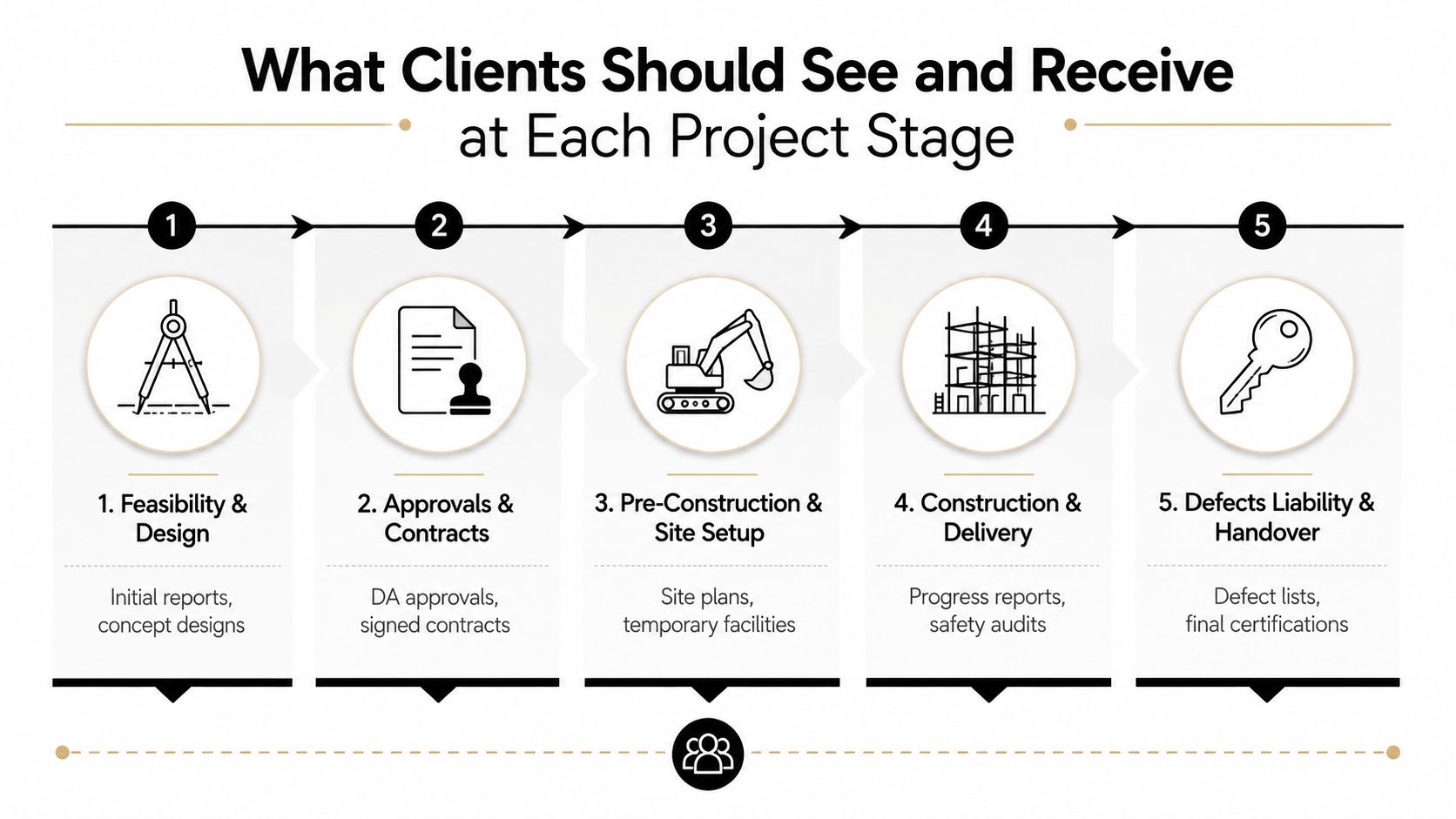
Feasibility and design
At this point, you should be getting design clarity, budget realism, and a sense of what the site will need. That means practical discussion about access, staging, and risk, not just pretty plans. If the builder can't talk through how the build will work on the block, they're not managing the site yet, they're guessing.
Approvals and contracts
At this stage, paperwork should become specific. You should see written scope, contract terms, and a schedule that makes sense against the approvals path. If change handling isn't written down before work starts, it usually becomes messy later.
Pre-construction and site setup
You should see site fencing, signage, temporary facilities, delivery planning, and clear instructions on access. Weekly or look-ahead scheduling should begin here. If the site is still being arranged after trades start arriving, the builder started too late.
Construction and delivery
This is the stage where you should receive regular program updates, meeting minutes, quality records, and inspection evidence. Safety incidents, delays, and changes should be documented, not narrated casually in passing. If the programme keeps changing but no one can show you why, that's a weak system.
Defects liability and handover
The finish line should include a proper defects list, final certificates, and clean handover documentation. You're entitled to written records, not verbal reassurance. If the builder rushes the end and leaves the paperwork for later, later usually never comes.
The warning signs are obvious once you know what to look for. Late meeting minutes, vague programmes, no written change orders, missing inspection records, and fencing that lags behind the work all point to weak control. A client doesn't need to micromanage, but you absolutely should expect a written trail that matches what's happening on site.
How Site Management Priorities Differ by Project Type
A renovation, an extension, a custom home, and a small developer project all need the same discipline, but they don't need the same priorities. If your builder uses one generic approach for every job, that's a problem. The risk profile changes, and the site manager has to change with it.
| Project type | Site management priority | What can go wrong fast |
|---|---|---|
| Renovation on a lived-in home | Dust control, access, neighbour care, sequencing around occupants | Interruptions, complaints, damage to existing finishes |
| Extension or addition | Tying new work into old structure, keeping services live, protecting existing spaces | Interface mistakes, rework, service conflicts |
| Bespoke custom home | Material lead times, design fidelity, tight quality control | Late decisions, substitution drift, finish defects |
| Small developer project | Margin protection, approval compliance, multi-unit sequencing | Delay ripple, holding-cost pressure, scope creep |
On a renovation, the site manager has to think like a host and a traffic controller. The family may still be living there, so every delivery, cut, and noisy task has to be sequenced with care. One poor decision can make the whole job feel chaotic.
On an extension, the builder's real job is protecting the connection point between old and new work. Services, levels, and existing finishes matter more than people expect. If that interface is handled badly, the fix is rarely cheap.
On a custom home, the danger is often not visible from the street. The risk sits in long-lead materials, design accuracy, and finish quality, so the site manager needs a tighter eye on details and ordering. A substitution made casually can change the whole feel of the home.
On a developer project, timing matters more sharply because delays hit the economics immediately. That's why schedule discipline and compliance tracking need to be stronger, not weaker. What feels like a nuisance on a one-off house can become a feasibility problem on a multi-unit job.
The common thread is simple. The site manager must shape the job to the project type, not force the project into a one-size-fits-all system.
Questions to Ask Your Builder Before You Sign
Your first meeting tells you more than the reference list does. A builder with real control can answer exact questions about programme, reporting, safety, and subcontractor management without sounding defensive. A weak operator gets vague, hands you marketing language, and hopes you won't push harder.
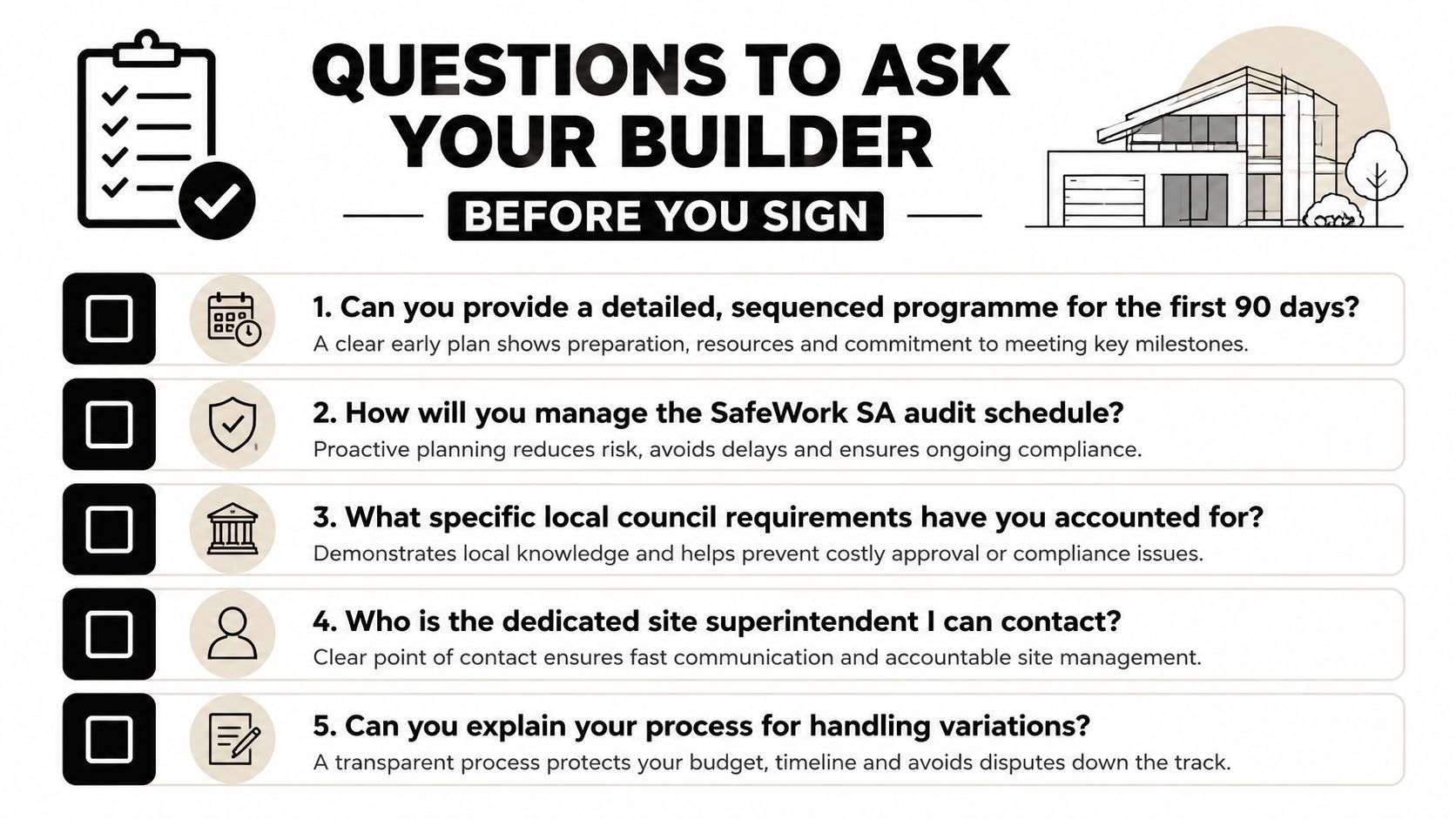
Use these questions and listen to the detail
- Can you provide a detailed, sequenced programme for the first 90 days? A serious builder should be able to explain the early works in order, not just say the job will “flow”.
- How will you manage the SafeWork SA audit schedule? You want to hear about process, records, and who owns compliance on site.
- What specific local council requirements have you accounted for? If they can't name them, they probably haven't checked them properly.
- Who is the dedicated site superintendent I can contact? If the answer bounces between people, your communication line will be messy later.
- Can you explain your process for handling variations? This should include written approval, tracking, and how changes affect time and cost.
You should ask different follow-ups depending on the project. For a renovation, ask how they'll protect existing finishes and manage dust. For an extension, ask how they'll keep the old and new work tied together cleanly. For a custom home, ask how they protect design intent through procurement and finishing. For a developer job, ask how they track RFIs, approvals, and multi-stage handover.
If the answer stays general, you're not hearing a process, you're hearing confidence without evidence.
A twenty-minute conversation can reveal whether the builder runs a proper system or just survives each week. Good site managers welcome these questions because they know their process can stand up to scrutiny.
Signals That Your Site Is Being Well Run
You don't need to be a builder to tell whether a site is under control. You just need to know what good looks like. The signs are mostly boring, which is exactly the point.
The everyday signs you should notice
- The site is tidy. Not showroom tidy, but organised enough that trades can work without stepping around clutter.
- Signage and fencing match the stage of the work. If the site has moved on, the controls should have moved on too.
- Trades arrive briefed. People know what they're doing, where they're working, and what depends on them finishing on time.
- Neighbours are spoken to, not ignored. The builder doesn't wait for complaints before managing access, noise, or disruptions.
- Program updates are current. You shouldn't have to guess what's next.
- The variation register is live. Any change should be written down and tracked, not left in conversation.
- Weekly reports land in your inbox. They should tell you what happened, what slipped, and what's coming next.
For a more engaged client, ask for monthly reporting that includes programme variance, cost variance, defect count, safety incidents, and RFI turnaround. Those measures don't need to be inflated or overcomplicated. They just tell you whether the project is behaving.
Quality control deserves special attention, because sloppy finishes often start as sloppy checking. A clear quality control process in construction projects is usually what separates a polished handover from one full of avoidable defects. If the builder treats quality as a final-stage issue, they've already missed the point.
The rule I'd use is this. If the site looks calm, the paperwork matches the work, and the builder can explain every current issue without scrambling, the project is probably being run well. If you keep hearing excuses, seeing gaps, or waiting for basic information, the site is drifting.
If you want a builder who treats construction site management as a serious part of delivering the job, not just a label on a chart, speak with Templeton Built. They work across renovations, extensions, custom homes, and development projects with the kind of site discipline Adelaide clients should demand. Visit Templeton Built and start the conversation before you sign.


Leave a Reply