

Improve Cost Estimate Accuracy for Australian Projects
Cost estimate accuracy gives you a realistic budget range rather than a single “right” number — it tightens as design definition improves and uncertainty is reduced.
Understanding the Key Concepts of Cost Estimate Accuracy
Cost estimate accuracy behaves a lot like a camera lens coming into focus. Early-stage estimates are intentionally wide because there’s little detail to work from. Later estimates narrow as drawings, specifications, and supplier quotes arrive. This progression is formalised in industry estimate classes, which directly link how much of a project is defined to how much costs might still shift.
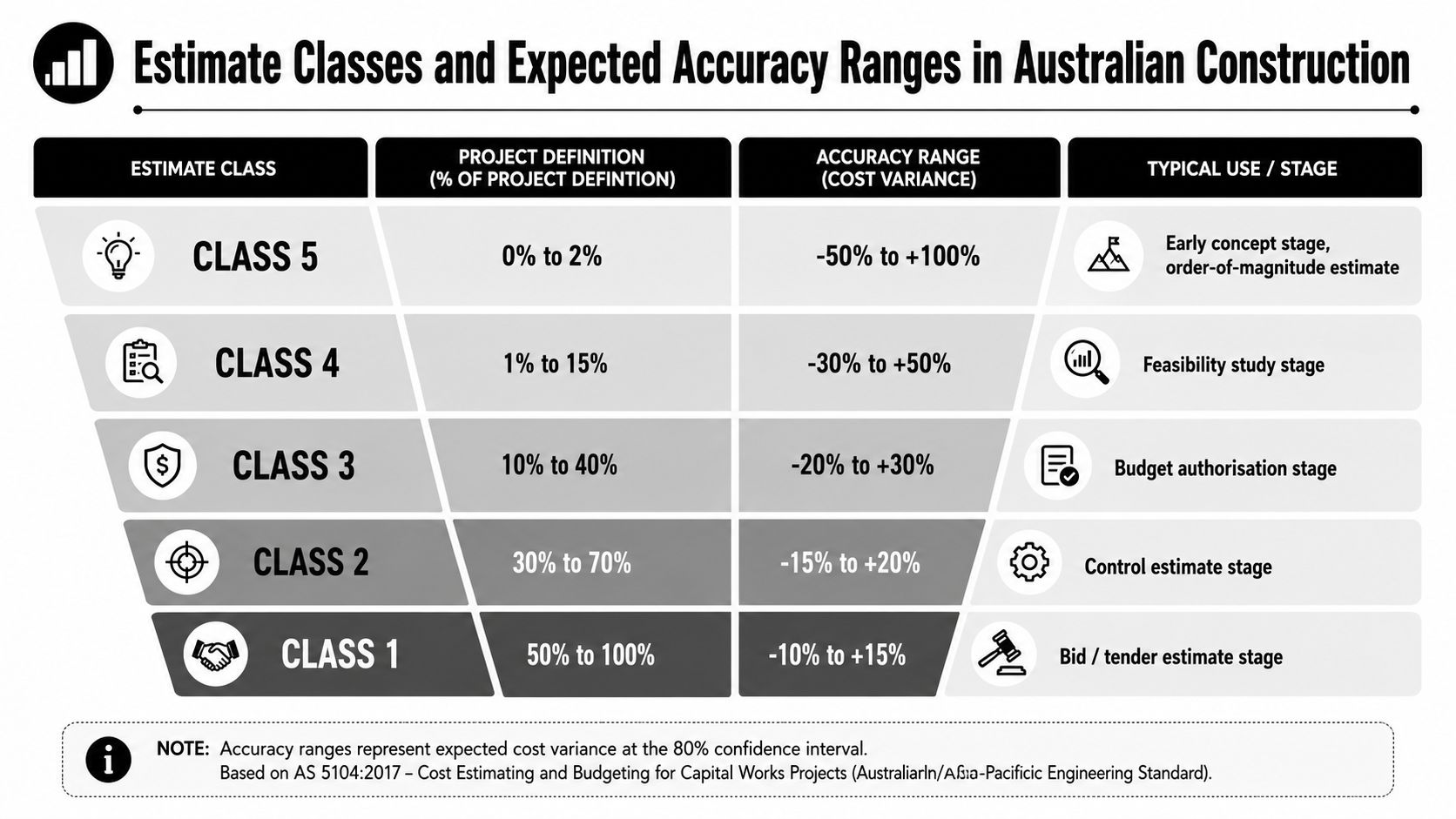
The chart above shows how estimate classes map project definition to expected accuracy ranges.
A practical way to read the classes is with a simple mental model:
- Think of Class 5 as a very rough road map; expect large swings while you’re still deciding whether the trip is worth taking.
- Class 3 is the mid-point where you can set a budget for approvals.
- Class 1 is the near-final picture used for tendering and contracts.
Key Metrics and Industry Terms
- Estimate Classes — a staged system linking project definition to accuracy bands.
- MAPE and Accuracy Bands — statistical measures like mean absolute percentage error help teams quantify historical estimating performance.
- Confidence Intervals — industry guidance often reports ranges at an 80% confidence level so stakeholders know the probability the final cost will land inside the band.
In Australian construction, cost estimate accuracy is often discussed through formal estimate classes rather than as a single “right number.” The Australian/Asia-Pacific engineering standard used by practitioners shows just how wide early-stage uncertainty can be. A Class 5 estimate, prepared when project definition is only about 0% to 2% complete, can sit anywhere from -50% to +100% in expected accuracy at an 80% confidence interval. Read the full guidance on estimate classes from AACE International Learn more about estimate class guidance
- Bullet list of practical takeaways
- Always ask which estimate class your quote represents and the confidence interval applied.
- Use Class 3 for internal budget decisions and Class 1 for tender-ready pricing.
- Treat early numbers as directional and budget with contingencies sized to the class.
Real-World Example
Imagine an Adelaide renovation quoted at $250,000 as a Class 5 figure. Given the Class 5 band above, the realistic planning range could span from roughly $125,000 to $500,000. That signals the need for staged design and serious contingency planning. As designs progress to Class 2 or 1, that range narrows and allows a firm contract sum to emerge.
Estimate Classes and Expected Accuracy Ranges
Understanding the relationship between project definition and expected cost variance is fundamental to interpreting any estimate. The table below outlines this inverse relationship, based on Australian engineering standards. As project definition increases, the expected accuracy range tightens significantly.
| Estimate Class | Project Definition Level | Expected Accuracy Range | Typical Use Case |
|---|---|---|---|
| Class 5 | 0% – 2% | -50% to +100% | Conceptual screening, feasibility |
| Class 4 | 1% – 15% | -30% to +50% | Study and budget authorisation |
| Class 3 | 10% – 40% | -20% to +30% | Budget control, approval for design |
| Class 2 | 30% – 75% | -15% to +20% | Tender and contract negotiation |
| Class 1 | 65% – 100% | -10% to +15% | Final bid, contract award |
This table reinforces why early estimates must be treated with caution. A Class 5 estimate is a starting point for discussion, not a fixed price. Only as a project moves through design development and into detailed documentation does the estimate become a reliable tool for financial commitment.
Good Questions to Ask Your Estimator
- Which estimate class is this and what confidence level was used?
- What historical MAPE or variance data informs this figure?
- Where are provisional sums or allowances included and why?
This progressive, transparent framing helps clients and builders move from guesswork to a shared understanding of cost estimate accuracy.
Why Early Stage Budgets Often Vary Significantly

Think of early-stage budgets as weather forecasts rather than bank balances—they point you in the right direction but offer no guarantees. When you first see a preliminary figure, view it as a rough guide that sharpens as the details fall into place.
A Concept or Class 5 estimate, for instance, relies on minimal definition, so it intentionally comes with a wide accuracy margin. This is exactly why a quoted renovation budget can feel like a moving target instead of a fixed commitment. The fog only lifts as drawings, specifications, and supplier quotes come through.
Key insight: A preliminary budget points to feasibility and priorities rather than a final price.
This kind of variance is surprisingly common. Even when a team feels confident holding a usable budget, the underlying uncertainty often remains substantial. One review found that 75% of project cost estimates carried errors between 20% and 60%, with the most likely error landing around 30%–50%. In practical terms, a $250,000 starter budget for a residential project can drift anywhere from $50,000 to $150,000 while the design is still evolving—a reality many Adelaide renovators know well. If you want the full breakdown, learn more about the estimate error findings here.
Picture this: a client opts for a high-spec kitchen appliance late in the schematic design phase. That single choice triggers a cascade of changes—extra glazing, upgraded electrical work, modified benchwork—compounding costs across multiple trades. This is exactly why early figures remain directional; a handful of small decisions can ripple through the entire job.
Stages Where Variance Shrinks
- Concept Stage: Broad order-of-magnitude numbers. Useful simply for deciding whether to proceed.
- Schematic Stage: Allowances and provisional sums come into play. Variance narrows, but the margin remains notable.
- Detailed Design Stage: Supplier quotes and quantified take-offs (QTOs) drive down uncertainty, allowing contingency allowances to become much more precise.
Practical Tips For Reading Early Budgets
- Ask which estimate class the figure represents and what confidence interval sits behind it.
- Size your contingency to match the estimate class rather than relying on a generic fixed percentage.
- Cross-reference the numbers against historical data or local benchmarks to sanity-check any wide figures.
Our advice to Adelaide clients at Templeton Built is straightforward: treat early estimates as a starting point for the conversation, and insist on staged updates as the design progresses. This approach keeps your aspirations visible while protecting your cash flow, turning potential surprises into planned decisions as the design firms up.
Numbered steps to reduce surprise:
- Lock critical selections early to prevent cascading changes across the board.
- Keep a live risk register to put a price on likely unknowns.
- Re-baseline the budget at every single design milestone.
For a deeper look at how this applies to your project, read our guide on feasibility studies at Templeton Built.
Key Drivers of Variance in Renovations and Custom Homes
Renovations and custom homes don't play by the same rules as standard new builds. From day one, cost estimate accuracy runs into pressures that tract builders rarely face.
The Unseen Stuff That Blows Budgets
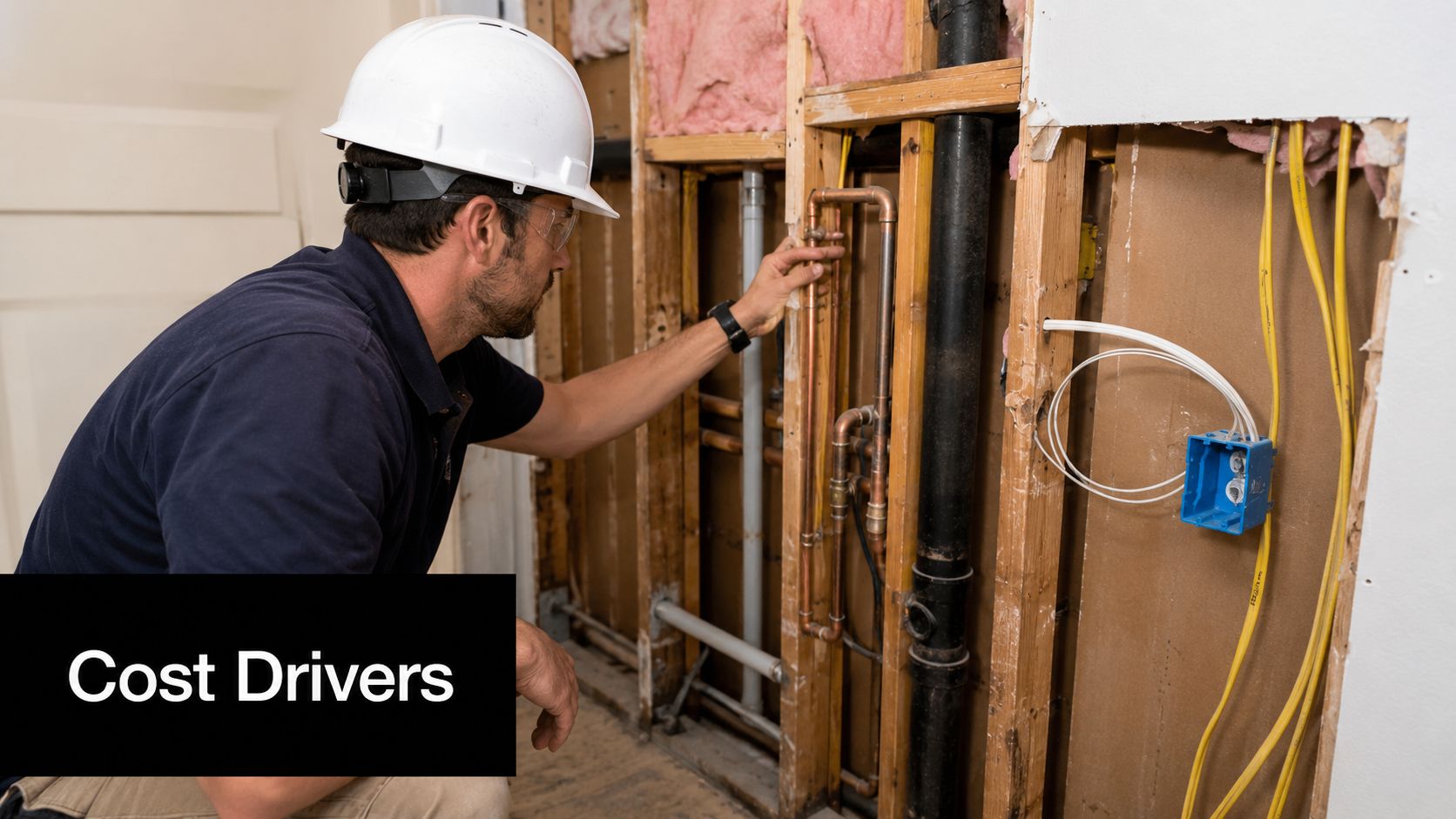
Hidden site conditions are the classic budget gremlins. Asbestos lurking behind walls, timber framing that's gone soft with age, wiring from the 1970s — you won't know about any of it until the demo crew starts pulling things apart. Finding these issues mid-project can tack on tens of thousands of dollars and send trades spiralling into delays. What started as a neat allowance suddenly becomes a major variation.
And here's the thing: surprises don't travel alone. They cascade.
How One Change Ripples Across Trades
Change cascades are real. Swap out a standard window for something larger or higher-performing, and you're not just paying for the window. You're adding structural framing work, more complex glazing labour, extra time for finish carpentry. One decision mutates into three or four separate cost lines. That's why small spec tweaks can cause outsized budget swings — especially when the original allowances were vague to begin with.
Why Local Markets Move the Needle
Labour and subcontractor markets aren't uniform across regions. In Adelaide, specialist glazing crews are few and far between, and roof plumbers get hammered during peak season. Short-term rate spikes of 10–25% aren't unusual, yet square-metre estimates almost never account for this. Region-specific pricing data isn't a luxury — it's the difference between a realistic budget and a finger-in-the-air guess.
When Materials Don't Have a Benchmark
Uncommon designs and bespoke materials come without a pricing history. Specifying imported tiles or non-standard timber means you can't lean on historical takeoffs. Estimators have to chase supplier quotes that shift with shipping costs and lead times, and those numbers can change between estimate and order.
Sorting What You Can Control from What You Can't
Not all variance is created equal. It helps to split it into two buckets:
- Controllable — scope creep, late selections, ambiguous specs. These are manageable with clear decision timelines and selection freezes.
- Uncontrollable — market swings, unexpected site conditions, regulatory changes. These demand contingency buffers and risk pricing built into the estimate from the start.
Key insight: Treat early figures as ranges, not promises. Build contingencies that match the estimate class and the specific risk factors at play locally.
Warning Signs an Estimate Is Underplaying Risk
Watch for these red flags:
- Vague allowances rather than quantified provisional sums that spell out what's included and excluded
- No local subcontractor quotes for specialist trades
- A single-line contingency with no connection to identified risks
Common Causes of Variance at a Glance
| Driver | Why It Matters | Typical Impact |
|---|---|---|
| Hidden Conditions | Unknown until demolition | $5k–$100k+ depending on severity |
| Scope Changes | Late client choices | Cumulative percentage increases |
| Local Labour Supply | Shortages or seasonal peaks | 10–25% rate shifts |
| Non-standard Materials | No benchmark pricing | Longer lead times, premium costs |
| Poor Specification | Ambiguity in scope | Provisional sums and disputes |
How Templeton Built Handles This in Adelaide
- Staged estimates tied to the current definition level — no pretending you have certainty you don't.
- Critical selections locked early to stop change cascades before they start.
- A live risk register priced against actual local project history, not generic data.
A real example: an Adelaide kitchen upgrade where a late high‑end appliance choice added roughly 8% to subcontractor scopes. Lock those selections earlier and that ripple gets absorbed within tighter allowances instead of blowing out the budget.
A Quick Checklist for Clients
- Ask which estimate class is being used and what the confidence interval looks like.
- Request local subcontractor quotes for any specialist trades.
- Insist on a risk register with priced contingencies — not just a percentage tacked on at the bottom.
These steps move unknowns into priced line items, which means fewer surprises once construction starts. That's where real cost estimate accuracy comes from.
Practical Methods to Improve Estimating Reliability
Getting cost estimates right isn't about getting it perfect the first time. It's about making steady, methodical refinements throughout the design process. Think of it less like a single calculation and more like sharpening a blade—each pass makes the edge cleaner.
The foundation is a well-defined scope. Vague project aims invite assumptions, and assumptions breed blowouts. When every trade knows exactly what's expected, quantity takeoffs tighten up and allowances shrink.
Detailed specifications are where the real work happens. Rather than writing "high-quality kitchen finishes," list the actual sink model, the specific tile range, the exact hardware finish. This eliminates the back-and-forth that plagues most projects and stops scope creep before it gains momentum.
A kitchen spec that names a single sink model, for instance, saves hours of email chains and prevents the kind of downstream price surprises that erode client trust. Once you've got that discipline in place, historical benchmarking becomes your next advantage.
Comparing new proposals against actual costs from completed jobs reveals patterns that raw calculations miss. Templeton Built maintains a database of past Adelaide renovations, which helps catch outliers early and size contingencies with more confidence. It's not about copying old numbers—it's about understanding where real projects land versus where we predicted they'd land.
Key takeaway: Accurate estimates come from staged validation at each design milestone rather than a one-off guess early on.
Pricing Uncertainty Explicitly
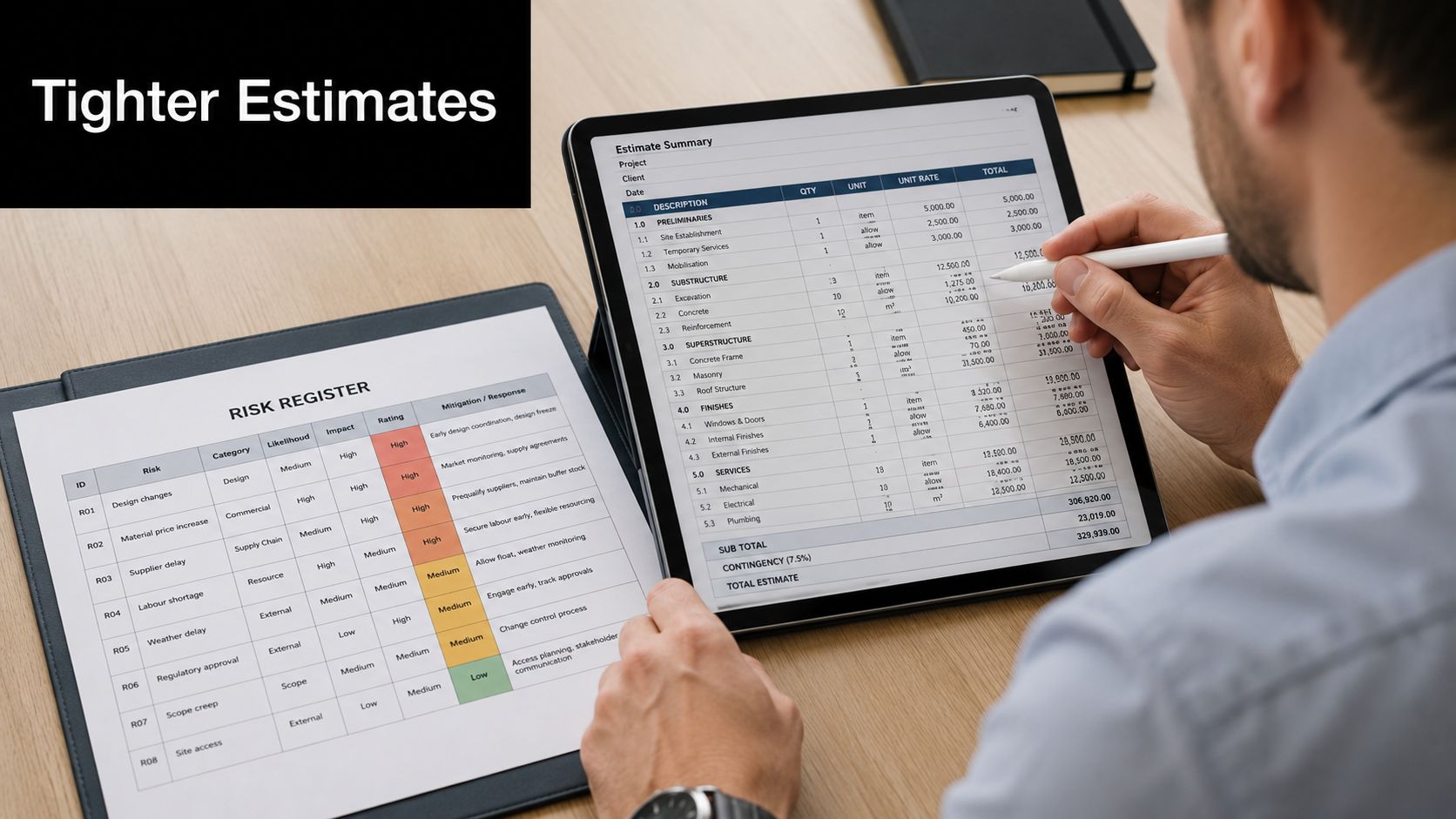
A live risk register transforms vague worry into something measurable. List out what you don't know yet, rate how likely each issue is and how much it would cost, then assign a dollar figure to each line item. Clients can actually see and approve that contingency instead of wondering where it came from.
Independent checks matter more than most people admit. A quantity surveyor or even a thorough peer review will spot the optimism bias that creeps into every internal estimate. They act as a second pair of eyes, catching small omissions that compound into major blowouts over a twelve-month build.
Process Steps That Actually Work
- Produce staged estimates at concept, schematic and detailed design, each with clear estimate class labels and confidence bands so decision-makers understand the margin of error.
- Run a detailed QTO once detailed design is locked in, and source actual supplier quotes for high-cost items rather than relying on catalogue pricing.
- Maintain regional cost libraries and update labour rates seasonally to reflect what's actually happening in the Adelaide market, not what happened two years ago.
Tools and Quality Assurance
Modern estimating software connected to BIM or current cost libraries has largely replaced the brittle spreadsheets that used to cause so many headaches. Real-time supplier pricing keeps numbers grounded in reality.
Implement a formal QA checklist that reviews assumptions, provisional sums and exclusions before any estimate leaves the building. It takes twenty minutes and saves weeks of disputes.
Guidance for Clients
Read estimates as ranges, not fixed sums, and always ask which estimate class and confidence interval applies. A Class 3 estimate carrying a ±15% band tells a very different story than a Class 5 with ±30%.
Insist on priced provisional sums and a transparent contingency tied directly to a risk register. If your builder can't explain where the contingency came from, that's worth probing further.
Read also: Learn more about how a quantity surveyor strengthens early cost accuracy with our guide on what a quantity surveyor does at Templeton Built
What This Looks Like in Practice
Lock your critical selections early—appliances, glazing, finishes—because every late change sends ripples through the budget. And re-baseline at each design milestone so the estimate evolves with the project rather than becoming a relic you stop referring to by month three.
Interpreting Estimates and Managing Client Expectations
Reading an estimate is a lot like checking the weather forecast for a build. It gives you probabilities, timing, and a heads-up on where you might need cover—not a guaranteed outcome. Before you get too deep into the numbers, figure out what you are actually looking at. Is it a firm quote, a provisional sum, or a prime cost item? Each one behaves differently and shifts the risk around in your final contract.
To get a clear picture, ask a few straightforward questions right off the bat:
- Which estimate class does this fall under, and what confidence band applies?
- Which items are provisional sums with clearly defined scopes, and which are just open allowances?
- How was the contingency calculated, and exactly what risks does it cover?
Key insight: A well-prepared forecast for new construction should land within 5% to 10% of the median of competitive bids once it is detailed. Less developed estimates might only hit 20% to 30% accuracy. For the full context and methodology, read the research on cost predictability.
How to Spot Missing Assumptions
Assumptions have a nasty habit of hiding in plain sight. Here is where to look:
- Check the exclusions first. If something is not listed as excluded, the estimator probably assumed it was included.
- Watch out for single-line contingencies with no attached risk register. They tend to hide assumptions rather than explain them.
- Confirm whether local subcontractor quotes were actually used for specialist trades.
When you are trying to figure out how accurate an estimate really is, a practical approach goes a long way.
- Ask for the estimate class and a confidence interval. This lets you translate those percentage bands into actual dollar ranges.
- Request priced provisional sums and named allowances instead of vague percentage lines.
- Push for a short risk register that shows the likelihood and dollar impact of each major unknown.
Real-world context makes all the difference here.
- A Class 3 budget with a ±15% band gives you a completely different decision threshold than a Class 5 with ±50%. Treat them accordingly.
- If glazing is priced as an allowance rather than a solid supplier quote, expect the numbers to shift if lead times or specialist labour change.
Expert tip: Ask for historical benchmarking or comparable local projects. It is the best way to sanity-check allowances against what actually happened on similar jobs.
Keeping your budget safe takes a bit of discipline, but it pays off.
- Lock in your critical selections—appliances, glazing, finishes—before you go to tender. This stops cascade effects in their tracks.
- Re-baseline the budget at every design milestone so the estimate grows and changes alongside your decisions.
- Consider staged contracts or cost-plus models when early uncertainty makes a lump-sum too risky. Learn more about cost-plus contracts at Templeton Built.
Getting good at reading estimates changes the whole dynamic. Instead of being a point of friction, estimating becomes a collaborative tool that drives better decisions and sharper cost estimate accuracy.
Templeton Built Approach to Transparent Cost Planning
Templeton Built treats cost estimate accuracy as an ongoing conversation, not a one-off number. Their in-house design-and-build team closes the feedback loop between design choices and prices so estimates evolve with decisions rather than lagging behind them.
This matters because early figures are wide by design. For example, Templeton Built uses staged estimating so a concept-level Class 5 ballpark is followed by progressively tighter Class 3 and Class 1 cost plans as drawings and specifications firm up. That staged rhythm reduces surprises.
Their local experience is an advantage. With over 400 renovations and 64 custom homes since 2001, Templeton Built maintains a regional cost library that benchmarks new estimates against actual Adelaide outcomes. This historical MAPE helps quantify likely variance and informs realistic contingencies.
How They Make Estimates More Reliable
- Staged estimates at each design milestone with clear estimate class labels and confidence bands, so clients see the expected accuracy range and plan contingencies accordingly.
- A live risk register priced against local project experience that turns unknowns into line items rather than vague percentages.
- Early subcontractor engagement for specialist trades so critical items carry supplier-backed numbers instead of generic allowances.
"Accurate costing isn't a deliverable, it's a discipline embedded into how the work gets done" — a guiding insight that stresses process over a single promise.
Practical steps Templeton Built follows include locking critical selections early to stop change cascades and running independent quantity takeoffs when detailed design is available. They also re-baseline budgets at each milestone so cost estimate accuracy improves incrementally.
Examples And Client Guidance
- Feasibility check for developers where end-to-end modelling tests returns before design money is spent.
- Renovation clients shown historical comparators so a proposed $250,000 kitchen sits next to similar Adelaide projects and realistic contingency bands.
- Clear separation of provisional sums, prime cost items and firm quotes in every estimate so clients can see where risks remain.
Table comparing estimate stage and client action
| Stage | Templeton Built Output | Client Action |
|---|---|---|
| Concept (Class 5) | Broad budget band | Decide go/no-go |
| Schematic (Class 3) | Refined cost plan | Lock major selections |
| Tender (Class 1) | Tender-ready sum | Authorise contract |
By combining local data, staged validation, priced risks and supplier engagement, Templeton Built turns ambiguity into measurable ranges—helping Adelaide clients make confident, informed decisions about their budgets and design ambitions.
Frequently Asked Questions About Estimate Accuracy
How often should an estimate be refreshed during design
Refresh it at every major design stage — concept, schematic, and detailed design. Early Class 5 numbers are really just directional, so update to a Class 3 once schematic drawings exist, then to a Class 1 when tender-ready documents are final. This way your budget tightens with each round, and you’re less likely to be blindsided later.
What is the real difference between a quote and an estimate
A quote is a supplier or subcontractor’s promise for a fixed scope and price. An estimate, on the other hand, is a forecast built on assumptions and accuracy bands. For instance, a Class 3 estimate might carry a ±20% band, while a supplier quote is usually firm. Read them together — that’s where you see exactly where certainty starts and ends.
How can accuracy improve without full documentation
You don’t need final drawings to tighten things up. A few practical steps make a big difference:
- Bring subcontractors in early for real local rates and lead times.
- Use a priced risk register so unknowns show up as actual dollar lines.
- Benchmark against similar Adelaide projects to catch outliers before they blow out.
These moves turn guesses into priced items, and they’ll often cut variance more than any vague specification alone.
Key insight
Ask for the estimate class and confidence band. That lets you translate percentage ranges straight into dollar figures for your project.
How to judge if a builder’s contingency is adequate
Look for a contingency that’s tied to a risk register, not just a flat percentage. A meaningful contingency will show:
- Listed risks with their likelihood and dollar impact.
- Local labour and material volatility reflected (for Adelaide, specialist trades can swing 10–25%).
- How provisional sums will be converted to firm quotes as the design develops.
If the contingency can’t be explained in these terms, treat it as thin and dig a bit deeper.
Quick next steps for homeowners and developers
- Get the estimate class, confidence interval, and priced risk register.
- Lock in high-impact selections early to stop cascade costs.
- Require staged re-baselining so the estimate evolves with your decisions.
For clear cost planning and staged estimating in Adelaide, contact Templeton Built.


Leave a Reply