

Cost Plus Contracts Explained: Benefits & Risks
You've probably had this moment already. The plans are taking shape, the wish list is getting longer, and someone asks the question that changes the tone of the whole conversation: “How are we going to contract this?”
That's where many renovation and custom home clients get stuck. A fixed price sounds safe. A cost plus arrangement sounds open-ended. Neither label tells you much on its own.
What matters is how the contract behaves once work starts. On a simple build with fully resolved drawings, a lump sum can make perfect sense. On a renovation where no one knows exactly what's behind the walls until demolition starts, the wrong contract can create friction, inflated allowances, and arguments over who should carry the risk. Cost plus contracts aren't better by default. They're better when the project has uncertainty and the paperwork is set up properly.
What Are Cost Plus Contracts in Construction?
A cost plus contract is the building equivalent of agreeing to pay for the actual ingredients, then paying the chef a separate amount to plan, organise, cook, and manage the whole meal.
In construction, that means the owner reimburses the actual project costs for things like labour, materials, equipment, and subcontractors, then pays an additional builder's fee for overhead and profit. The final price isn't fixed at the start. That's the central trade-off.
This model didn't appear by accident. Cost-plus contracting became important on projects where scope couldn't be pinned down accurately before work began, and that's still why it shows up so often in Australian renovations and custom homes, according to this construction history overview. If you're opening up an older home, extending into an awkward site, or designing a bespoke home while details are still evolving, certainty on paper can be more apparent than real.
Why homeowners consider it
A cost plus contract is not typically chosen due to a fondness for administration. Instead, it is opted for because it eliminates the need for a builder's guesswork.
A renovation is full of moving parts. Existing structures hide surprises. Joinery selections change. Engineering details develop. Services need rerouting. In that setting, a fixed figure can force one of two outcomes:
- A padded quote that tries to cover every possible unknown
- A strained build where every surprise turns into a variation dispute
A properly run cost plus contract handles uncertainty more transparently.
A good cost plus contract doesn't remove risk. It shows you where the risk sits and how it will be managed.
If you want a homeowner-friendly explanation of how these agreements work locally, it's worth taking a moment to explore Australian cost-plus contracts before signing anything. The local context matters because contract language, allowances, and approval processes need to match how Australian residential projects run.
What clients often misunderstand
The common fear is that cost plus means “blank cheque”. It shouldn't.
A poor cost plus contract is vague, loose, and trust-based in all the wrong ways. A good one is documented, auditable, and disciplined. The difference sits in the definitions, approvals, reporting, and fee structure.
The Anatomy of a Cost Plus Contract
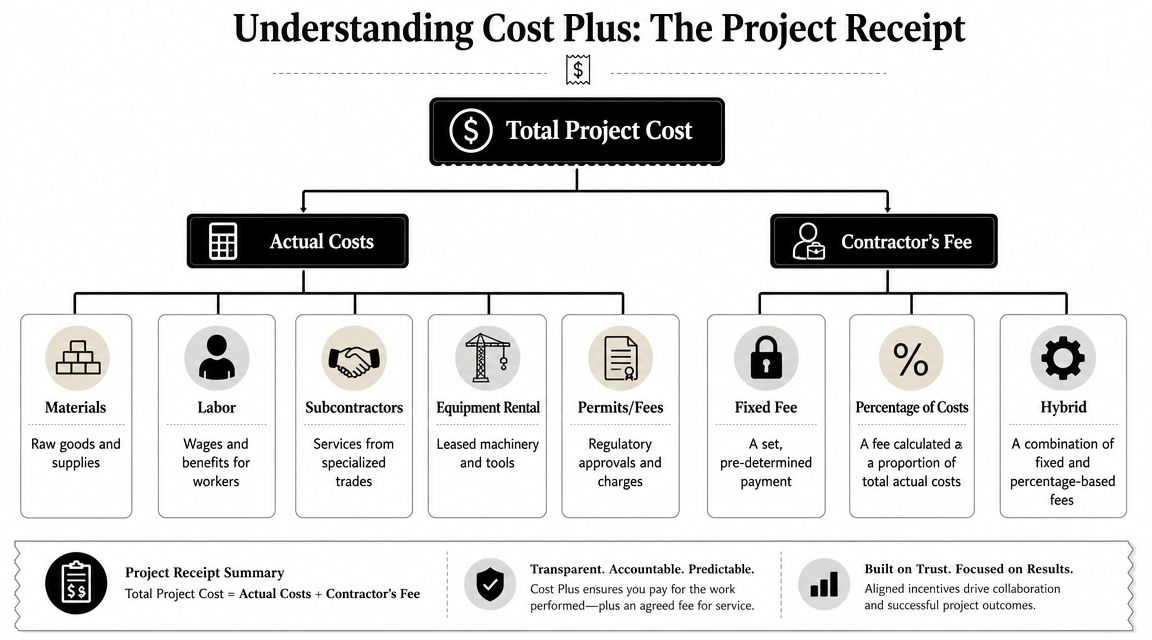
If you want to understand cost plus contracts clearly, stop thinking of them as one number. Think of them as a project receipt.
Every cost has a place. Every claim should be traceable. Every invoice should show what happened on site, not just what someone says happened.
The three moving parts
A workable cost plus contract usually comes down to three buckets.
Direct costs
These are the costs tied directly to the build itself. Think:
- Materials such as timber, steel, plasterboard, tiles, fixtures, and finishes
- Labour for the people doing the work on site
- Subcontractors including electricians, plumbers, cabinetmakers, painters, and other trades
- Equipment and site-specific items where the contract allows them
These costs should be identifiable and supported by supplier invoices, timesheets, subcontract claims, or similar records.
Indirect costs and overheads
Many disputes often originate here.
Indirect costs aren't the same as direct construction inputs. They can include project administration, supervision, insurance, and business overheads if the contract allows them. If they're not defined properly, clients can feel they're paying twice. Once in the reimbursable cost, and again in the builder's fee.
That's why documentation matters long before site start. During the construction documentation phase, this is the kind of detail that should be locked down, not left to interpretation later.
The builder's fee
This is the “plus” in cost plus.
It's the amount paid to the builder for managing the work, carrying business overhead, and making a profit. The fee might be structured in different ways, which changes the incentives dramatically. More on that in the next section.
What open-book billing should look like
Open-book doesn't mean dropping a stack of receipts on the table and calling it transparency. It means the billing format is organised enough that a client can follow the story of the build.
A strong cost report usually includes:
- Clear categories so labour, materials, subcontractors, and approved overheads aren't blended together
- Source documents attached to support each claim
- Regular timing such as monthly or milestone-based reporting
- Variation tracking so approved changes don't disappear into general project spend
Practical rule: If you can't understand an invoice without a phone call, the contract administration isn't tight enough.
Where people get caught out
The biggest mistake is assuming transparency happens automatically.
It doesn't. It has to be built into the contract and the reporting rhythm. A cost plus agreement only works well when everyone agrees upfront on what can be charged, how often it will be reported, and what level of backup will be provided.
Understanding Different Cost Plus Contract Types
Not all cost plus contracts create the same behaviour on site. Two agreements can both be called “cost plus” and still pull builder and client in very different financial directions.
That's why the fee structure matters more than the label.
Cost plus percentage of cost
Under a percentage-of-cost model, the builder's fee rises as project spend rises. Australian construction commentary commonly treats this structure as high risk because it weakens the incentive to keep costs down, and industry guidance often places that fee in the 10% to 20% range of total project cost for construction work, as outlined in Procore's explanation of cost-plus contracts.
That doesn't mean every percentage-based arrangement is badly run. It means the incentives need to be acknowledged clearly. If the builder earns more as the spend grows, the client needs particularly strong cost controls and very clear definitions around allowable charges.
Cost plus fixed fee
This is usually the cleaner model for uncertain residential work.
A cost-plus-fixed-fee structure separates reimbursement from profit. The builder's fee is negotiated at the start and does not vary with actual project cost, although the fee can still be adjusted if the scope changes through formal variations, as noted in the FAR guidance on CPFF contracts. That's why many practitioners see it as the more defensible version of cost plus.
For a homeowner, the benefit is straightforward. If the builder's fee doesn't increase just because the project costs more, the commercial alignment is better.
Guaranteed maximum price
A guaranteed maximum price, often called a GMP, sits between pure cost plus and pure lump sum.
The project is still administered with open-book cost tracking, but there's a ceiling or cap that limits the owner's exposure if cost certainty is a major concern. This can work well when a project carries some unknowns but the client still wants a backstop.
A GMP only works, though, if the underlying assumptions are realistic. If the cap is set on hopeful numbers or incomplete scope, the tension just moves elsewhere.
Which structure usually works best
For renovations and custom homes, the practical hierarchy is often simple:
| Contract type | Main incentive | Main concern |
|---|---|---|
| Cost plus percentage | Flexible and easy to apply | Fee rises with spend |
| Cost plus fixed fee | Better alignment on cost control | Total project cost still varies |
| Cost plus with GMP | Flexibility plus a ceiling | Cap must be based on disciplined assumptions |
If the scope is uncertain, a fixed builder's fee usually gives the cleanest line between genuine project cost and builder profit.
Cost Plus vs Fixed Price Which Is Right for Your Project?
This is the decision most clients are trying to make. Not “what is cost plus?” but “which option leaves me in a better financial position for my job?”
The answer depends less on personality and more on project conditions. A contract should fit the build, not the other way around.
The hidden cost inside fixed prices
A fixed-price contract can feel safer because the number is known upfront. But fixed-price bids commonly include a 5% to 10% contingency for unknowns, according to this guide comparing cost-plus and fixed-price contracts. That contingency is the builder's protection against uncertainty already sitting inside the quote.
So the comparison isn't really “certainty versus risk”. It's often visible risk versus hidden risk.
With cost plus, the fee and the underlying costs are exposed. With fixed price, the uncertainty is often packed into one headline number. Some clients prefer that. Others would rather see the moving parts.
Side-by-side comparison
Here's the cleaner way to assess it.
| Feature | Cost-Plus Contract | Fixed-Price Contract |
|---|---|---|
| Price certainty at signing | Lower. Final cost depends on actual spend. | Higher. Price is set upfront, subject to contract terms and variations. |
| Transparency | High if reporting is open-book and well organised. | Lower. The client sees the contract sum, not every input behind it. |
| Flexibility | Strong for evolving scope, selections, and latent conditions. | Best when plans and specifications are complete and stable. |
| Risk allocation | More cost risk sits with the owner. | More pricing risk sits with the builder, until variations arise. |
| Variation management | Usually more straightforward if approvals are disciplined. | Can become adversarial when the original scope wasn't fully resolved. |
| Best fit | Renovations, extensions, custom homes, uncertain sites. | Straightforward, well-defined projects with low ambiguity. |
If you want better budget control under either model, the discipline around reporting, forecasting, and approvals matters as much as the contract form itself. That's where practical construction cost management becomes more important than the headline contract label.
A simple decision threshold
Cost plus tends to make more financial sense when the project contains genuine unknowns that can't be priced responsibly at the start.
That often includes:
- Renovations to older homes where demolition may uncover structural or service issues
- Extensions that must tie into an existing building with imperfect records
- Custom homes where design details, finishes, or engineering are still being refined
- Client-led selection processes where choices are likely to evolve during the build
A fixed price tends to work better when:
- the drawings are fully resolved
- finishes are selected
- engineering is complete
- site conditions are understood
- the client wants a firm upfront number more than flexibility
Some owners overpay for certainty they don't actually get. Others avoid cost plus when it would have shown them the real cost of uncertainty more honestly.
Essential Clauses and How to Manage Risk
Cost plus contracts succeed or fail in the paperwork.
That might sound dry, but it's the truth. A well-run cost plus build doesn't rely on goodwill. It relies on clear contract language, disciplined approvals, and records that can be checked without drama.
Start with cost definitions
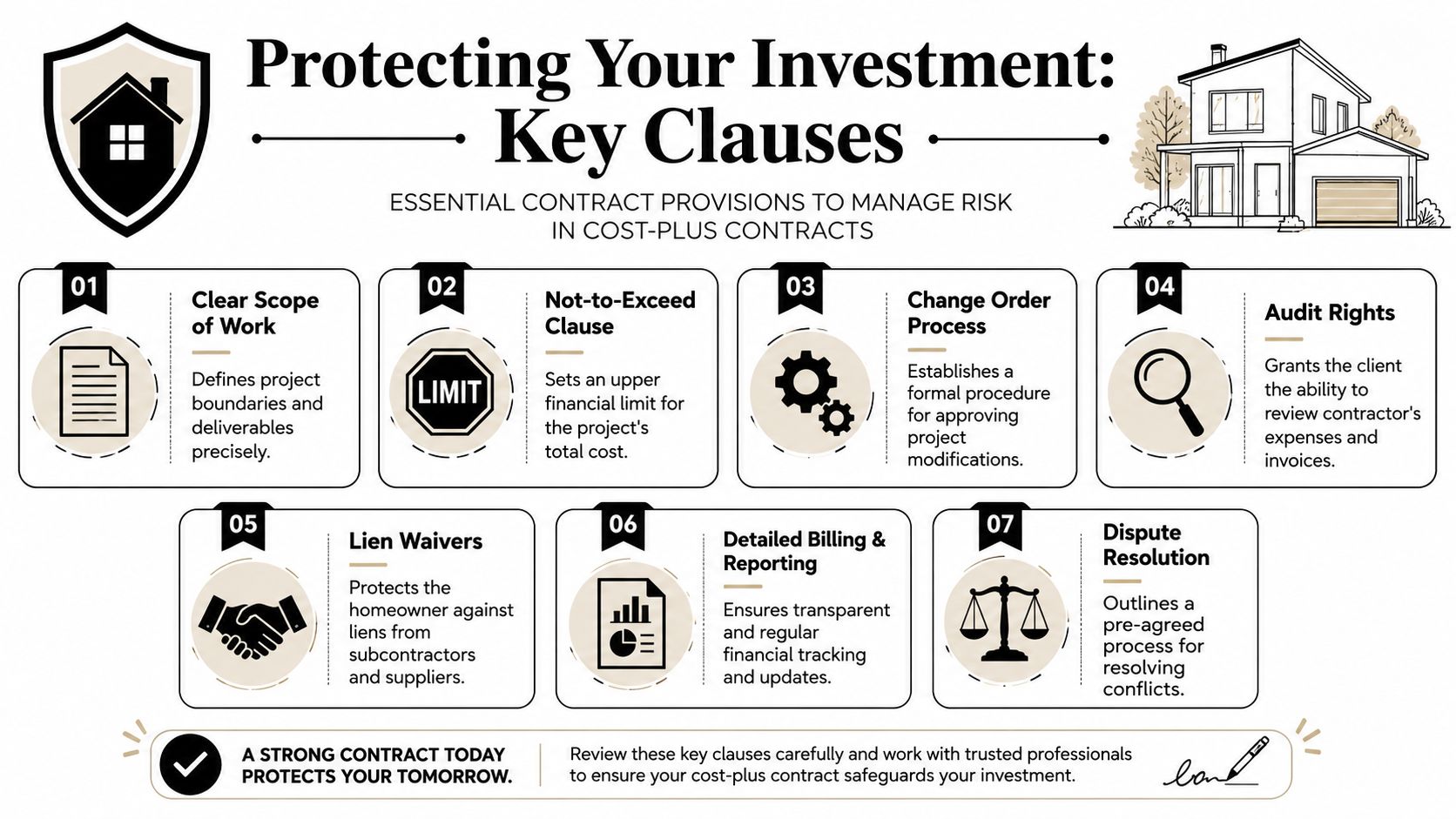
A primary failure mode in cost plus contracts is weak cost definition. The contract needs to distinguish direct costs from indirect overhead, define what is reimbursable, and exclude what isn't. It also needs a written change-order process, as explained in Stripe's guide to cost-plus contracts.
If that sounds basic, it's because many disputes begin at the most basic level.
For example, is site supervision reimbursable? Are temporary protection items included? Are delivery charges claimable? Is admin time covered by the fee or billed separately? If the contract ducks those questions, the invoice review becomes a guessing game.
The clauses worth insisting on
A residential cost plus contract should usually spell out at least these items:
- Defined reimbursable costs so there's no confusion about what can be charged to the project
- Non-reimbursable exclusions so the client knows what sits inside the builder's fee
- Billing frequency such as monthly or milestone-based claims
- Source document requirements including invoices, receipts, and trade claims
- Variation approval steps before extra work starts
- Allowance and provisional treatment so selections and undefined items are managed transparently
- Audit rights so the owner can inspect supporting records
- A not-to-exceed mechanism or GMP if the client wants a financial ceiling
A useful way to sense-check contract discipline is to look outside residential building. Even unrelated service sectors rely on templates to define scope, inclusions, approvals, and dispute pathways. That's one reason even operational businesses download snow plowing contract templates before sending work out the door. Different trade, same lesson. Clear paperwork prevents expensive assumptions.
Here's a quick explainer on the contract side of the issue:
Governance on a live project
Good governance isn't just legal wording. It's a routine.
That routine should include:
- Regular cost reports that compare actual spend against the current working budget
- Prompt variation decisions so changes are priced and approved before they roll into the work
- Invoice backup attached to each claim, not provided only when a dispute starts
- Allowance tracking so clients can see whether selections are trending up or down
- Meeting notes that record financial decisions clearly
If you're reviewing terms, this practical guide on what to look for in a building contract is worth keeping open beside the draft.
Contracts don't create trust on their own. They create a framework where trust can survive stress.
What doesn't work
Three habits usually cause trouble fast.
First, vague language around overheads. Second, verbal approvals for scope changes. Third, reporting that arrives late and in bulk. By the time the owner sees the numbers, the money has already moved and the options have narrowed.
When to Choose a Cost Plus Agreement
The easiest way to choose is to stop asking which contract is “best” and start asking which contract matches the level of uncertainty in your project.
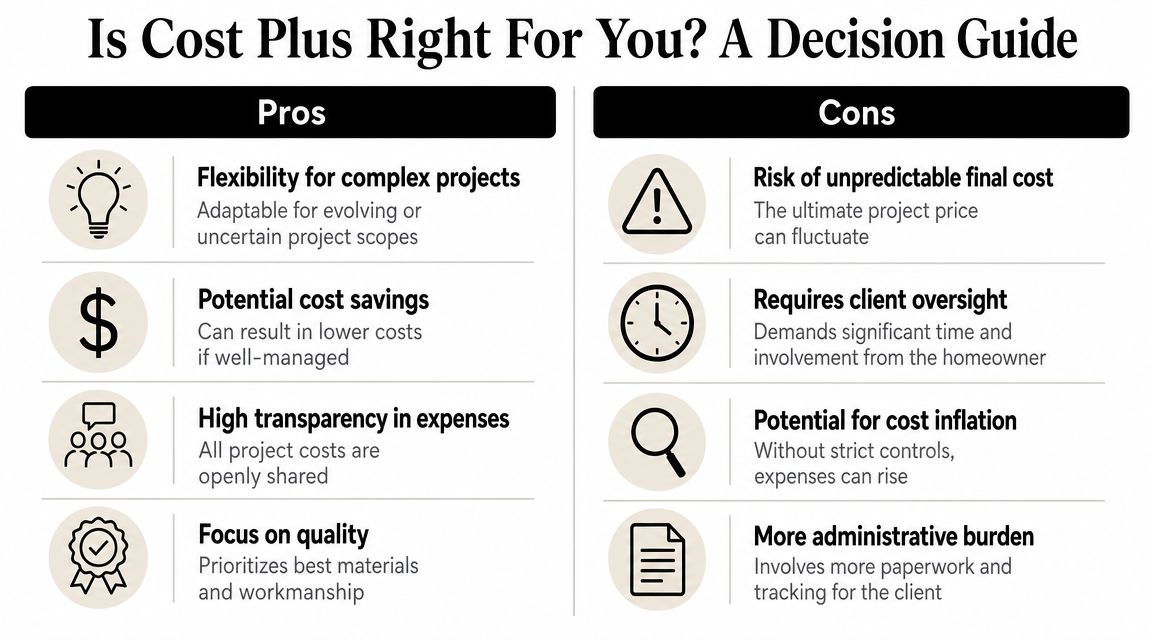
Cost plus is usually the smarter fit when
- You're renovating an existing home and there's a real chance of hidden conditions once work opens up
- You're building a custom home where details may continue to evolve through documentation and construction
- You want flexibility in finishes and selections rather than locking every choice in before contract signing
- You're comfortable reviewing reports and approving changes as the project moves
In those situations, cost plus can be the more honest commercial model because it deals with uncertainty openly instead of burying it inside a single number.
Fixed price is usually the better fit when
- The scope is fully documented
- Selections are complete
- The site conditions are well understood
- You want maximum upfront price certainty and less ongoing involvement
The key question isn't whether surprises are possible. It's whether they can be priced responsibly before work begins.
If they can't, a fixed price may only create the appearance of certainty. If they can, a lump sum can keep administration simpler and budgeting easier.
Your Cost Plus Contract Questions Answered
Can I still have a budget with a cost plus contract
Yes. You should still have a working budget, allowances, and regular reporting against that budget.
What changes is the nature of the number. Instead of treating it as a locked contract sum, you treat it as a live financial plan that gets updated as selections, site conditions, and approved changes become clearer.
What happens if material prices increase during the build
Under a cost plus arrangement, the owner generally pays actual cost as incurred, subject to the contract terms and approval processes. That's one reason these contracts are often used when uncertainty is high. They deal with market movement more directly rather than forcing a builder to absorb it or bury it in a broad allowance.
The protection for the client isn't pretending prices won't move. It's requiring visibility, backup, and timely reporting when they do.
How do I know the invoices are legitimate
The contract should require open-book evidence. That usually means supplier invoices, subcontract claims, receipts, and clear cost coding. You should also know how often claims will be submitted and what level of detail will accompany each one.
If the builder says the contract is transparent but the reports are hard to follow, ask for a better format.
Is a percentage fee always a bad idea
Not automatically. But it does create a harder conversation around incentives because the fee rises with project spend. That's why many owners feel more comfortable with a fixed-fee arrangement on uncertain residential work.
Can I cap the risk
Sometimes, yes. A not-to-exceed clause or guaranteed maximum price can add a ceiling if the scope is advanced enough to support one. The cap only has value if the assumptions underneath it are realistic and documented.
What should I ask before signing
Ask these five things:
- What costs are reimbursable, exactly
- What is excluded
- How is the fee calculated
- How are variations approved
- What documents come with each claim
If the answers are crisp, the contract is probably on the right track. If they're fuzzy, keep asking.
If you're weighing up contract options for a renovation, extension, or bespoke home, Templeton Built can help you assess which structure fits your project and how to set it up with proper visibility from day one. The right contract won't remove every unknown, but it will make the build fairer, clearer, and easier to manage.


Leave a Reply