

Custom Home Builder Salary: An AU & Adelaide Guide (2026)
If you're pricing a renovation, planning a bespoke home, or trying to work out whether custom building is a career worth chasing, you've probably asked the same blunt question: what does a custom home builder earn?
The trouble is, that question sounds simple and rarely has a simple answer. In custom residential work, income isn't just a wage. It can be a salary, a share of business profit, owner drawings taken across the year, or a mix of all three. Two builders can run similarly priced projects and end up with very different personal incomes because their business structures, overheads, and cash flow discipline are different.
That matters for both sides of the fence. If you're a builder, your income depends on more than how hard you work on site. If you're a client, the builder's compensation model affects how they price your job, how stable their business is, and how reliably they can carry your project from contract to handover.
Unpacking the Custom Home Builder Salary
A lot of online advice tries to reduce custom home builder salary to one annual figure. That works for some industries. It doesn't work well here.
A custom builder can be an employed construction professional on a fixed salary. They can also be a director of a small company who pays themselves modestly during the year and relies on project profit later. Some owner-operators take drawings as cash allows and smooth their income unevenly across active jobs. Others build a team around them and trade lower short-term take-home pay for stronger capacity and steadier delivery.
Why one number misses the point
Custom residential building combines several functions that other sectors split across separate roles. A builder may handle estimating, programming, subcontractor procurement, site supervision, client communication, variations, quality control, warranty follow-up, and compliance. On architecturally detailed homes, extensions, and renovations, that stack gets heavier, not lighter.
That means the central question isn't only what is the custom home builder salary. It's also:
- Are they an employee or an owner? An employee usually has more predictable income. An owner usually has more upside and more risk.
- What kind of work do they do? Renovations and bespoke homes often demand more coordination than standardised volume builds.
- How is the business set up? A lean sole operator and a staffed boutique builder don't carry the same overhead or deliver the same supervision model.
- When does income arrive? In building, effort and payment don't always land in the same month or even the same stage of the project.
A builder's earnings model isn't separate from the client's experience. It shapes quoting, supervision, communication, and resilience when jobs get complicated.
The practical lens
From an Adelaide perspective, this matters because custom work here often sits in the difficult middle ground. It's not repetitive project-home construction, but it's also not abstract design theatre. It's real work on sloping blocks, character homes, tight access sites, additions to lived-in houses, and detailed finishes that need active management.
That's why the most useful way to look at builder income is structural, not headline-based. The salary figure gives you a starting point. The compensation model tells you how the business survives.
What a Custom Home Builder Earns in Australia
The cleanest national benchmark isn't a job title called "custom home builder". It's the closest official occupation that captures the management side of the work.
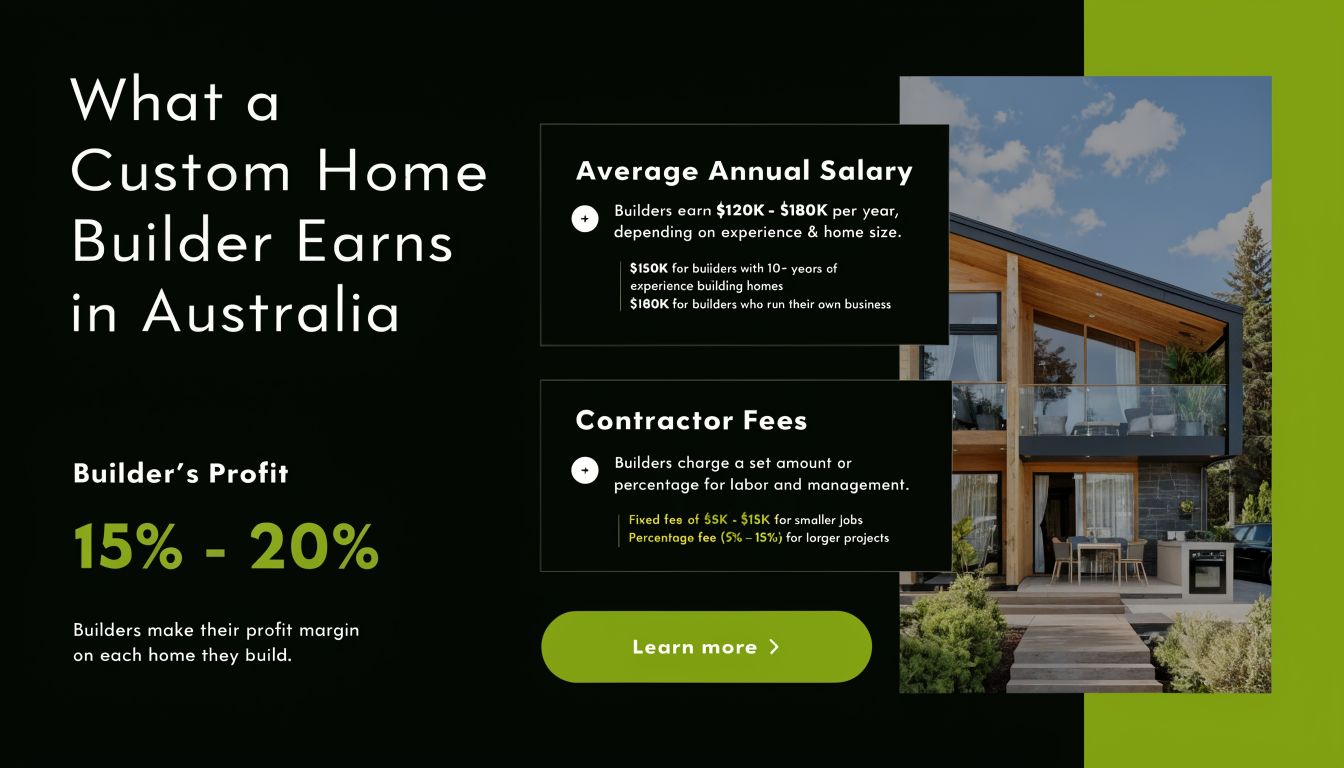
According to this salary benchmark for home-building adjacent roles, the closest Australian comparator is construction managers, with median weekly earnings of about A$2,477 in 2024, or roughly A$128,804 per year before tax. That's a useful anchor because custom building often bundles site coordination, estimating, subcontractor management, client communication, and compliance into one role.
Why this benchmark fits custom building
A boutique custom builder doesn't just watch a site. They usually sit across pre-construction planning, procurement timing, buildability decisions, budget pressure, and problem-solving once the job starts. That's much closer to a construction management function than a straightforward trade wage.
In practical terms, that benchmark tells you two important things.
- Custom building sits above a basic trades wage model. The work carries planning, risk, and coordination responsibility.
- The earning baseline reflects management value. The builder isn't only paid for labour. They're paid for judgement.
If you're comparing roles in the industry, it's also worth understanding where cost planning fits into the process. A quantity surveyor's role in residential building often intersects with builder estimating, but it doesn't replace the commercial and delivery responsibility the builder carries once the project moves from paper to site.
What changes in Adelaide
The national benchmark is only a starting point. Adelaide custom work can shift actual earnings up or down depending on project mix and business setup.
A builder focused on straightforward, repeatable work may have more predictable operations. A builder handling architecturally driven renovations, additions to existing homes, or difficult sites may justify stronger income because the management load is heavier. The trade-off is that these jobs also expose the business to more moving parts. Existing structure surprises, design revisions, staging around occupied homes, and sequencing constraints all put pressure on margins and management time.
Practical rule: In custom residential work, higher responsibility doesn't automatically mean easier money. It usually means more decision-making tied to the same build.
Salary benchmark versus lived reality
For employed professionals, the construction manager benchmark is a sensible reference point for what a strong custom-building role can command. For owners, it helps frame the value of their management labour, but it doesn't tell the full story of take-home income.
That's because owners don't live by payslip alone. Their compensation can be spread across wages, retained earnings, and distributions that arrive unevenly. That's where many readers get tripped up. They compare an employee salary to a business owner's turnover and assume both numbers mean the same thing. They don't.
Beyond the Payslip: Salary, Profit, and Owner Drawings Explained
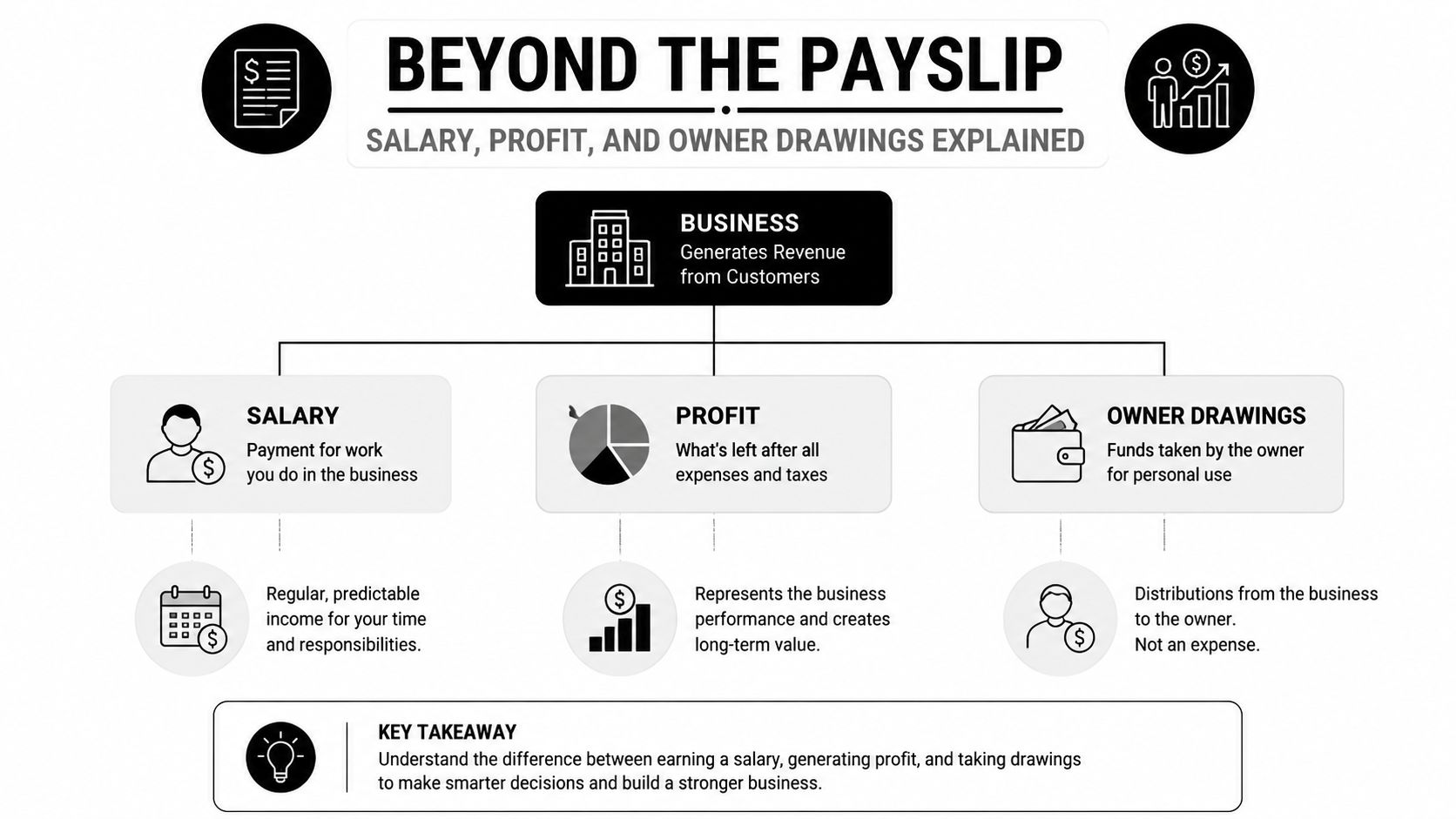
Most confusion around custom home builder salary starts when people use salary, profit, and drawings as if they're interchangeable. They aren't.
An employed site or project manager gets paid much like any other salaried professional. A builder who owns the company gets paid through the business, and that can happen in several ways. Some owners take a regular wage through payroll. Some rely more heavily on drawings. Some leave profit in the company for working capital and pay themselves conservatively until projects close cleanly.
Three common income models
Salaried builder or manager
This is the easiest model to understand. The person earns a wage or salary for their role, whether that's supervision, project management, estimating, or operations. Their income is relatively stable, and the business carries the commercial risk.
This model suits builders who want consistency, or businesses that separate ownership from day-to-day project delivery.
Owner with salary plus profit
This is common in established custom building companies. The owner pays themselves a base salary for the work they perform in the business, then may receive additional income from profit if the company performs well.
That distinction matters because salary compensates labour. Profit compensates business risk, capital commitment, and commercial performance.
Owner-operator relying on drawings
This is often the least understood model. Drawings are not the same thing as profit. They are amounts the owner takes out of the business, and they need to be handled carefully. If you want a plain-English explanation of the accounting difference, this guide on owner draws vs. loans is useful because it shows why cash taken from a business isn't automatically the same as earned income.
Why net profit doesn't equal take-home pay
According to this industry commentary on custom builder income structure, custom builders operate with 20.7% gross profit margins and 8.7% net profit margins in the benchmarking cited there. The same source also notes that owner income can diverge from net profit because owner salary may be treated as operational overhead rather than as a later distribution.
That changes how outsiders read the numbers. A building company might show a profit figure on paper, but that doesn't mean the owner pockets that amount. If the owner is doing project management, estimating, purchasing, and warranty work, some of their compensation may already sit inside overhead before net profit is even calculated.
| Income element | What it pays for | How it feels in practice |
|---|---|---|
| Salary | Labour performed in the business | Predictable, easier to budget personally |
| Profit distribution | Reward for business performance and risk | Irregular, tied to results |
| Owner drawings | Cash taken by the owner from the business | Flexible, but can be dangerous if disconnected from true profitability |
If a builder looks profitable but cash is thin, the owner may still be paying themselves carefully. Healthy margins on paper don't guarantee easy cash in the bank.
What clients should take from this
Clients often look at a builder's margin and assume it flows straight into the builder's pocket. It doesn't. In a boutique operation, the owner may be filling several roles that larger businesses spread across multiple staff members.
That means a realistic quote has to support more than visible site labour. It has to support management time, business overhead, warranty exposure, and enough retained strength for the builder to keep delivering when the project hits a rough patch.
Key Factors That Influence a Builder's Income
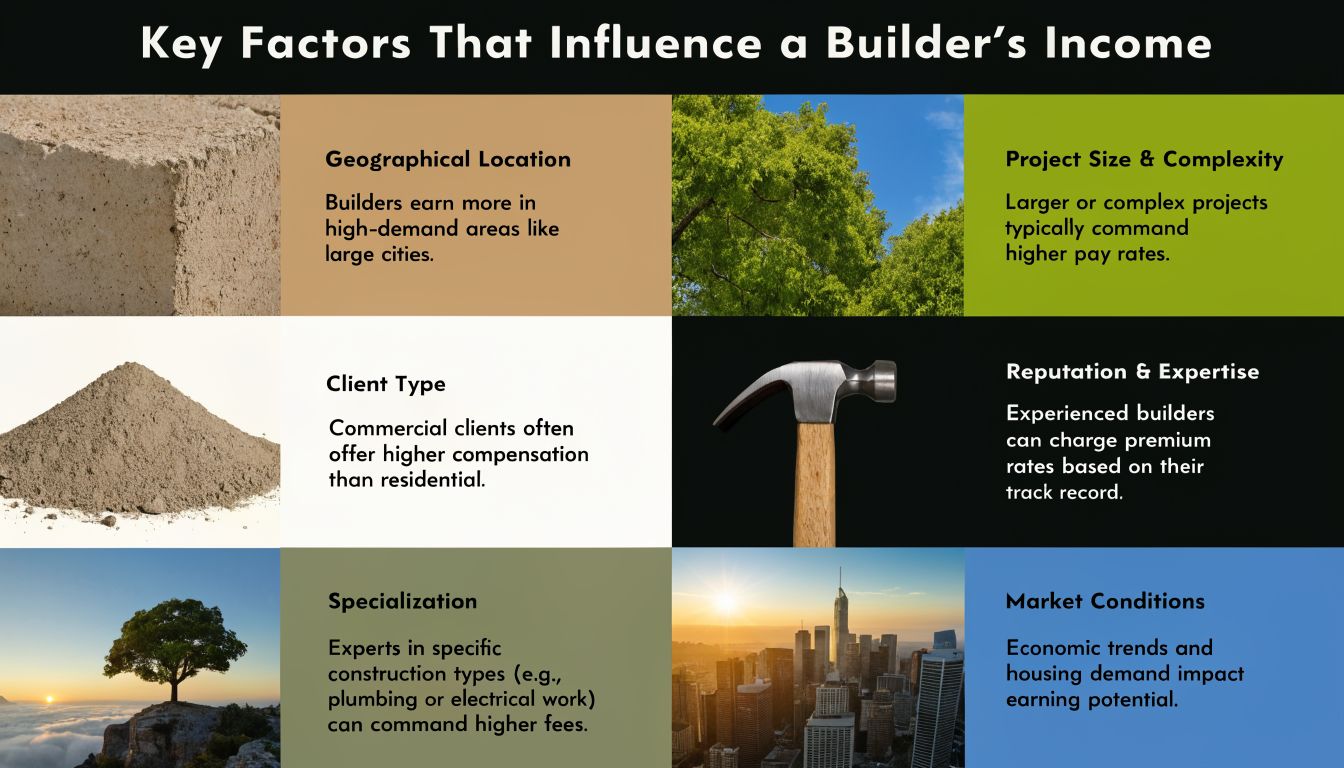
Two builders can work in the same city and produce very different income outcomes. The gap usually comes down to the type of work they take on, the way they run the business, and how well they control delivery.
Project complexity changes the pay equation
A clean new build on a simple site is one thing. A rear addition to an older home with limited access, live-in conditions, matching existing details, and consultant coordination is another.
Complex jobs usually demand more from the builder in areas that clients don't always see:
- Pre-construction input: buildability reviews, sequencing advice, scope clarification
- Site management: tighter staging, more trades overlap, more supervision
- Decision pressure: details need resolving quickly to avoid delays
- Client handling: occupied homes and bespoke selections usually mean more communication
That extra management load can support stronger income, but it can also consume more time than the original quote allowed if the job isn't scoped properly.
Business scale matters
A sole operator may keep overhead lower. A staffed builder carries more fixed cost but can usually offer broader supervision and better continuity.
Neither model is automatically better. The issue is fit.
| Business model | Income upside | Main trade-off |
|---|---|---|
| Solo operator | Leaner structure can preserve margin | Capacity can get stretched across jobs |
| Boutique team | More systems and coverage can support stronger delivery | Overhead has to be funded consistently |
Reputation and experience shape pricing power
Builders with a proven track record on difficult projects usually have more confidence in how they price risk. They've seen what poor documentation, unclear selections, and rushed decisions can do to a job. As a result, they tend to quote with more discipline.
Less experienced operators sometimes win work by being aggressive on price. That doesn't always mean they're efficient. Sometimes it means they've under-allowed for supervision, overhead, or problem-solving time.
The market rarely rewards the builder who guessed lowest. It rewards the one who can still finish well when the job becomes harder than expected.
Specialisation influences income quality
Specialisation isn't just a branding exercise. It changes how accurately a builder can estimate, sequence, and manage work.
A builder who repeatedly handles bespoke homes and detailed extensions will usually be better at pricing custom risk than someone trying to apply a volume-build mindset to one-off projects. That often leads to steadier income quality, not only higher headline income.
External conditions still bite
Even a well-run builder can't control every external pressure. Material lead times, subcontractor availability, approval delays, and changes in client selections all affect how smoothly income turns from estimate to real cash.
The better operators don't pretend these variables disappear. They build systems around them, protect scope clarity early, and avoid treating best-case assumptions as normal conditions.
How Builder Compensation Affects Your Project Quote
A project quote isn't just a tally of timber, tiles, and labour. It also has to support the business that will manage the work for the full life of the project.
That's the part many homeowners miss when they compare prices line by line. They can see the bathroom fittings. They can see the excavation allowance. They usually can't see the cost of project supervision, procurement time, office administration, insurances, warranty support, and the owner's need to keep the business healthy while the job runs.
Why timing matters as much as price
According to this breakdown of owner income timing in custom building, owner income often splits between a base salary and profit distributions tied to project completion milestones. That same source highlights a 27-month lag between operational expenditure and income recognition in the model described there.
For clients, the practical lesson isn't the exact accounting setup. It's the timing problem. Builders often spend money on labour, administration, equipment, subcontractor coordination, and operational overhead long before they can fully realise profit from completed work. If the business doesn't manage that timing well, pressure shows up on site.
What a sustainable quote usually includes
A sound quote generally needs to cover these categories:
- Direct construction costs: materials, labour, subcontract trades, equipment
- Project management effort: planning, ordering, supervision, meetings, problem-solving
- Business overhead: office support, compliance, systems, insurance, vehicles, admin
- Commercial buffer: enough margin for the builder to remain solvent and accountable
If you want a fuller sense of how residential pricing comes together, this guide on the cost to build a house in Adelaide gives helpful local context around what drives total project budgets.
Why the cheapest quote can become the expensive one
A low quote can come from genuine efficiency. It can also come from omission.
The warning signs are familiar in practice:
- Thin supervision allowances: the job is priced as if it will manage itself
- Optimistic programming: little room for approvals, selections, or coordination issues
- Weak overhead recovery: the business depends on cash from the next job to support the current one
- Underpriced complexity: bespoke details are treated like standard construction
A fair quote should leave enough room for the builder to stay organised, responsive, and financially calm through the hard parts of the job.
Payment schedules tell you a lot
Clients often focus on the contract sum and overlook the payment structure. That's a mistake.
A transparent milestone schedule usually shows that the builder has thought properly about cash flow through the life of the project. It spreads capital requirements across progress stages rather than relying on guesswork or distress. That's better for the builder and better for the client, because a financially stable builder is far more likely to maintain supervision quality and finish strongly.
Career Paths and Salary Progression in Custom Building
Individuals typically don't start in custom building as business owners. They come in through the trade side, move into supervision, and only later decide whether they want the commercial responsibility that comes with running projects and a company.
A typical path looks less like a neat ladder and more like a widening circle of responsibility. Early on, you're judged on workmanship and reliability. Later, you're judged on whether you can run trades, read drawings accurately, manage clients, and protect margin without sacrificing quality.
A realistic progression
Take a carpenter who becomes the person everyone trusts to solve site problems. They start coordinating small sections of work. Then they supervise a whole stage. Then they carry programme pressure, subcontractor relationships, and client communication. At that point, they're no longer only trading labour. They're building management value.
Once they step into ownership, the game changes again. Income is no longer just about what they can earn in a week. It's tied to whether the business prices accurately, delivers cleanly, and keeps enough cash inside the company to survive uneven project cycles.
According to this commentary on custom builder financial performance, single-family builders averaged 20.7% gross profit margin and 8.7% net profit margin in 2023, with net margin rising from 7.0% in 2020 to 8.7% in 2023. The practical takeaway is that owner income is linked to business performance, not just wages.
Typical income progression in custom home building Adelaide
Because compensation structures vary so widely, the table below is best read as a model of progression rather than a fixed wage card.
| Role | Experience Level | Typical Annual Income Range (AUD) | Primary Compensation Type |
|---|---|---|---|
| Trade-based builder or leading hand | Early career to developing supervisor | Varies by employer, trade background, and responsibilities | Wages or salary |
| Site supervisor | Developing to established | Often benchmarked qualitatively against management-level residential roles | Salary |
| Project manager in custom residential | Established | Often aligns more closely with higher-responsibility management earnings than basic site wages | Salary, sometimes performance-linked |
| Business owner or director | Established operator | Variable, tied to salary, owner drawings, and profit distributions | Salary plus drawings and/or profit |
For readers considering the ownership path, reviewing portfolios of best custom home builders in Adelaide is useful not just for design ideas but for understanding how mature operators present their systems, project types, and market position.
What changes when ownership begins
Ownership offers more upside, but it also exposes every weakness in the business.
- Margin discipline matters more: underpricing one complex job can wipe out the gain from another.
- Cash-flow judgement becomes critical: being busy isn't the same as being financially secure.
- Delivery systems decide income quality: the owner who constantly firefights usually earns less cleanly than the owner with strong pre-construction and supervision processes.
The jump from employee to owner isn't just a pay rise. It's a shift from earning for labour to earning for labour, risk, systems, and capital management.
Common Questions About Builder Salaries
Do builders earn more on new homes or renovations
Not automatically. Renovations and extensions can carry more management intensity because the builder has to deal with existing conditions, access limits, staging, and hidden surprises. New homes can be cleaner to programme, but bespoke homes still demand high coordination. The better question is which type of work the builder prices and manages well.
Is company profit the same as the builder's personal salary
No. Profit belongs to the business until it's distributed appropriately. A builder may also draw a salary for the work they perform inside the company. That's why a business can appear profitable while the owner's personal take-home remains conservative.
Should clients worry if a quote includes margin for management and overhead
They should worry when it doesn't. A builder who can't recover supervision and overhead properly is more likely to struggle later in the project. Sustainable pricing usually supports better communication, steadier site control, and lower risk of shortcuts.
How can you tell if a builder's compensation model is healthy
Look for clear scope, transparent allowances, sensible staging, and a payment schedule that matches progress. Ask who will supervise the job, how often they'll be on site, and how variations are handled. Healthy builders usually answer those questions directly because they've already built the systems behind them.
If you're planning a renovation, extension, or bespoke home in Adelaide and want a builder who understands both the design side and the commercial realities behind a successful project, Templeton Built is worth a closer look. Their team brings together in-house design, practical construction knowledge, and the kind of transparent project thinking that helps clients make better decisions from the start.


Leave a Reply