

Custom Home Builder vs General Contractor: 2026 Guide
You're standing in the driveway with a sketch in one hand and two very different quotes in the other. One person is talking about design meetings, selections, approvals and trade sequencing. The other is talking about getting the work done against an existing plan. If you're building in Adelaide, that choice isn't really about a label. It's about scope, design intensity, risk allocation, and who carries the project from concept to completion.
| Criterion | Custom Home Builder | General Contractor |
|---|---|---|
| Best fit | Bespoke new homes, complex additions, highly specified builds | Renovations, extensions, defined-scope site work |
| Design input | Often involved early, helps shape the brief | Usually works from existing plans or a set scope |
| Trade coordination | Coordinates design, estimating, selections and trades end to end | Manages subcontractors and sequencing against the agreed works |
| Cost structure | Better aligned with integrated estimating and fixed-price new builds | Often suits work where scope is already clear, especially remodels |
| Risk profile | Better for projects where scope clarity is built in early | Better when the job is already defined, but changes can still bite |
What Each Role Actually Does on an Adelaide Project
You've probably heard both titles used in the same conversation, sometimes by people who mean very different things. In Adelaide, the practical split usually comes down to who is driving the whole delivery model, not who holds the loudest opinion about the build.
A custom home builder is the party best suited to take a highly specific brief and turn it into a finished home. That usually means dealing with design decisions, pricing, sequencing, trade coordination and the handover from concept through to construction. If you want a clearer primer on that model, Templeton Built's explanation of a custom home builder is a useful starting point.
A general contractor is more often the coordinator of a defined scope. They line up trades, manage the programme and deliver the works against plans that already exist, which makes them a natural fit for renovations and extensions where the job is already understood. The difference is less about “who builds” and more about who owns the coordination burden.
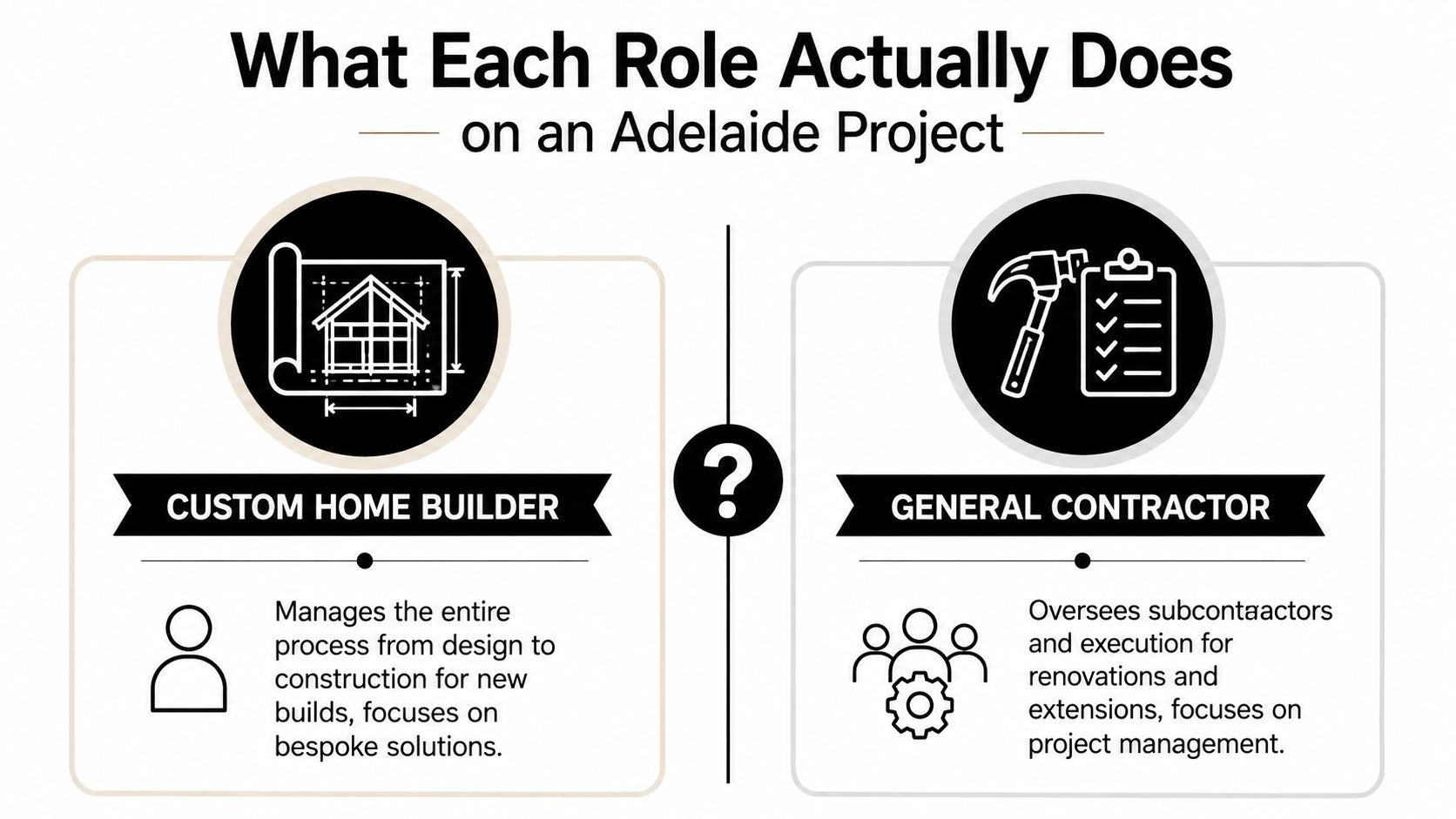
The practical split on site
In real terms, the custom builder is usually closer to the client's brief, especially when the design is still being refined. The general contractor tends to come in when the scope is already set and the job is about execution, not rethinking the whole solution.
Practical rule: if you need someone to help shape the build, cost it properly and keep the moving parts aligned, you're looking at a custom builder model.
That distinction matters because Adelaide projects rarely fail on “who can swing a hammer”. They fail when the wrong person is asked to carry the wrong kind of risk. If approvals, selections and detailing are still in flux, a builder who only wants a tidy construction package is the wrong fit.
Side by Side Comparison of Capabilities and Risk
A lot of comparison articles flatten this into “new build versus renovation”. That misses the core decision. In Adelaide, the better lens is whether the job needs design collaboration, trade orchestration, and active scope control from day one. That is the delivery-model question.
| Criterion | Custom Builder | General Contractor |
|---|---|---|
| Scope suitability | Strong for bespoke homes and heavily tailored work | Strong for clearly defined renovations and extensions |
| Design involvement | Often involved earlier, sometimes from concept | Usually enters after design is already settled |
| Trade management depth | Coordinates a wider chain of decisions and trades | Manages subcontractors against a tighter defined scope |
| Cost certainty | Often stronger when the brief is locked early | Can be efficient when scope is stable, but changes can move quickly |
| Risk allocation | Better when one party carries the integrated delivery risk | Better when the homeowner already has a clear scope and accepts some change management |
The reason this split exists is structural, not cosmetic. Housing sector reporting shows residential builders rely heavily on subcontracting, with builders using an average of 24 subcontractors per new home and subcontracting about 84% of construction costs in a typical home, which is why coordination skill matters so much on a custom build model NAHB study. The Housing Industry Association also points to the scale of the residential building sector in Australia, which underlines how trade-heavy and commercially exposed this work really is.
On Adelaide sites, that translates into a simple question. Who can carry the coordination load without turning every unresolved detail into a variation?
If you already have a full set of documents and a plain-vanilla scope, a general contractor can be efficient. If the project still needs design decisions, feasibility checks and sequencing discipline, a custom builder is usually the safer call. For projects that need that earlier integration, Templeton Built's design-build construction process shows the kind of coordination layer that reduces friction before site work gets complicated. The wrong match affects more than price, it affects how much rework, delay and stress you carry through the build.
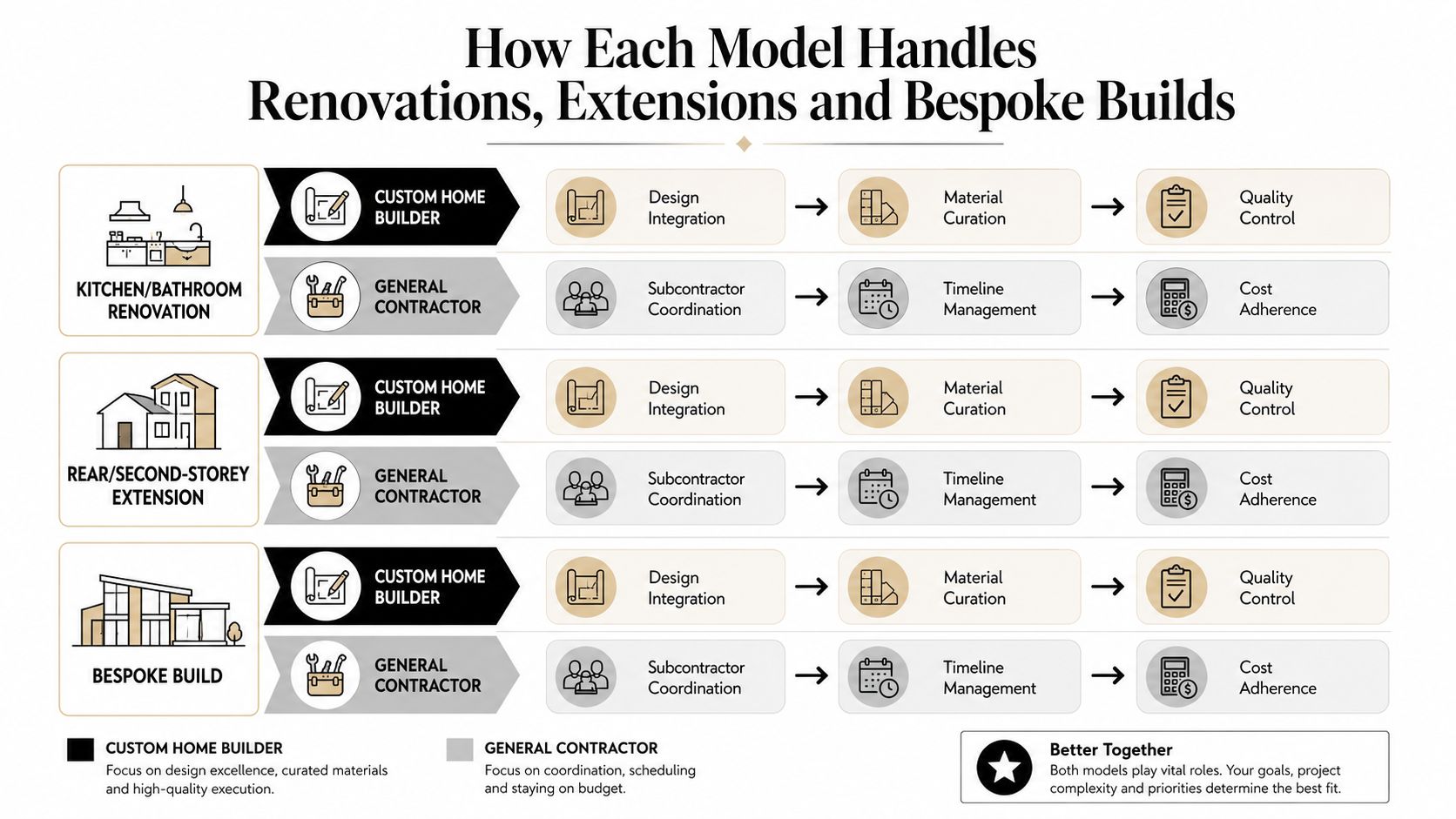
How Each Model Handles Renovations, Extensions and Bespoke Builds
A kitchen overhaul, a rear extension and a ground-up custom home all look like “building work” from the footpath. They are not the same job behind the scenes. The delivery model changes how early decisions get made, where the unknowns sit, and who feels the pain when the scope shifts.
Renovations need tight scope control
For a kitchen or bathroom renovation, a general contractor can be efficient when the work is straightforward and the design is already settled. The key is that the room is usually constrained by existing services, existing structure and existing finishes, so the job is about orderly execution more than reinventing the whole house.
A custom builder starts to make more sense when the renovation is not just cosmetic. If the layout changes, structural work appears, or selections need active coordination, the project moves beyond simple contracting and into integrated delivery. That's where a builder who can manage design input and trade sequencing can reduce handoff friction.
Extensions expose the weak points fast
Rear additions and second-storey work are where assumptions get tested. You're not just adding area, you're tying new work into old work, and old houses love to hide surprises. In that setting, the right model is the one that can manage interfaces, not just labour.
What I've seen on Adelaide sites: the extension that looks cheap at quote stage often gets expensive when nobody has properly priced the joins, the services tie-ins and the finish transitions.
A general contractor can handle this well if the scope is fully documented and the trade sequence is tight. A custom builder is often the better fit when the extension needs more design thinking, because the builder can keep the build logic aligned with the client brief instead of treating the drawings as the end of the conversation.
Bespoke homes need the integrated model
A fully custom home is where the difference is clearest. The project demands more than supervision, it demands a party that can coordinate design, selections, cost control and trades as one system. That is why the custom builder model is structurally more aligned with bespoke homes than a straight contractor arrangement.
The broader market logic supports that view. In comparable housing statistics, custom homes accounted for 20.2% of U.S. single-family homes started in 2019, up from 19.5% in 2018, while homes built for sale fell to 75.4% and homes built for rent were tracked separately at 4.4% custom-home share trend. It's not an Australian dataset, but it shows the same direction of travel, the more customised the brief, the more important integrated coordination becomes.
Contracts, Insurance and Licensing That Change Your Exposure
The biggest mistake homeowners make is treating the contract as paperwork after the decision has been made. It isn't. The contract decides who carries the variation risk, how money moves during the build, and how exposed you are if the scope drifts.
A fixed-price building contract usually suits a job where the scope is properly defined. That gives you a clearer baseline, but only if the drawings, selections and inclusions are nailed down. A cost-plus or construction-management style arrangement gives more flexibility, but it also puts more cost movement back on the owner if the scope changes. For a design-and-construct style project, the value is in getting the scope right before pricing hardens.
That's why financing and progress claims matter so much. If the scope is loose, lender drawdowns and variation claims can become messy quickly. If the scope is tight, a builder can price and sequence the work with less churn, which is exactly why an upfront feasibility process matters so much in Adelaide.
South Australian homeowners also need to pay attention to licensing, insurance and warranty obligations. The party signing the head contract should be the one you expect to carry the build responsibility, because that's where your exposure sits when problems appear. If you want a practical overview of insurance questions, Templeton Built's building insurance guide is the kind of reference worth reading before you sign anything.
What to ask before you commit
- Who holds the contract: the person you're paying should be the person accountable for delivery.
- How variations are priced: get the process in writing before the first change request appears.
- Who supervises daily: sales talk is irrelevant if site supervision is weak.
- What is excluded: the cheapest quote is often the one that left the most out.
- Which insurances apply: don't assume the builder has every cover you need just because they sound organised.
If the person quoting can't explain the contract structure in plain English, they probably haven't thought through the project properly either.
Real Adelaide Scenarios That Reshape the Cost Conversation
The price debate gets ugly when people compare quotes without comparing the job underneath. A heritage extension in a tight inner suburb and a knock-down-rebuild on a clean block do not behave the same way, even if the floor area looks similar on paper.
In a heritage cottage extension, the risk sits in the unknowns. Existing structure, tie-ins, site access and approval sensitivities make the project more design-heavy and more likely to need careful sequencing. In that sort of job, a custom builder can sometimes deliver better cost certainty because the scope is interrogated earlier, even if the headline number looks higher at first glance. A cheaper general contractor quote can look attractive until the variations start landing.
For a modern knock-down-rebuild on a flat block, the calculation changes. The site is cleaner, the scope is more repeatable, and the delivery can be more efficient if the design is already settled. In that situation, a general contractor or a builder working to a very tight construction package can be the right commercial move.
The bigger Adelaide issue is that housing delivery is under pressure. Recent Australian data shows housing starts and completions remain below national policy targets, with the pipeline constrained by planning delays, labour shortages and affordability pressure, which is exactly why project capability and sequencing matter more than the label alone consumer guidance on choosing a builder. In infill suburbs, that pressure shows up as slower approvals, tighter sites and more coordination with consultants and certifiers.
Two jobs, two very different risk profiles
A heritage renovation often rewards the team that can identify problems early and price the unknowns transparently. A modern rebuild rewards the team that can keep the programme lean without turning every decision into a dispute.
That is also why a custom builder on a well-defined extension can be the better cost decision overall. A quote that looks cheaper at the start isn't cheaper if it leaves the details unresolved. On the flip side, a highly controlled rebuild can be wasted on a delivery model that adds unnecessary design overhead.
Templeton Built sits in the integrated side of the market, with in-house design and construction services across renovations, extensions and custom homes. That matters because the right delivery model on an Adelaide project is often the one that can hold design, pricing and sequencing together without passing problems between separate firms.
Which One to Choose for Your Specific Project
Start with the brief, not the title. If your project still needs design development, planning strategy or feasibility work, a custom home builder is usually the better fit. If the scope is already mapped and the job is mainly about orderly site delivery, a general contractor can be the leaner choice.
Use this rule set.
- Choose a custom home builder if: the project is bespoke, the layout is still fluid, or the site has constraints that will affect design and cost together.
- Choose a general contractor if: you already have a clear set of plans, the scope is relatively contained, and you want efficient execution.
- Choose a custom builder for extensions if: the job needs design input to solve structure, services or finish transitions.
- Choose a contractor for straightforward renovations if: the room works are simple and the risk sits mostly in labour and sequencing.
- Choose the integrated model if: approvals, selections and trade coordination are all moving at once.
The counter-intuitive cases matter. A small renovation can be better handled by a custom builder if the design is doing most of the heavy lifting. A complex bespoke home can sometimes work with a trade-led contractor model if the design package is exceptionally complete and the homeowner is comfortable carrying more coordination risk. The deciding factor is not size, it's how much unresolved decision-making the project still contains.
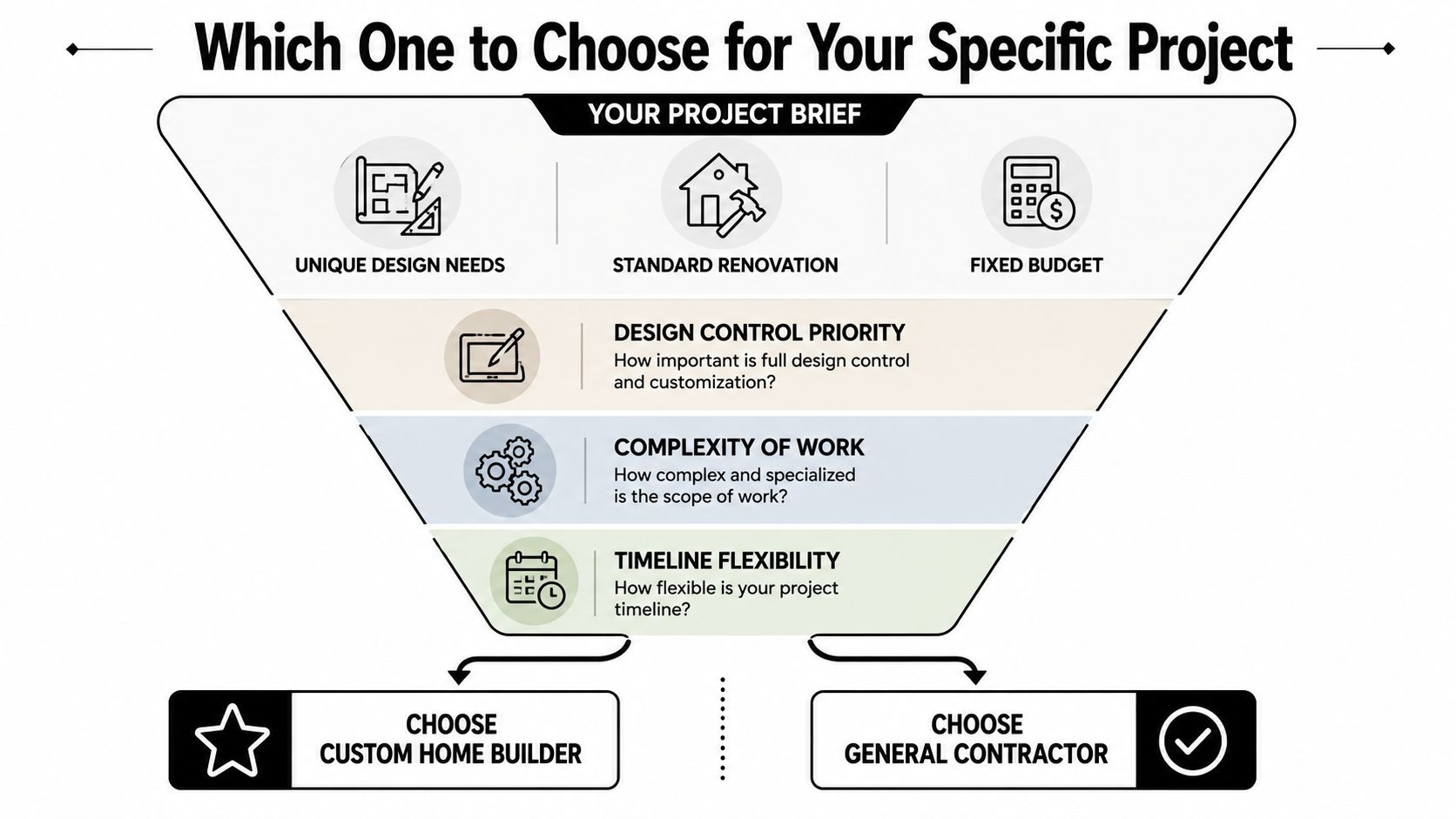
Best-fit rule: if the project will change a lot once you start pricing it, choose the person who is equipped to manage that change, not the one who simply sounds cheaper today.
Questions to Ask and a Hiring Checklist You Can Take to the First Meeting
The first meeting should tell you how the project will be run. Price matters, but delivery capability matters more. You want direct answers, not polished generalities.
Ask these questions in order.
- Who will supervise the job day to day? You need the name of the person who will be on the hook when trades turn up and details change.
- How do you handle variations? A clear variation process protects both sides.
- Who manages selections and approvals? If that work is being pushed back to you without warning, expect friction later.
- What contract structure do you recommend, and why? The answer should match your scope, not their preference.
- How do you handle defects at handover? A proper closeout process matters more than a cheerful promise.
Then check the basics before you go further.
- Licensing: confirm the builder or contractor is properly licensed for the work.
- Insurance: ask what cover applies to the project and get it in writing.
- References: speak to recent clients with similar project types.
- Contract type: fixed-price, cost-plus or another model should be clearly explained.
- Scope detail: inclusions, exclusions and allowances need to be explicit.
- Warranty terms: know what happens after handover if something needs attention.
If you want a shortlist of who can take a project from concept through delivery, Templeton Built is one Adelaide option that offers in-house design and construction across renovations, extensions and custom homes. Don't buy the sales pitch first. Get the answers, compare the delivery model, and choose the team that can carry the risk your project creates.
If you're weighing up a renovation, extension or bespoke home in Adelaide, talk to a builder who can explain the delivery model before they talk about finishes. Templeton Built works across design, pricing and construction on custom homes, extensions and renovations, so you can get a clearer read on scope, risk and sequencing before you commit.


Leave a Reply