

Expert Custom Home Builders Adelaide | Your Guide to a Perfect Home
Building your own home from the ground up is a massive undertaking—likely one of the biggest investments you'll ever make, both financially and emotionally. That's why picking the right team from the pool of custom home builders Adelaide has available is the most important decision you'll face. It sets the tone for the entire project and directly impacts the final quality, cost, and your overall stress levels.
Why Your Adelaide Custom Home Journey Starts Here
A custom build is your chance to craft a home that genuinely fits your life. It’s not about settling for someone else's idea of a perfect layout. Whether you're dreaming of a sprawling family home nestled in the Adelaide Hills or a sharp, modern retreat closer to the coast, this guide is your roadmap. Think of it as a practical chat, designed to cut through the industry jargon and give you the confidence to move forward.
The local market for bespoke homes in Adelaide is buzzing with potential. We often see national trends play out locally, and a recent Housing 100 report noted a significant 11% rise in home construction right across Australia. That translated to 64,407 homes delivered in the 2024/25 period. While the report didn't single out Adelaide, this national growth points to a healthy, expanding industry, which is great news for you—it means more choice and plenty of skilled builders.
Understanding The Path Ahead
Before you get lost in tile samples and tapware catalogues, it's crucial to get your head around the entire process. A well-planned project is a smooth project, saving you a lot of headaches and unexpected costs later on.
Your journey will generally follow a few key phases:
- Vision and Budget: This is where it all begins. You need to clearly define what you want to build and, just as importantly, what you can realistically afford.
- Finding Your Builder: The big one. This involves a lot of research, interviews, and background checks to find a partner you genuinely click with and trust.
- Design and Approvals: Working with architects or designers to get your vision onto paper and then navigating the local council approval process.
- Construction: The exciting part! You'll watch your home take shape, from the first slab pour to the final coat of paint.
To get the ball rolling, it's worth taking a moment to answer some foundational questions. Thinking through these points now will make your conversations with potential builders much more productive.
Key Questions for Your Adelaide Custom Build
A quick look at the essential factors to consider before you begin your search for a local builder.
| Factor | Key Questions to Ask Yourself | Why It's Important |
|---|---|---|
| Budget | What is my absolute maximum spend? Have I factored in a contingency fund (10-15%) for unexpected costs? | A realistic budget from day one prevents financial strain and helps your builder provide accurate quotes and design options. |
| Location | Do I own land already? What are the specific challenges of my block (e.g., slope, soil type, access)? | The site heavily influences design possibilities, council regulations, and overall construction costs. |
| Vision | What is my "must-have" list vs. my "nice-to-have" list? What architectural style do I love? | Clarity on your non-negotiables ensures the final design meets your core needs and reflects your personal taste. |
| Timeline | Is there a hard deadline I need to meet? How flexible can I be if delays occur? | Understanding your timeline helps set realistic expectations with your builder for the entire construction schedule. |
Answering these questions honestly gives you a solid foundation to start from. It equips you with the clarity needed to find a builder who can truly bring your vision to life.
A successful build is built on a foundation of clear communication, mutual trust, and a shared vision between you and your builder. It’s a partnership, not just a transaction.
We'll dive into each of these stages in more detail throughout this guide. If you want to get a feel for how a structured timeline works in practice, you can explore our detailed custom home building process. This framework is designed to make sure nothing gets missed, turning your unique vision into a home you'll love for years to come.
Getting to Grips with the Real Cost of a Custom Build
When you start dreaming about a new home, the first question that almost always pops up is: "How much is this actually going to cost?" It's tempting to look for a simple price per square metre, but the truth is, that's just scratching the surface. The final figure you'll see from custom home builders in Adelaide is a tapestry woven from dozens of different threads.
Getting your head around this early on is the best way to avoid nasty surprises later. The cost isn't just about how big the house is; it's about the complexity of the design, the quality of the materials you choose, and the unique quirks of your block of land.
It's More Than Just a Base Price
People often use average construction costs as a starting point. Right now in Adelaide, you might see figures ranging anywhere from $1,960 to over $3,800 per square metre. That's a huge spread, and it really drives home how much your personal choices can influence the bottom line, whether you're building a practical family home or a high-end architectural masterpiece.
But those numbers are just one part of a much bigger equation. They usually cover the physical structure—the "sticks and bricks"—but often leave out a whole host of other essential expenses. A realistic budget has to capture everything, from the first scribble on a napkin to the very last plant in the garden.
So, what are the big things that push the price up or down?
- Architectural Complexity: A straightforward, rectangular home is always going to be cheaper to build than a design with intricate angles, sweeping curves, and a complex roofline. Every extra corner costs money.
- The Land Itself: A sloping block in the Adelaide Hills, for example, will come with hefty extra costs for excavation, retaining walls, and specialised foundations. That’s a world away from building on a perfectly flat lot in a new estate.
- Your Finishes and Fittings: This is where the budget can really blow out. The gap between standard laminate benchtops and imported Italian marble is massive. The same goes for tapware, tiles, flooring—you name it. These choices can easily add tens, or even hundreds, of thousands to the total.
Uncovering the So-Called "Hidden" Costs
Where a lot of first-time builders get caught out is with the costs that aren't spelled out in the initial building contract. A truly comprehensive budget needs to be all-encompassing.
A builder's quote will cover the construction of the house itself. But the 'all-in' cost needs to include everything else required to turn that house into a liveable home on your specific piece of land.
Think about it this way. A quote for a home in a new subdivision looks pretty clean. But what if your project involves knocking down an old house first? Or what about council fees and the cost of hooking up to power and water? These are almost always separate, and they need to be in your budget.
For a deeper dive, our guide on the cost to build a house in Adelaide breaks all of this down in much more detail.
Make sure your financial plan has room for these crucial items:
- Design and Engineering Fees: This covers your architect, draftsperson, and structural engineer.
- Council and Approval Fees: The costs for lodging your Development Application (DA) and getting all the necessary permits.
- Site Work: Think soil tests, land surveying, demolition, and any major earthworks.
- External Works: This is your driveway, paths, fencing, and all the landscaping.
- Utility Connections: The fees charged to connect your new home to the electricity, water, gas, and sewer grids.
By factoring these expenses into your budget from day one, you build a financial plan that's grounded in reality. It’s the best way to make sure the home you've been dreaming of is one you can comfortably afford.
How to Find and Vet Adelaide's Best Builders
Choosing the right builder is easily the most critical decision you'll make when building a custom home. It's the difference between a smooth, exciting journey and one plagued by budget blowouts, frustrating delays, and constant stress.
Finding the best custom home builders Adelaide has to offer means going beyond a quick Google search. You have to be a bit of a detective.
A great way to start is by looking at who's winning local industry awards. Accolades from respected bodies like the HIA (Housing Industry Association) or Master Builders South Australia are a solid sign of quality craftsmanship and a good reputation among their peers.
Don't forget to tap into your professional network. Architects, building designers, and even real estate agents often have a go-to list of builders they trust and have seen deliver exceptional results time and time again.
The Initial Vetting Process
Once you've put together a shortlist of three to five potential builders, it’s time to do some homework. This is where you can start to separate the seasoned professionals from the pack before you even pick up the phone.
Your first checks are straightforward but absolutely essential:
- Licence and Insurance: Is their builder's licence current and valid in South Australia? It’s a non-negotiable. You also need to see proof of their public liability and builder’s warranty insurance.
- Portfolio Deep Dive: Spend some real time on their website and social media. Are they building homes that match the style and scale you're dreaming of? If you're planning a complex build on a sloping block in the Adelaide Hills, you want to see that they've done it before, and done it well.
- Reading Between the Lines: Go through online reviews and testimonials, but be discerning. A string of flawless five-star reviews can be just as telling as a few negative ones. Look for consistent themes in what past clients are saying, both good and bad.
Meeting Your Potential Partners
With your list narrowed down, it’s time for face-to-face meetings. This is as much about checking their expertise as it is about seeing if you actually click. You’re going to be in a close working relationship for at least a year, so personal rapport matters. A lot.
Come prepared with a list of questions that dig deeper than "how much will it cost?". A truly professional builder will welcome this, seeing it as a chance to demonstrate their transparency and process. We’ve actually put together a comprehensive guide on how to choose a builder that includes a checklist of must-ask questions.
Don't be shy about getting into the details. Ask about their relationships with their trades, the project management software they use, and how they’ve handled unexpected issues on past projects. A confident, open answer is a very good sign.
One of the most valuable things you can do at this stage is to see their work in person. Ask to visit a site that’s currently under construction. A clean, organised site says a lot about a builder's standards.
Then, ask if you can see a finished home that’s a few years old. This is the real test. It shows you how their craftsmanship stands up to the test of time, giving you a true picture of the quality you can expect.
Navigating the Design and Approval Process
Once you’ve found the right builder, the really exciting part begins: turning all those ideas in your head into a tangible set of blueprints. This isn't just about drawing lines on a page; it's a truly collaborative process where your vision meets the designer's creativity and the builder's practical know-how.
This phase is all about detailed conversations. You’ll work together to refine everything, from the big-picture floor plan right down to the smallest interior details. Your builder is there to help translate your family's daily rhythm into a functional layout, making sure the flow between rooms feels completely natural.
As you start to think about the aesthetics, you'll be making all sorts of choices. For anyone drawn to a clean, elegant style, exploring resources on Italian contemporary interior design principles can provide some fantastic inspiration.
From Concept to Construction Drawings
The design journey always moves from broad strokes to fine details. It kicks off with preliminary sketches, and as you make more decisions, the plans get layered with more and more specific information.
Think of it as a step-by-step refinement:
- Finalising the Floor Plan: This is where you lock in the layout, the exact dimensions of each room, and where the windows will go to make the most of the natural light and any views.
- Selecting Materials and Finishes: Now for the fun stuff! You’ll be choosing everything from the external cladding and roofing material to the internal fixtures, flooring, and custom joinery.
- Engineering and Compliance: Behind the scenes, structural engineers get involved to ensure the design is not only beautiful but also structurally sound and compliant with all the necessary building codes.
The end result of all this work is a complete set of construction-ready drawings. This isn't just a guide for the build; it’s the essential documentation needed for the next big hurdle: getting council approval. A good builder makes sure these plans are watertight to avoid any frustrating delays.
Your final approved plans become the single source of truth for the entire project. When the drawings are clear and detailed, there’s no room for guesswork. It minimises the risk of expensive variations and ensures everyone, from the carpenters to the electricians, is working towards the very same goal.
Understanding the Adelaide Council Approval Maze
Before a single shovel hits the dirt, your project needs the green light from the local council. Here in South Australia, that means lodging a Development Application (DA). This is a formal request for consent to build, and it’s where having one of the best custom home builders Adelaide has to offer really pays off.
An experienced local builder knows the ins and outs of the various Adelaide councils, from the Adelaide Hills to coastal spots like Glenelg. They can often anticipate potential roadblocks, whether it’s dealing with a heritage overlay, addressing potential concerns from neighbours, or meeting specific zoning rules.
This local knowledge is critical. Building approval trends can fluctuate, and a builder who stays on top of the latest regulations can navigate the system much more effectively, giving your application the best possible chance of a smooth run.
Bringing the Blueprint to Life: The Construction Phase
This is the moment everything gets real. After all the planning, paperwork, and site prep, the construction phase is where you finally see your dream home rise from the ground. It's an exciting time, and understanding the process helps you appreciate every milestone.
The journey kicks off with the groundwork. First comes the excavation and laying of all the essential in-ground plumbing and services. Then, the foundation or slab is poured—a critical step that provides the solid base for your entire home. It won’t be long before the wall frames and roof trusses go up, giving you the first exhilarating glimpse of your home's true scale and shape.
Hitting the Major Milestones
A well-organised build moves through distinct stages, with specific tasks and inspections at each point. A quality builder will keep you in the loop as they tick off each phase, so you always know what’s happening on-site.
This infographic breaks down the typical flow, from getting the structure up to adding those all-important final touches.
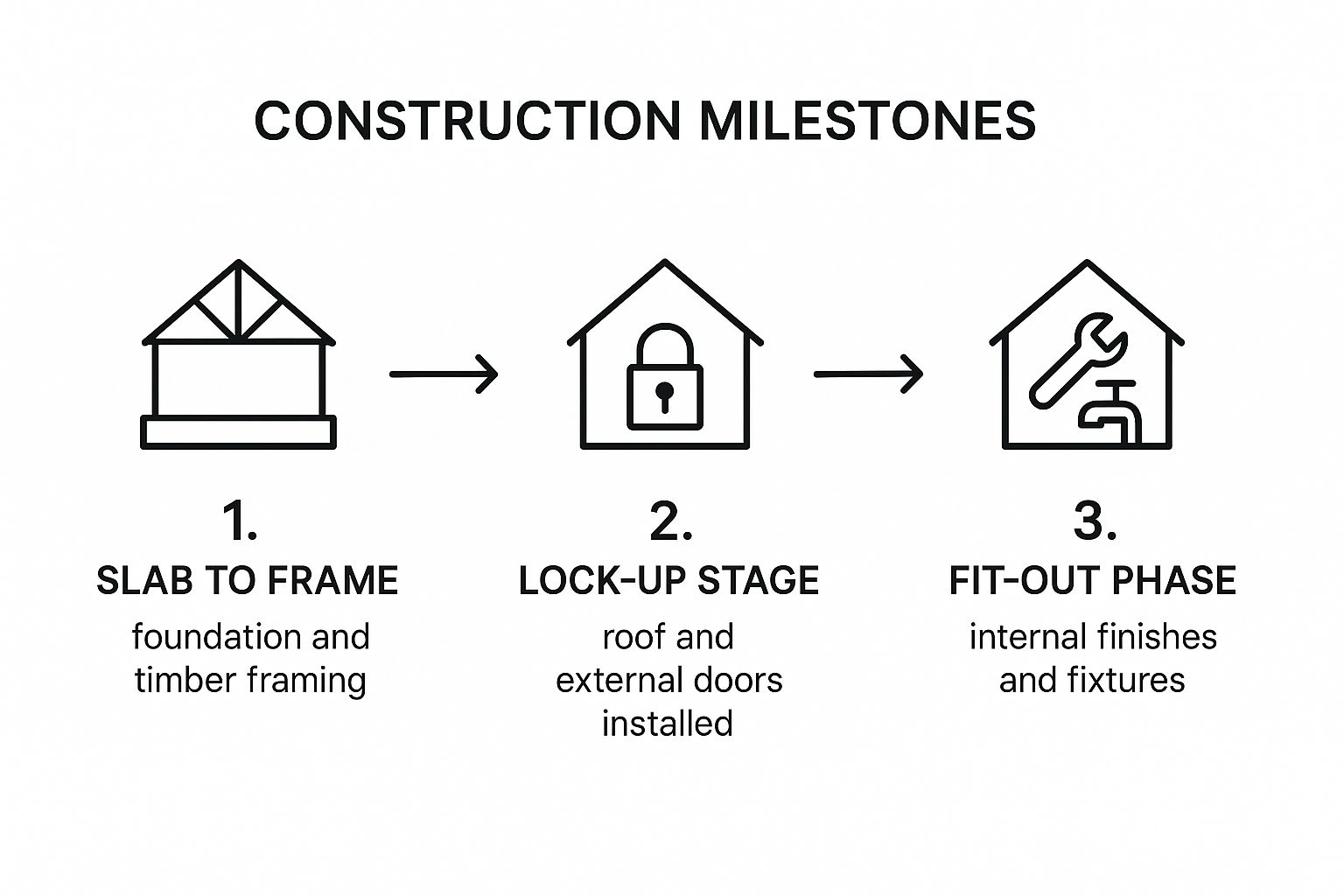
As you can see, it's a logical progression. The first goal is to create a weatherproof shell, and then all the focus shifts to meticulously finishing the internal spaces where you'll actually live.
One of the biggest moments is reaching the lock-up stage. This is when your home is fully secure and weatherproof. The roof is on, the external cladding is complete, and the windows and temporary external doors are all installed. From here, all the action moves inside.
Staying in the Loop: Communication and Site Visits
Keeping the lines of communication open with your site manager is absolutely vital. They are your go-to person for day-to-day updates and for answering any questions you have along the way. Regular check-ins—whether it’s a quick call, an email, or a scheduled site walk-through—are key to preventing misunderstandings.
Just remember, when you do visit, it's an active construction zone. Safety first.
- Book It In: Never just drop by. Always arrange a time with your site manager to make sure it’s safe for you to be on-site.
- Gear Up: At a minimum, you'll need sturdy, closed-toe shoes. Your builder will supply a hard hat and any other required safety gear.
- Keep Your Eyes Open: Be aware of your surroundings. There will be tools, materials, and uneven ground everywhere.
Think of it this way: open dialogue and planned site visits make you an informed partner, not just a spectator. A strong relationship with your site manager is the secret to a smooth build where everyone is on the same page.
What happens if you have a last-minute change of heart? That’s what we call a variation. It could be something small, like moving a power point, or something bigger, like changing your mind on the bathroom tiles. The important thing to know is that variations often affect both the budget and the timeline.
Before any changes are made, have a proper chat with your builder. They’ll provide a formal variation document that details the new costs and any schedule adjustments. You approve it, and only then does the work proceed. The best custom home builders in Adelaide will have a crystal-clear process for handling these requests.
Your Final Walkthrough and Handover Checklist
The final handover is the moment your vision becomes your reality. But before you pop the champagne, there’s one last crucial step: the Practical Completion Inspection (PCI). This is your official walkthrough with the builder to meticulously identify and document any final defects or incomplete items.
Don't be shy during this inspection. This is your chance to go over every detail with a fine-toothed comb and ensure the quality you paid for has been delivered. A good builder will expect and encourage this level of scrutiny.
Your Inspection Hit List
Arrive prepared. Bring a notepad, a pen, and your phone for taking photos of anything you spot. It's best to move through the house systematically, room by room, testing every single component.
Here are a few things to keep a close eye on:
- Paint and Plaster: Scan the walls and ceilings for any paint drips, uneven finishes, patchy areas, or scuff marks. Check where walls meet cornices and skirting boards for clean lines.
- Fixtures and Fittings: This is where you test everything. Turn every tap on and off (check hot and cold), flick every light switch, and test every power point.
- Joinery: Open and close every single door, drawer, and cupboard in your kitchen, bathrooms, and wardrobes. Make sure they align properly and that handles are secure.
- Flooring: Carefully inspect tiles for chips or cracks and check the grout for any gaps or imperfections. On timber or carpeted floors, look for scratches, stains, or any other flaws.
This inspection is your final opportunity to have minor issues rectified before making that last payment. A detailed list, agreed upon with your builder, ensures nothing gets overlooked during the final touch-ups.
To help you stay organised, here's a checklist you can use as a guide for your PCI.
Practical Completion Inspection Checklist
A guide for your final inspection to ensure every detail of your new Adelaide home is perfect.
| Area/System | Items to Check | Notes/Issues Found |
|---|---|---|
| Kitchen | Check all appliances work. Test taps (hot & cold). Open/close all cupboards & drawers. Inspect benchtop for scratches. Check splashback & grout. | |
| Bathrooms | Flush toilets. Run taps & showers. Check for leaks. Inspect tiles, grout & sealant. Check extractor fans. | |
| Bedrooms | Open/close all windows & doors. Check wardrobe doors & drawers. Test all light switches & power points. Inspect paint & flooring. | |
| Living Areas | Inspect walls, ceiling, and cornices for paint defects. Check all power points. Look for any flooring imperfections. | |
| Electrical | Test every single light switch and power point throughout the home. Check the switchboard for clear labelling. | |
| Plumbing | Check all taps for correct pressure & temperature. Look under sinks for any drips or leaks. | |
| Exterior | Inspect brickwork/cladding for damage. Check paint finish on eaves & fascia. Ensure external taps work. Check doors & locks. |
This is just a starting point, so feel free to add anything specific to your own build.
Taking Possession of Your Home
Once you’re satisfied and the final items are addressed, it's time for the official handover. This is more than just getting the keys; it’s a formal transfer of responsibility. Your builder will provide a folder packed with essential documents for your new home.
This handover pack should contain:
- All warranty information for appliances, fixtures, and materials.
- Certificates of compliance (e.g., for plumbing and electrical work).
- A copy of your building contract and any variation documents.
In South Australia, your home is also protected by a statutory warranty. This includes a defect liability period (usually around 3 to 12 months) for minor cosmetic issues that might pop up as the house settles. More importantly, major structural elements are covered for up to six years.
Now that your custom home is finally complete, the real fun begins. You can start envisioning how to personalise each space and make it truly yours. For some great inspiration on creating a beautiful personal retreat, check out these creative master bedroom decorating ideas.
Got Questions About Building in Adelaide? We've Got Answers
Stepping into the world of custom home building can feel a bit daunting, and it's only natural to have a lot of questions. We get it. Below, we've tackled some of the most common queries we hear from clients thinking about building their dream home right here in Adelaide.
How Long Does a Custom Build Really Take?
There's a common misconception that building a custom home is a multi-year epic. While it’s certainly a more considered process than picking a design from a catalogue, you might be surprised. For most custom homes in Adelaide, you're typically looking at a timeframe of 12 to 18 months from the first design concepts to the day we hand over the keys.
Of course, a few things can influence that timeline:
- Design complexity: A sprawling, architecturally ambitious home will naturally take longer than one with a more straightforward footprint.
- Council approvals: Navigating the Development Application (DA) process can vary. Some councils are quicker than others, and this is a key variable.
- The block itself: A tricky, sloping block that needs significant earthworks will add time to the front end of the build compared to a flat, ready-to-go site.
Is It Cheaper to Buy an Existing House or Build a New One?
This is the million-dollar question, and the answer isn't as simple as comparing sticker prices. Buying an established home might seem like the cheaper option on paper, but a custom build is an investment in long-term value and lower running costs.
Think about it: a brand-new home is built to today's stringent energy efficiency standards. That means a warmer house in winter and a cooler one in summer, with the lower power bills to prove it.
You also sidestep the nasty financial surprises that often come with renovating an older home. With a new build, there are no leaky roofs, outdated plumbing, or dodgy wiring to discover after you've moved in.
Building a custom home means you're investing in a home that's perfectly suited to your life from day one. In the long run, that quality and functionality often makes far more financial sense.
What on Earth is a Defects Liability Period?
Once you've moved in, your new home will go through a natural settling-in phase. Here in South Australia, builders are required to provide a defects liability period, which usually runs for three to twelve months after handover.
This is your peace-of-mind period. It covers any minor, non-structural issues that might pop up as the house settles into its foundations – things like fine hairline cracks in the plaster or a door that starts to stick. Your builder will come back and fix these things for you, free of charge, making sure your home stays exactly as it should be.
Ready to get answers tailored to your specific project? The team at Templeton Built is here to walk you through every step with honest, expert advice. Start the conversation with us today.


Leave a Reply