

Adelaide Defects Liability Period: Your 2026 Guide
You've got the keys. The builder has handed over the home. Family members are already talking about where the couch goes, what to plant outside, and how good it'll feel to sleep there on the first night.
Then the practical things start showing up.
A bedroom door rubs slightly on the frame. One tap drips now and then. A patch of paint looks uneven in the afternoon light. Maybe a small crack appears near a cornice a few weeks after you move in. That mix of excitement and unease is common, especially after a renovation, extension, or custom build in Adelaide where people often move straight from construction stress into everyday living.
That's where the defects liability period becomes useful. It isn't a hidden trap in the contract or a sign that something has gone wrong. It's a planned post-handover window that gives both homeowner and builder a practical way to deal with items that only become obvious once the house is occupied and used normally.
If you're still preparing for handover, it helps to understand the inspection side too. A plain-English guide to What is a home inspection? can help you separate pre-handover checks from what gets handled afterwards during the defects liability period.
Your New Home is Ready But What Comes Next
The first few weeks in a new or updated home are rarely perfect in the Hollywood sense. They're real life. You start using every door, light switch, shower, window latch, and appliance connection. That's when the smaller issues tend to reveal themselves.
A couple in Adelaide finishing a rear extension might notice that the new sliding door needs adjustment after the house settles. A family moving into a custom home might find that a vanity door is misaligned or a paint touch-up was missed behind a bedroom door. None of that automatically means the project was badly built. It often means the home is now being used fully, which is exactly when these items become visible.
A good handover doesn't mean nothing will ever need attention. It means there's a clear process for sorting out genuine defects properly.
That process matters because handover can feel like a hard finish line to a client, while in practice it's often the start of the settling-in phase. New materials acclimatise. Sealants cure further. Timber can move slightly. Occupants begin to test the house in ways no site walkthrough ever can.
Why this period exists
The defects liability period gives structure to that early phase of occupation. Instead of relying on memory, ad hoc phone calls, or frustration, both sides work from an agreed process in the contract.
For homeowners, that creates confidence. You know where to report issues, how they should be recorded, and that the builder has an obligation to return to fix covered defects. For builders, it creates order too. Items can be assessed, grouped, scheduled, and resolved without confusion.
What homeowners often worry about
Individuals don't worry about the legal phrase itself. They worry about practical questions:
- Is this normal settlement or a real defect
- Do I report it now or wait and see
- Will the builder come back
- What happens if I accidentally cause the issue myself
Those are fair questions. Once you understand how the defects liability period works, the whole thing feels less mysterious and much more manageable.
What Exactly Is a Defects Liability Period
The easiest way to think about a defects liability period is this. It's like a project-wide warranty period written into your building contract.
Definition: A defects liability period is a contractual period after practical completion when the contractor must return to rectify defects covered by the contract, usually at no extra cost to the owner.
That simple definition clears up a lot of confusion. The key word is contractual. In Australian practice, the DLP is widely treated as a standard construction-contract mechanism rather than a statutory one, which means it only exists if the parties put it in the contract. South Australian commentary also notes that a 12- to 24-month DLP is fairly common, and that the end of the period often triggers release of retention money once defects are resolved, according to this discussion of limitation periods and defects liability periods.
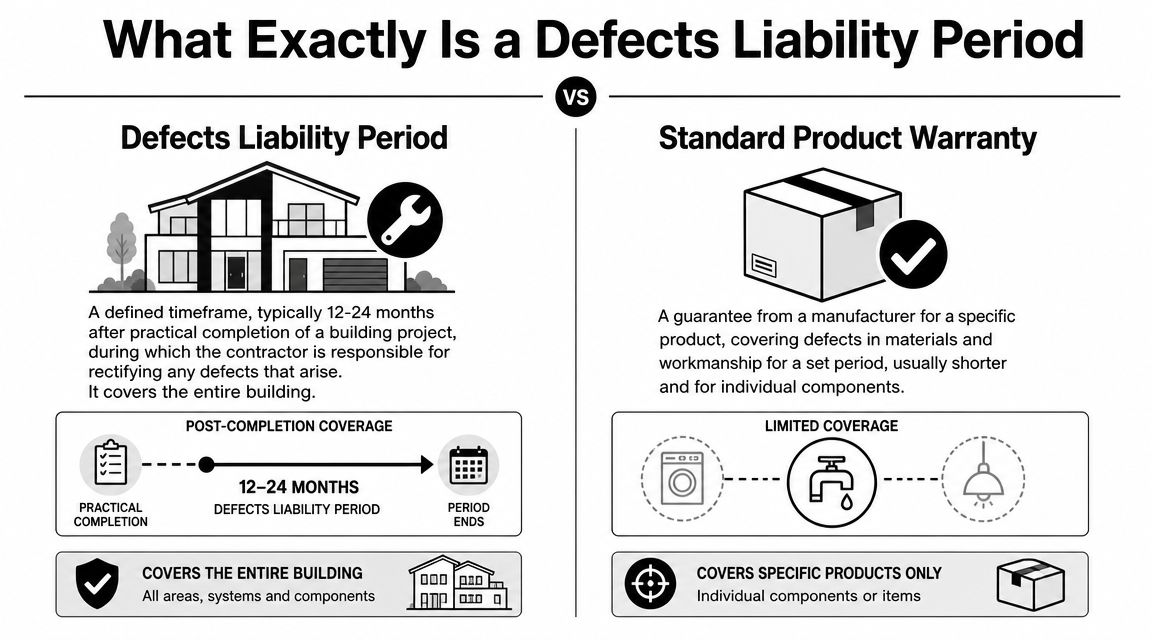
Think of it like a warranty, but for the whole job
If you buy a dishwasher, the manufacturer might give you a warranty for defects in that appliance. A defects liability period works on a similar idea, except it applies to the completed building work rather than one product.
That can include issues tied to workmanship, installation, finishing, or items that only become apparent after ordinary use. It gives the owner a defined window to notify the builder and gives the builder a defined obligation to put covered defects right.
What it is not
People frequently get this aspect confused. The DLP is not the same thing as a long-term legal right to bring a claim. It's not the whole legal framework. It's one contract mechanism inside it.
A useful distinction is below.
| Item | What it does |
|---|---|
| Defects liability period | Creates a post-completion process for reporting and fixing contract defects |
| Statutory warranties or broader legal rights | May provide separate remedies outside the DLP, depending on the law and the contract |
The DLP is the practical repair window. It is not the outer limit of every legal right you may have.
Why this matters in Adelaide projects
For renovations, extensions, and bespoke homes, the DLP is where communication really counts. Adelaide homeowners often want certainty, not legal theatre. They want to know who to contact, what counts as a defect, and when the builder is expected to act.
That's why the wording in your contract matters so much. If the DLP is clear, the post-handover period tends to feel calm and organised. If it's vague, even minor items can become bigger than they need to be.
How the Defects Liability Period Works in Practice
The practical starting point is practical completion. That's the point where the work is complete enough for you to take possession and use the home, even if a few minor items still need finishing or adjustment. If you want a plain-language explanation of that milestone, this guide on practical completion is worth reading before you sign off on handover.
Soon after that point, the DLP starts running.
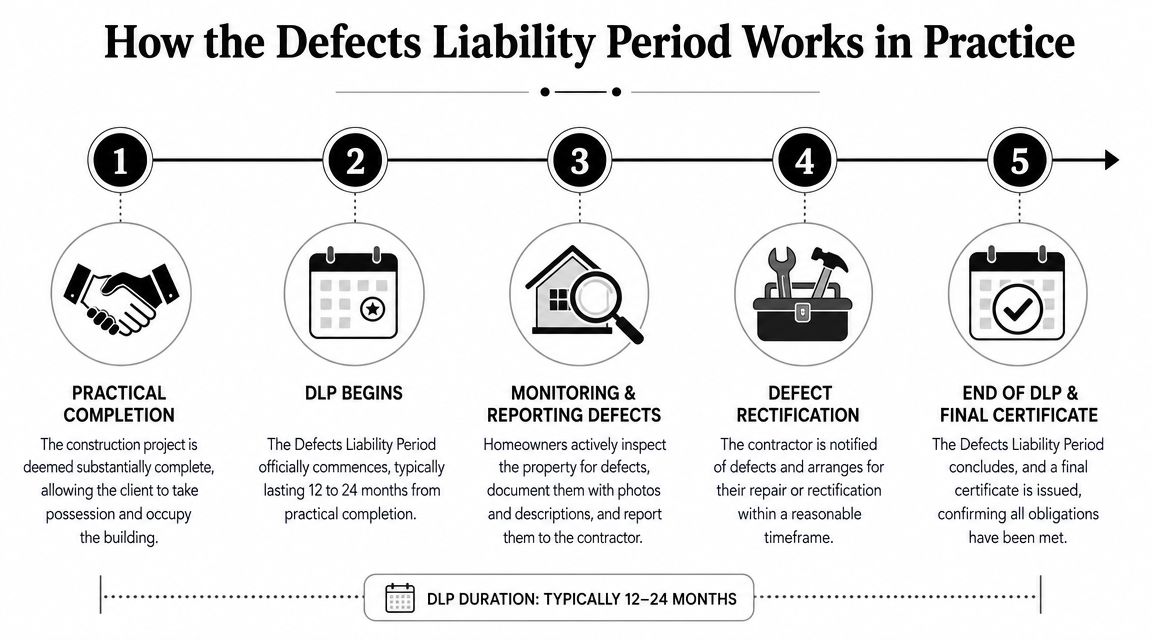
The usual timeline
In Australia, a DLP commonly lasts 12 months, although many contracts use 6 to 12 months for straightforward projects and 24 to 36 months for more complex engineering work. It is a contractual remedy window, not the same as the statutory limitation period for a breach-of-contract claim, which may extend beyond it under contract law, as explained in this Australian construction law overview.
For a homeowner, the practical sequence usually looks like this:
Practical completion is reached
You can move in or start using the space.The DLP begins
The clock starts from the date set out in the contract.You live in the home and monitor it
Small issues become easier to spot through normal use.You notify the builder of defects
Ideally in writing, with photos and clear descriptions.The builder rectifies covered items
Access is arranged, trades return, and works are completed.Final review happens near the end of the DLP
Outstanding items are checked off and the job is formally closed out.
A short visual often makes that easier to grasp:
What practical completion feels like on a real job
For a kitchen renovation, practical completion might mean the room is fully usable, but a cupboard door still needs a final adjustment after a few weeks of use.
For a new custom home, it could mean the house is ready for occupation, while a small list of post-handover touch-ups gets managed during the DLP.
The point isn't perfection on day one. The point is that the house is complete enough to be occupied safely and as intended, with a formal mechanism for genuine defects that show up afterwards.
Why retention money matters
Another area clients often hear about but don't always understand is retention money. In many contracts, part of the money is withheld until obligations are satisfied. That gives the owner a level of commercial protection and gives the contractor a clear incentive to close out outstanding defect items properly.
Practical rule: The end of the defects liability period isn't just administrative. It's often tied to final money, final certificates, and final closure of the project.
That's why good builders don't treat the DLP as an afterthought. It's part of finishing the project well.
Owner and Contractor Responsibilities During the DLP
A smooth DLP depends less on legal jargon and more on each side doing the obvious things well. Most tension starts when one party assumes the other should “just know” what to do.
In Australian construction contracts, a defects liability period usually begins at practical completion and is commonly 6 or 12 months for straightforward building work. During that period, latent workmanship issues that emerge after handover are contractually allocable to the contractor, reducing the owner's need to rely immediately on disputes or statutory warranty claims, as outlined in this PwC Australia note on DLPs.
The owner's role
Owners help the process run well when they stay organised and specific.
- Report issues promptly. Don't keep a mental list for months and send a frustrated email later. If something looks wrong, record it and notify the builder through the agreed channel.
- Describe the issue clearly. “Bathroom leak” is too broad. “Water appearing on floor beside vanity after basin use” is far more useful.
- Allow reasonable access. Builders and trades can't rectify defects if they can't inspect or enter the property at a workable time.
- Separate defects from accidental damage. A chipped benchtop caused by moving furniture in isn't the same as a defect in workmanship.
- Know what your contract says. If you're reviewing terms before signing, guides on what to look for in a building contract can help you spot how notice, access, exclusions, and rectification are handled.
If you're trying to understand how formal wording is usually structured, reviewing sample legal contract templates can also help you recognise clause language before you speak with your builder or adviser.
The contractor's role
Builders have a different set of responsibilities, and they're just as important.
| Homeowner expectation | Contractor responsibility |
|---|---|
| Clear communication | Acknowledge notices and explain next steps |
| Timely assessment | Inspect reported items within a reasonable timeframe |
| Proper rectification | Fix covered defects to the contract standard |
| Respectful process | Minimise disruption to the household |
A contractor should assess reported defects fairly, not defensively. Some items will be straightforward. Others may need a supplier, specialist trade, or further investigation to confirm the cause.
Where things go wrong
Problems usually appear when communication becomes vague or emotional.
A homeowner might say, “There are heaps of things wrong,” without a list. A builder might say, “That's just settlement,” without inspecting properly. Neither response helps.
Good DLP management is simple. Written notice, clear photos, reasonable access, and a practical discussion about cause and remedy.
When both sides treat the period as a shared close-out phase rather than a fight, most issues get resolved with far less stress.
A Practical Guide to Identifying and Reporting Defects
This is the part that saves people the most grief. Don't wait until the end of the defects liability period and then try to reconstruct months of little issues from memory. Use a basic system from day one.
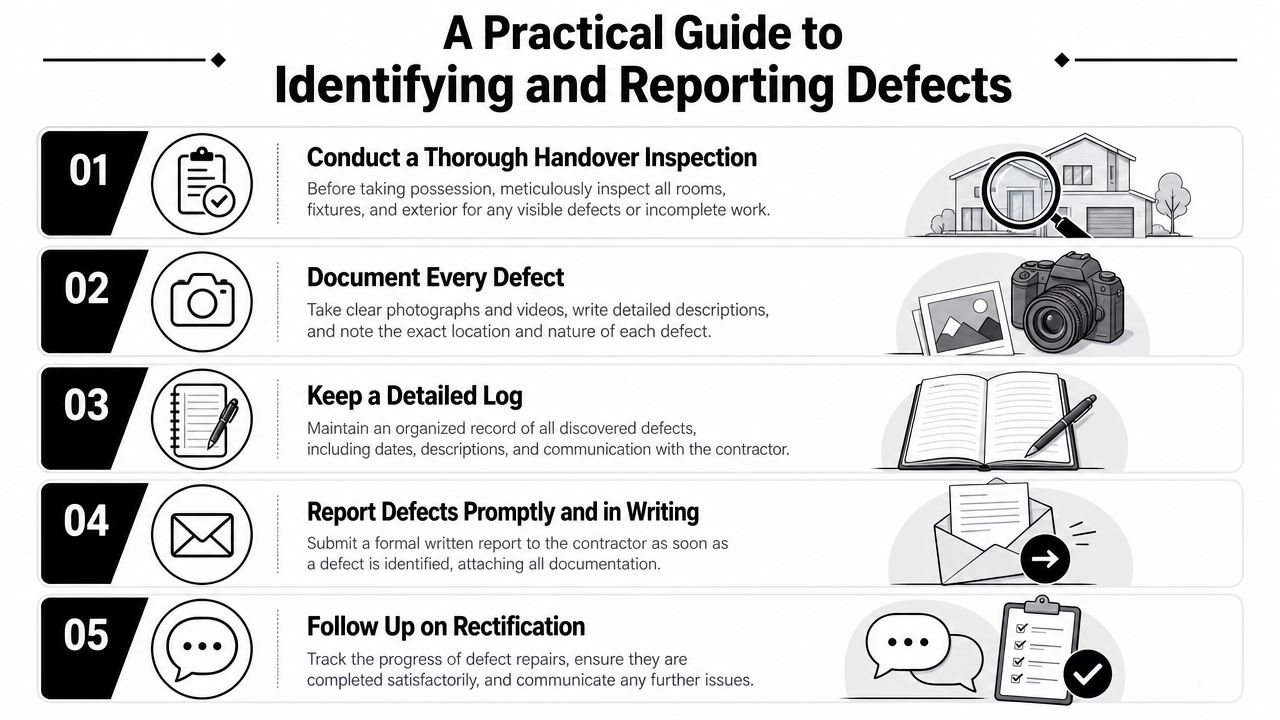
What to check after handover
Walk through the house room by room and use it like an occupant, not like a visitor on inspection day.
Doors and windows
Open, close, lock, and latch each one. Check for rubbing, sticking, gaps, or handles that feel loose.Plumbing fixtures
Run every tap. Flush each toilet. Look under sinks. If you want to monitor unexplained water use between checks, this guide on how to read your water meter is a practical companion for spotting leak-related patterns.Electrical points and lighting
Test switches, power points, exhaust fans, and external lighting.Cabinetry and joinery
Check alignment, drawer runners, soft-close hardware, and finish quality.Paint and plaster finishes
Look in both daylight and artificial light. Minor movement can appear over time, so note what changes and when.External items
Inspect paving interfaces, drainage behaviour after rain, gates, outdoor taps, and sealant lines.
How to log a defect properly
Your record doesn't need to be fancy. It just needs to be usable. A spreadsheet, notes app, or shared document is enough if it captures the right details.
Include:
| Item | What to record |
|---|---|
| Date noticed | When you first saw the issue |
| Location | Exact room or area |
| Description | What is happening, not what you think caused it |
| Photo or video | Clear visual evidence |
| Impact | Cosmetic, functional, safety, water ingress, access issue |
| Status | Reported, inspected, booked, completed |
Sample defect notification email
You don't need legal language. You need clarity.
Subject: Defect notification under contract for [project address]
Hi [builder/contact name],
We've identified the following items at the property during the defects liability period:
- Ensuite vanity leak. Water appears inside the cupboard after basin use. First noticed on [date].
- Bedroom 2 door rubbing at top edge and not latching smoothly. First noticed on [date].
- Hairline crack above living room sliding door. Photo attached. First noticed on [date].
I've attached photos and can provide access on [days/times]. Please confirm receipt and advise the next steps for inspection and rectification.
Kind regards,
[Name]
A sample clause structure to recognise
Every contract is different, so treat this as an example of the kind of wording to look for, not a universal clause.
The contractor must rectify defects, shrinkages, or other faults appearing within the defects liability period and notified by the owner in writing within the time required by the contract. The owner must provide reasonable access for inspection and rectification. Work excluded by the contract, fair wear and tear, and damage caused by the owner or third parties is not included.
When you read your own contract, focus on these phrases:
- When the period starts
- How long the period lasts
- How notice must be given
- How quickly defects must be rectified
- What is excluded
- What happens at the end of the period
A simple habit that works
Keep one running defect register and send grouped updates rather than scattered messages, unless an item is urgent. That gives the builder a workable list and gives you a clean written record if any disagreement appears later.
Navigating Common Disputes and Resolutions
Most disputes during a defects liability period don't begin with a major legal issue. They begin with a different view of the same problem.
The homeowner says, “This shouldn't be happening.”
The builder says, “That's normal movement.”
Sometimes one of them is right. Sometimes both are partly right.
Defect, damage, or wear and tear
A useful way to sort the issue is to ask what likely caused it.
- Defect usually points to workmanship, installation, or a contract item that wasn't completed to the required standard.
- Damage is often caused after handover by occupants, movers, pets, trades, or accidental impact.
- Wear and tear comes from normal use over time.
- Settlement or shrinkage can sit in a grey zone. Some movement is normal in buildings, but the outcome still needs assessment if it affects function or finish beyond what the contract allows.
A calm path to resolution
If something is disputed, avoid the urge to jump straight into threats. A structured approach works better.
Re-read the contract
Check the defect clause, exclusions, notice requirements, and any standards referenced.Send a clear written notice
Include photos, dates, and what outcome you're seeking.Request inspection
Don't argue the cause before the item is properly seen on site.Keep records of all communication
Emails, photos, attendance dates, and any promised actions matter.Escalate only if needed
If direct communication stalls, use the formal process set out in the contract. If the issue remains unresolved, options may include mediation or formal dispute pathways. For a broader overview of that process, this guide to building dispute resolution is a practical starting point.
The fastest way to inflame a small defect issue is to make it personal. The fastest way to resolve it is to document it, inspect it, and deal with the facts.
When to get extra help
If there's a pattern of non-response, repeated failed repairs, or disagreement over whether an item is covered, it may be time to get contract advice or technical advice. That doesn't mean a fight is inevitable. It means the issue needs a clearer framework.
The Templeton Built Approach to Your Peace of Mind
A defects liability period works best when it feels like the final stage of service, not the start of a struggle. That comes down to communication, documentation, and having one clear path for the client to follow after handover.
For Adelaide homeowners, that's especially important. Renovations and extensions are personal. Custom homes are personal. Once clients move in, they don't want to chase five different trades or wonder whether their email reached the right person. They want a simple process and a professional response.

What a reassuring DLP experience looks like
The strongest post-handover process usually includes a few practical features:
- Clear handover information so clients know what to monitor and how to report concerns
- One point of contact so communication stays organised
- Written tracking of defect items to avoid confusion
- Respectful scheduling for inspections and rectification visits
- A close-out process that confirms when reported items are complete
That approach builds trust because it removes uncertainty. Clients know what's expected of them. The builder knows what has been reported. Small items get handled before they turn into larger frustrations.
Why this matters more than the clause alone
A well-drafted contract is important, but the lived experience of the DLP depends on people. The homeowner needs to report issues clearly. The builder needs to respond like a professional who stands behind the work.
When that partnership is there, the defects liability period becomes what it should be. A calm, structured settling-in phase that protects both sides and helps the project finish properly.
If you're planning a renovation, extension, or custom home in Adelaide and want a builder who treats handover and post-handover care as part of the job, speak with Templeton Built. Their team can guide you through the contract process, practical completion, and the post-handover period with the kind of clarity that makes the whole experience easier.


Leave a Reply