

Eastern Building Group: Adelaide Builder Profile Guide
You're often standing at the same fork in the road: the block looks workable, the plans feel close, and three builders all say they can “handle anything.” That's exactly where projects go sideways in Adelaide, because the wrong builder choice usually isn't about workmanship alone, it's about project fit. Eastern Building Group is worth a close look because its public footprint points to a very specific kind of local builder, one that sits somewhere between custom-home delivery and small development work, not a generic volume operation.
Understanding Eastern Building Group as an Adelaide Builder
A project can look straightforward on paper and still become difficult once the builder is on site. The usual fault line is project fit, because a builder that handles one type of work well can still be the wrong choice for another.
Eastern Building Group reads like a boutique operating model rather than a high-volume builder. Its LinkedIn profile lists the business as Privately Held, with 11–50 employees, headquartered in Marden, South Australia, and the firm's founding date is 1998 on Eastern Building Group's LinkedIn company profile. The company's own site says it has “over 25 years of experience” and describes a South Australian legacy built around detail, design, competitiveness, and service.
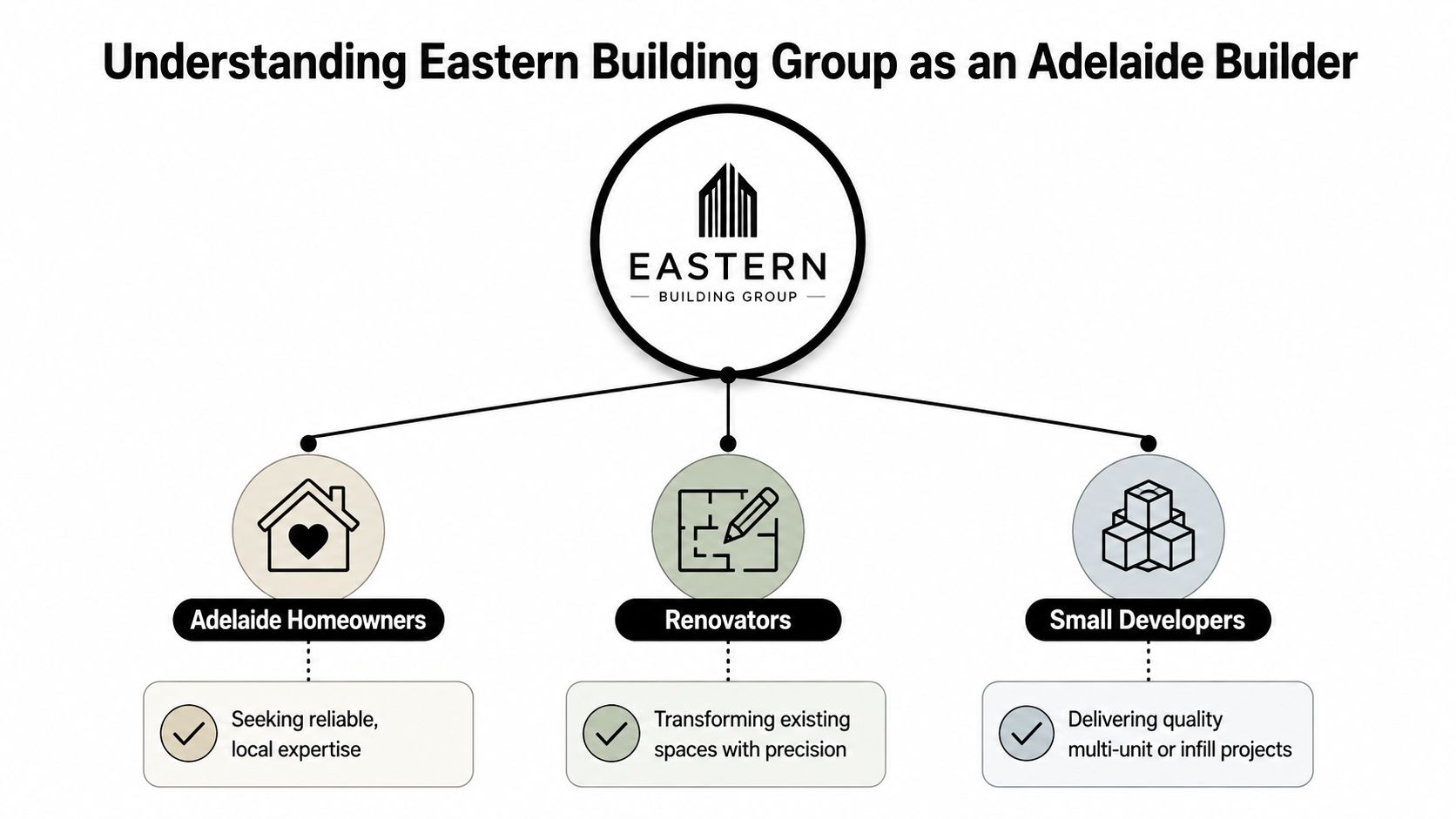
What those company signals usually mean
A long-running local builder often knows the council process, the supplier network, and the day-to-day realities of keeping work moving in Adelaide. That still does not guarantee quality. It does tell you how to read the business. A smaller team usually points to more direct involvement, tighter project selection, and less interest in cookie-cutter work.
Practical rule: if a builder's public profile looks small and local, read it as a sign that the team is set up for controlled project delivery, not endless volume.
That lens suits Eastern Building Group. A firm operating from Marden, with a history that reaches back to 1998, is likely to be more hands-on than a large franchised builder. For a homeowner, that can help when the brief is specific and the decisions need judgment rather than a standard package. For a developer, it can matter on a tight site, on a staged scope, or where the build needs careful coordination between trades and design changes.
Why this matters before you shortlist anyone
Too many buyers shortlist builders based on finish photos alone, and that can send them toward the wrong match. A glossy portfolio can hide a poor project fit, as one homeowner finds out after signing with a builder known for custom homes on a renovation brief.
Eastern Building Group deserves evaluation on fit, not just branding. If you are comparing it with another Adelaide builder, check who will run the job, how deep the team is, and whether the builder's size matches the complexity of your project. That is the difference between a build that stays under control and a contract you keep revisiting under pressure.
Company Background and Local Footprint
Eastern Building Group's credibility starts with facts you can verify, not polished copy. The business has a 1998 founding date, which places it among long-established South Australian builders, and its current base is clearly tied to Marden, South Australia, 5070 on Eastern Building Group's contact page. Its LinkedIn profile places the company in Marden, South Australia, Australia, with 11–50 employees and a Privately Held structure.
Those details matter because construction is local in ways brochures usually miss. A builder anchored in one area is more likely to work with the same subcontractors, suppliers, surveyors, and council pathways again and again. That can improve continuity on live jobs, especially when a project runs longer than planned or the scope changes during design and construction. It also helps with the practical demands of keeping projects on track in the Adelaide market.
How to read a small-team profile
A team of 11–50 employees points to a business that probably does not chase every job. That can be a good sign if you want tighter control over site management and client communication. It also usually means the business is selective about project type, because a small team cannot absorb endless change without strain.
The founding date tells you about staying power. Longevity means the business has survived enough market cycles to keep operating. It does not automatically tell you how well they handle variations, documentation, or dispute prevention.
A builder's age tells you they've lasted. It doesn't tell you whether they're the right tool for your job.
The local footprint matters too. The Marden base shows Eastern Building Group is operating inside the same market clients are building in, not from a distance with only a passing sense of Adelaide conditions. That can help when a job needs site visits, quick meetings, or coordination with nearby trades.
What's missing from the public record
There is one limit worth stating plainly. The available research does not provide independent technical performance data specific to Eastern Building Group. A fair assessment therefore has to rest on transparent business signals, project scope, and direct verification from the builder itself, not invented track records or vague reputation claims.
So the sensible takeaway is simple. Eastern Building Group looks like an established Adelaide builder with local continuity and a small-team structure, but any final decision should depend on how well its actual project history matches your brief.
Services, Project Types, and What Eastern Building Group Builds
A builder profile can look tidy on paper and still tell you very little about the type of work the company is set up to handle. If you are trying to separate a one-off family home from a duplex site or a small development brief, the service mix matters more than the sales language.
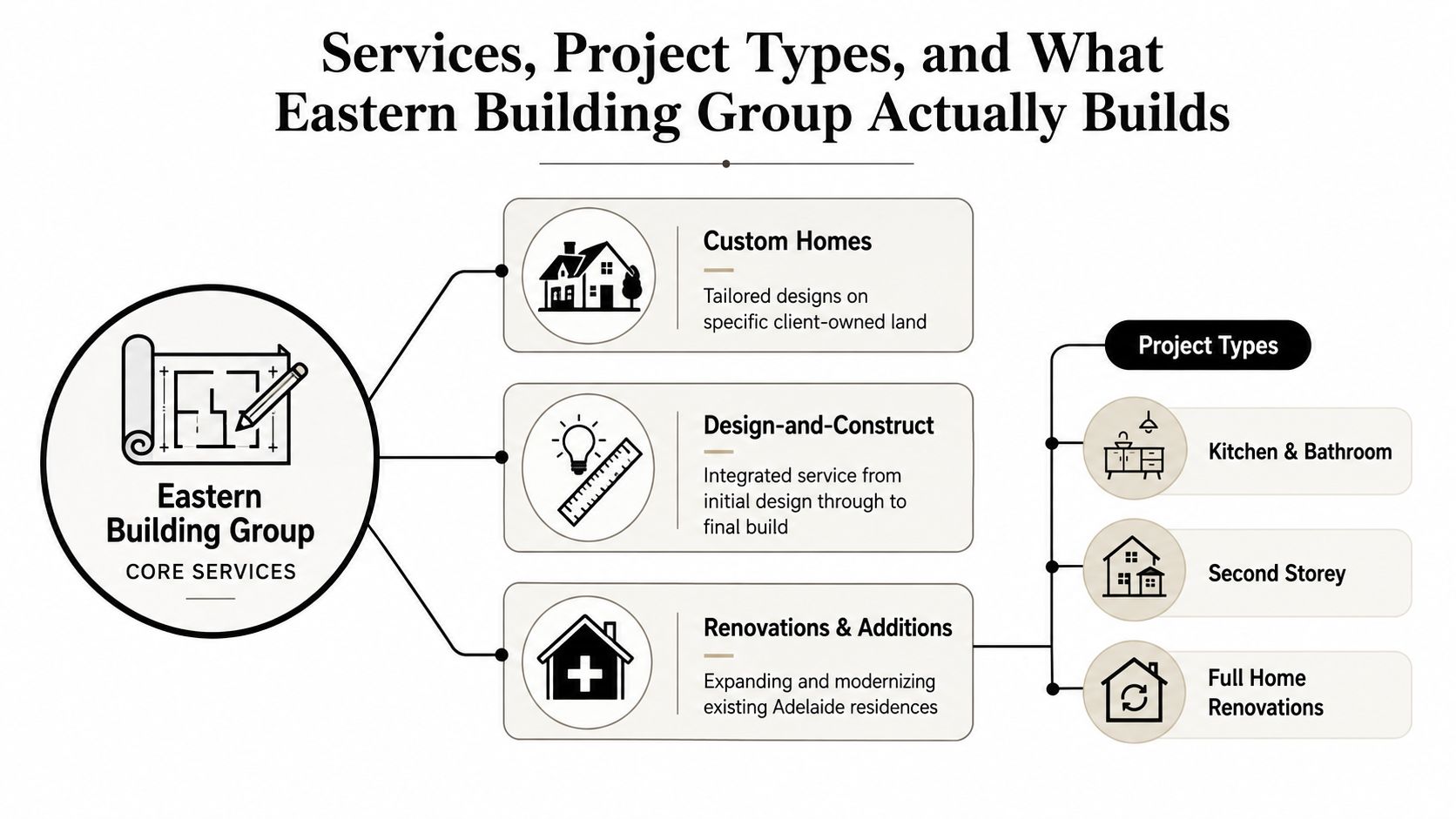
Eastern Building Group's own website shows a wider mix of custom homes, developments, and design-and-construct residential projects on its custom homes page. Its LinkedIn profile goes further, listing duplexes, triplexes, medium-density developments, villas, bungalows, and architecture/interior design. That spread is worth paying attention to, because those project types sit at different points on the complexity scale and ask different things from the builder.
Custom homes and development projects follow different workflows
A custom home is usually shaped around one household, one block, and one lifestyle brief. The work tends to concentrate on layout decisions, how the land is used, and whether the finished plan fits the way the owners live. Development work centres on site yield, planning constraints, staging, and return on capital.
Those are separate jobs. A builder who handles bespoke houses well can still be the wrong fit for multi-unit or infill work, because the workflow shifts, the paperwork changes, and the risk profile changes with it.
Eastern Building Group's published mix suggests it is not locked into a single lane. It appears to work across bespoke residential jobs and density-oriented product, which may suit clients who need a builder familiar with more than one delivery model. It also means you need to be precise about which lane your own project sits in before you start comparing quotes.
Design-and-construct changes the way a job runs
Design-and-construct means design and construction are coordinated under one delivery path. That can keep communication tighter and reduce the handover friction that often appears when the designer, consultant team, and builder are all working separately. It can also bring decisions forward earlier, because scope, cost, and buildability have to line up from the start.
That structure suits some briefs more than others. If you already have a strong architectural concept and an external consultant team, you may prefer a different arrangement. If you want fewer moving parts and a smoother client journey, integrated delivery can be a practical fit.
Project types to match against your brief
Eastern Building Group's listed categories point to several likely client types.
- Custom home owners, who want a single dwelling on a specific block.
- Renovators, who need precision around existing structures and liveable staging.
- Small developers, who care about infill, duplex, triplex, and medium-density outcomes.
- Clients wanting design support, where interior and architecture input matter as part of the package.
If your project sits outside those lanes, or if you need highly specialised commercial delivery, the fit needs to be tested carefully before you sign anything. The useful question is not whether the builder sounds capable. It is whether the builder's real service mix lines up with your site, budget, and intended use.
Eastern Building Group vs Templeton Built Comparing Adelaide Builders
A useful comparison doesn't start with “who is better.” It starts with “who is better for this job.” That's especially true in Adelaide, where builders can look similar on the surface but operate very differently once you compare delivery style, project size, and how much design support they provide.
Eastern Building Group and Templeton Built overlap in the same general market, but their public positioning isn't identical. Eastern Building Group presents as a local builder with a mix of custom homes, developments, duplexes, triplexes, and medium-density work on its developments page. Templeton Built, by contrast, is an Adelaide boutique builder established in 2001 with documented experience across over 400 renovations, 200+ extensions, and 64 custom homes.
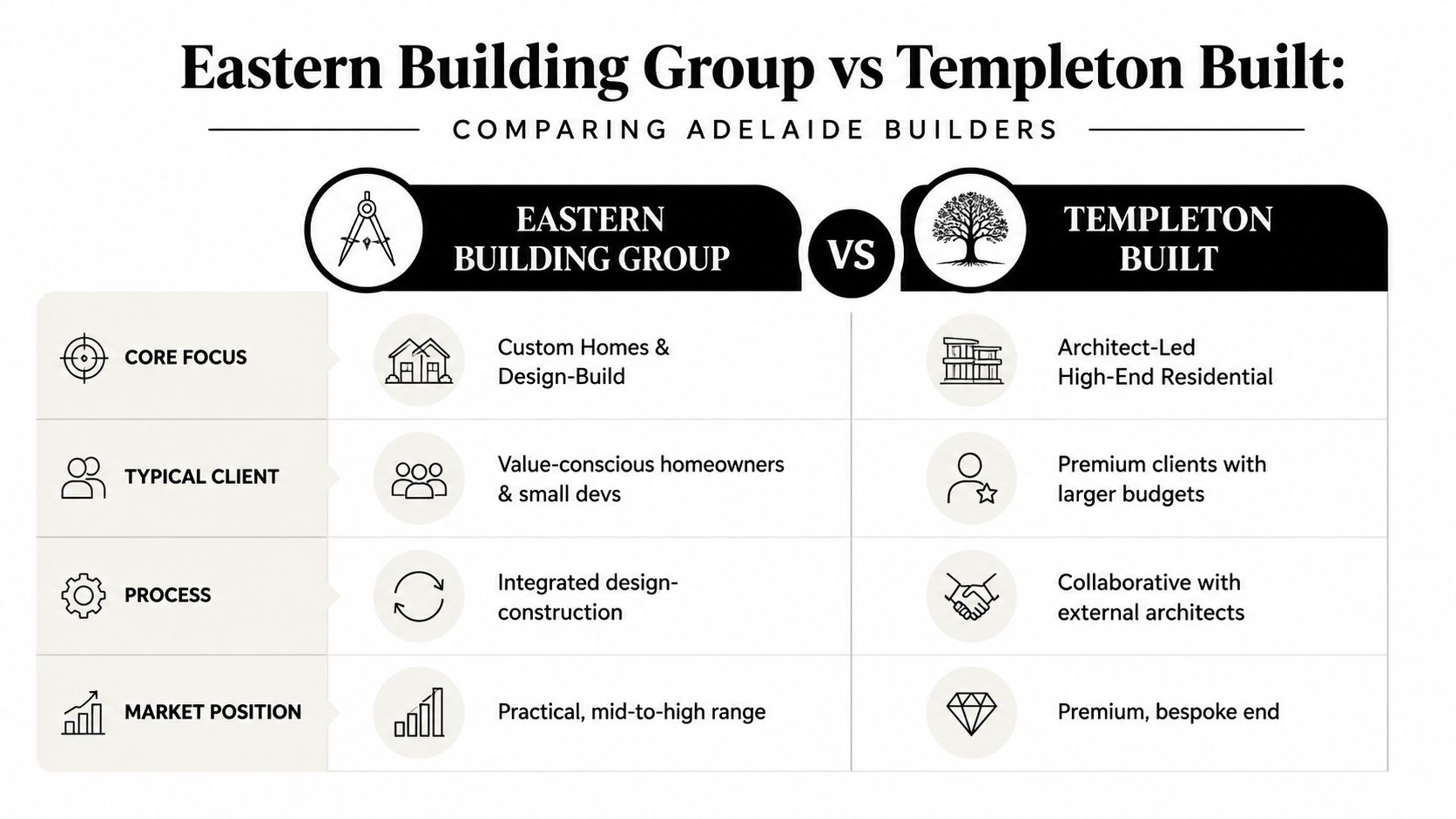
How the two firms read on paper
Eastern Building Group's profile suggests a builder comfortable with both bespoke residential work and small-density product. That can appeal to clients who need flexibility across design-led homes and infill-style opportunities. Templeton Built's published record is more explicit about renovation, extension, and custom-home volume, which gives you a clearer picture of where its day-to-day experience sits.
That difference matters if your project already has constraints. A renovation, for example, often needs careful existing-structure management, clean site sequencing, and realistic variation control. A duplex or triplex needs a very different mindset, one focused on yield, planning alignment, and construction efficiency.
Choosing between them without guessing
If you're comparing builders for a new build on a clean block, the question is whether you want a more generalist boutique builder or a firm that clearly leans into highly residential work. If you're comparing for an extension or renovation, published experience in that lane becomes far more important than portfolio style alone.
Use the builder that already lives in your problem. A company that does the same project type every week usually spots issues earlier.
Templeton Built's published project history gives it a strong signal for renovation and extension-heavy work. Eastern Building Group's public messaging suggests broader residential and development capability. Neither is automatically right or wrong. The right fit depends on whether your brief is a bespoke single home, an alteration to an existing structure, or a small development with density implications.
If you want a direct, practical prompt for comparison, use this: which builder can explain your project in plain terms, quote it cleanly, and tell you what happens if the scope changes? That's usually where differences appear.
Cost, Feasibility, and When a Bespoke Build Makes Financial Sense
A lot of homeowners fall in love with a design before they have checked whether the numbers still work. That is how projects stall after concept stage, because the budget has to carry land, approvals, site works, finishes, and the scope decisions that always show up later.
The broader market context is still tight. Residential building activity has stayed strong while approvals have moved around, and the practical constraints on supply have been clear, cost pressure, trade shortages, and planning delays all shape what gets built and how cleanly it moves through the system. South Australian planning and housing discussions have also kept pushing infill supply and faster assessment pathways, which makes feasibility a live issue, not a theoretical one.
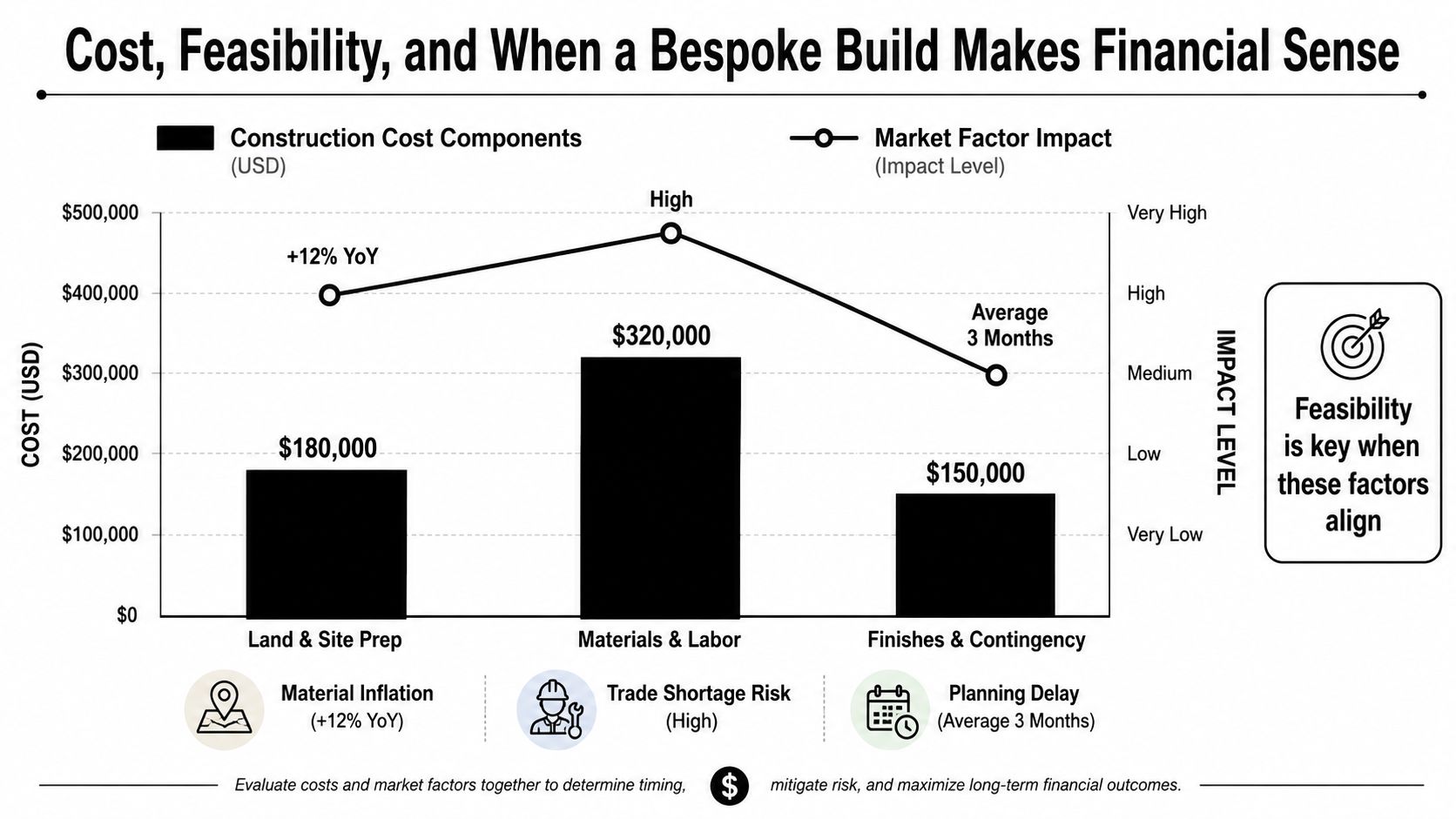
When bespoke is the right financial choice
Bespoke builds make sense when the site and the brief justify them. That usually means the layout, the land use, the long-term fit, or the need for a one-of-a-kind outcome is delivering value that a standard product cannot match. If the block is unusual, the existing dwelling is a poor candidate for alteration, or the result has to be customized in a way that off-the-shelf plans cannot handle well, custom work can be a sensible decision.
The cost case weakens fast when the block supports a simpler path. If the land can be used more efficiently through a renovation, extension, or a small development approach, forcing a fully bespoke build can load the budget with design complexity that does not return enough value. For Adelaide owners, that is usually where the fine print gets expensive, because the headline design is only one part of the total outlay.
A feasibility lens beats a style preference
Feasibility has to come before finishes. If your project sits on a constrained site, or you are trying to pull value from an established suburb, a duplex or triplex-style approach may be more logical than a single premium dwelling. If the existing home is structurally workable, an extension may protect more capital than a demolition and rebuild. A closer look at what a feasibility study covers in a custom home or development context gives you a better starting point than a mood board.
If the numbers only work when every assumption stays perfect, the project probably is not feasible yet.
That is the trap many Adelaide owners miss. They choose a builder before they choose the right delivery model. Once you are comparing Eastern Building Group against any other builder, ask which option best fits the site, the council pathway, and the capital you are prepared to tie up.
Client Trust Signals and How to Verify Builder Reputation
Trust in construction is earned in details, not in polished language. A builder can have a good-looking website and still be a difficult fit once contracts, variations, and site coordination start affecting the job.
The most reliable trust signal is whether the builder can show completed work that resembles your project. A company with strong renovation results may still be the wrong fit for a medium-density site. A builder with a clean custom-home gallery may still struggle with extension sequencing or occupied-site work. That's why reputation has to be checked against project type, not just star ratings.
What to verify before you commit
Start with the documentation. Ask for a scope that is specific, exclusions that are clear, and timelines that acknowledge real-world site conditions. If a builder is evasive about what's included, that's a warning sign. If they're precise, it usually means their process is mature.
Then check the communication pattern. Do they answer questions directly, or do they keep circling back to generic design language? Do they explain who manages site decisions, and how changes are approved? Those are the questions that expose whether the build will stay controlled once the job starts.
A good checklist is already laid out in these questions to ask a custom home builder.
Trust signs that matter more than marketing
- Project match: Have they built the same kind of job before, not just something that looks nice in photos?
- Contract clarity: Are inclusions, exclusions, and variation rules written plainly?
- Site responsibility: Is there a clear process for who handles communication on the ground?
- Quality evidence: Can they point to finished work that you can inspect in context?
- Client consistency: Do they sound organised when discussing how they manage changes, delays, and approvals?
Longevity helps, but it doesn't replace evidence. Ask to see proof that the builder has handled jobs like yours.
That's the safest way to read Eastern Building Group or any other Adelaide builder. Don't let brand polish do the job of due diligence. Verify the project type, the contract structure, and the builder's ability to explain the build in plain English.
Actionable Checklist for Homeowners Choosing a Builder
The cleanest way to choose a builder is to treat it like a project decision, not a beauty contest. You're not just buying construction labour. You're selecting a team that will control scope, absorb pressure, and keep the job moving when something changes.
Start by matching your project to the builder's actual lane. If you need a custom home, ask whether they're strongest in bespoke delivery. If you need an extension, find out whether they regularly work around existing structures. If you're developing, check whether they understand density, planning, and staging, not just residential design. That same logic applies when comparing Eastern Building Group with any other Adelaide builder.
For a broader selection process, how to choose a builder is worth keeping beside your notes during meetings.
Use this shortlist before you sign
-
Define the project type first. Decide whether you're building new, renovating, extending, or developing. A builder who suits one may be wrong for another.
-
Read the inclusions properly. Don't skim the contract summary. Check finishes, fixtures, site works, and what's explicitly excluded.
-
Ask how variations are handled. Variation rules can change the cost outcome more than the original estimate if they're vague.
-
Test the timeline logic. Ask what happens if approvals slow down or site conditions change. Real builders have an answer.
-
Ask for similar completed work. The strongest proof is a finished project that looks like yours in scope and complexity.
-
Check who manages the job. The person selling the project isn't always the person running it.
Keep the decision simple
If a builder can't explain your project clearly, they're probably not the right fit yet. If they can explain it too quickly, they may be skipping risks you'll pay for later. The best choice is usually the builder who understands your brief, your site, and your budget without forcing the job into the wrong category.
Choose the builder that matches the project type first, and the styling second. That one decision prevents a lot of Adelaide headaches before they ever reach site.
If you're weighing up a renovation, extension, custom home, or small development in Adelaide, Templeton Built offers the kind of end-to-end guidance that makes the brief clearer before the build begins. Visit Templeton Built to see how a practical, design-led approach can help you choose the right path for your project.


Leave a Reply