

Heritage Building Restoration: Your Guide to Conserving Adelaide Icons
Taking on a heritage building isn't just another renovation project. It's about stepping into a story, becoming a guardian of a piece of Adelaide's architectural history. This is a process that demands more than just a good builder; it requires deep respect for the property's past, meticulous planning, and the right skills to bring it gracefully into the future.
A truly successful heritage building restoration is a delicate dance between preserving historical accuracy and creating a home that works for modern life.
Starting Your Heritage Restoration Journey in Adelaide
The idea of restoring a historic property is undeniably romantic, but the reality involves unique challenges alongside immense rewards. This isn't a standard build. You're not just a homeowner; you're a custodian. Every choice, from repairing a slate roof to selecting paint colours, is filtered through the lens of the building’s original character.
This guide is designed to give you a clear-eyed view of what the process actually involves. We’re moving past the glossy photos to provide practical, real-world advice for Adelaide homeowners—people who see the soul in an old villa and the story etched into its worn floorboards.
What to Expect From This Guide
Think of this as your roadmap. We'll walk you through the complexities, giving you the confidence and know-how to get started. We'll cover all the crucial stages you'll face, including:
- Uncovering Your Property's Story: The first step is always to understand the history and define the heritage significance that will shape every decision you make.
- Decoding Council Requirements: We’ll demystify the Development Application (DA) process and specific heritage regulations here in South Australia.
- Assembling Your A-Team: You can't do this alone. We'll talk about finding the right architects, builders, and specialist tradespeople who genuinely understand heritage work.
- The Balancing Act—Old vs. New: How do you integrate modern comforts and sustainable features without erasing the building's historical heart?
A heritage building is a tangible link to our past. Preserving these architectural landmarks ensures that the stories, craftsmanship, and cultural identity they represent endure for generations to come.
Ultimately, a thoughtfully executed restoration does more than just revitalise a property. It breathes new life into a piece of Adelaide's rich architectural tapestry, ensuring its legacy continues for many more years to come.
Uncovering Your Property's Story and Significance
Every heritage restoration project starts with a bit of detective work. Before a single tool is lifted, you need to step back and understand what makes the building tick. This isn't about demolition; it's about discovery. You're trying to get to the heart of the 'why'—why does this building matter, and what are the essential parts of its character that need to be protected?
Think of this initial investigation as the foundation for everything that follows. It will steer every decision you make, from the big picture stuff like a new extension down to the smallest details like the choice of a doorknob. Skipping this phase is like setting off on a cross-country trip without a map. You might end up somewhere, but it's probably not where you intended, and the journey will be full of costly and irreversible wrong turns.
The whole point is to build a solid framework that honours the property’s past while still making it work for your life today.
Bringing in a Heritage Consultant
Your very first phone call should be to a heritage consultant. These specialists are part historian, part architectural expert, and part detective, all rolled into one. Their job is to dig through archives, pore over old plans, and analyse the physical building itself to piece together its unique story and value.
They go way beyond just figuring out how old the building is. They’re assessing its aesthetic, historic, social, and even technical significance. For instance, a consultant might find out your old Norwood villa was one of the first in the suburb built with a specific local bluestone, or that its original owner was a key figure in the community. This isn't just a fun fact; it's crucial information that directly tells you which parts of the building are considered highly significant and must be preserved. A good consultant gives you the objective evidence you'll need to make your case to the council's heritage advisors.
Defining Your Property’s Value
All that research comes together in a critical document, usually called a Statement of Heritage Impact (SHI) or, for more complex sites, a Conservation Management Plan (CMP). Don't dismiss this as just more paperwork for the council—it’s the constitution for your entire project.
An SHI or CMP will typically break down:
- A historical summary: It lays out the property's construction timeline, who owned it, and how it has changed over the decades.
- A statement of significance: This is the core of the document. It clearly explains why the building is important and pinpoints the specific features that contribute to that value. It could be anything from the original slate roof and cast-iron lacework to the internal floor plan or the garden it sits in.
- An assessment of impact: Here, your proposed works are laid out and analysed against the heritage significance. It explains how your plans will affect the character of the place.
This document becomes your north star. It ensures your dream for a modern kitchen or an open-plan living area is designed in a way that respects what makes your home special. It provides a clear, defensible rationale for your project that both you and the council can get behind.
The Critical Condition Assessment
While you’re digging into the ‘why’, you also need to get a handle on the ‘what’—the building’s current physical state. A thorough condition assessment is a head-to-toe survey that identifies every single problem, from rising damp and termite damage to crumbling mortar and fragile timber joinery.
But this deep dive is about more than just finding flaws; it’s about finding opportunities. That rotting sash window might not need to be ripped out; a skilled carpenter could probably restore it. The salt-damaged limestone at the base of the walls might point you towards a specialist stonemason who knows exactly how to handle it.
“Understanding the existing condition of a building’s fabric is non-negotiable. It tells you where to invest your resources, prevents unforeseen budget blowouts, and helps prioritise works that ensure the long-term survival of the structure.”
Basically, this assessment is a health check for your home. It reveals the underlying issues that could completely derail your project and budget if they pop up unexpectedly down the track. The findings directly feed into your scope of works, your budget, and the order in which you tackle the job, making sure you fix the fundamentals before you even think about the finishes. It's this proactive approach that sits at the heart of a successful, sustainable heritage building restoration.
Navigating Council Approvals and Heritage Regulations
Diving into council approvals for a heritage building restoration can feel like the most intimidating part of the whole journey. I’ve seen many clients feel this way. But once you understand the logic behind it, the process becomes much less daunting. Think of it less as a hurdle and more as a structured conversation with your local council to ensure your project honours the property's unique story.
In Adelaide and right across South Australia, any significant work on a heritage-listed property will trigger the need for a Development Application, or DA. This isn't just about ticking boxes; it's about proving that your proposed changes are thoughtful, necessary, and sympathetic to the building’s historical character. A well-prepared application, backed by solid documentation, is your single best tool for a smooth approval.
This process ensures that preservation is a community commitment, not just a private one. The economic ripple effect is huge, too. Just to give you an idea, in NSW alone, heritage conservation projects in the 2023-24 financial year generated around $6.6 billion in construction value. That figure breaks down into $4.9 billion from applications under the Environmental Planning and Assessment Act 1979 and another $1.7 billion under the Heritage Act 1977. It really shows how vital this work is to both our cultural identity and the building industry.
Preparing Your Development Application
Your DA is where you tell your project's story. It needs to be clear, comprehensive, and ultimately, persuasive. That Statement of Heritage Impact (SHI) you put together earlier? It now becomes the star of the show, providing the evidence and justification for your plans.
A strong DA package is built on a few key pillars:
- Detailed Architectural Plans: These go far beyond basic floor plans. They must show existing and proposed elevations, materials, finishes, and specific construction details, clearly marking the line between what’s original and what’s new.
- The Statement of Heritage Impact (SHI): This is your core argument. It explains why your property is significant and critically assesses how your proposed works will affect that significance.
- Supporting Expert Reports: Depending on the project, you’ll likely need reports from a structural engineer, an arborist (if mature trees are involved), or other specialists to back up your claims.
This simple flowchart shows how that initial discovery work directly feeds into the plans you'll submit to the council.
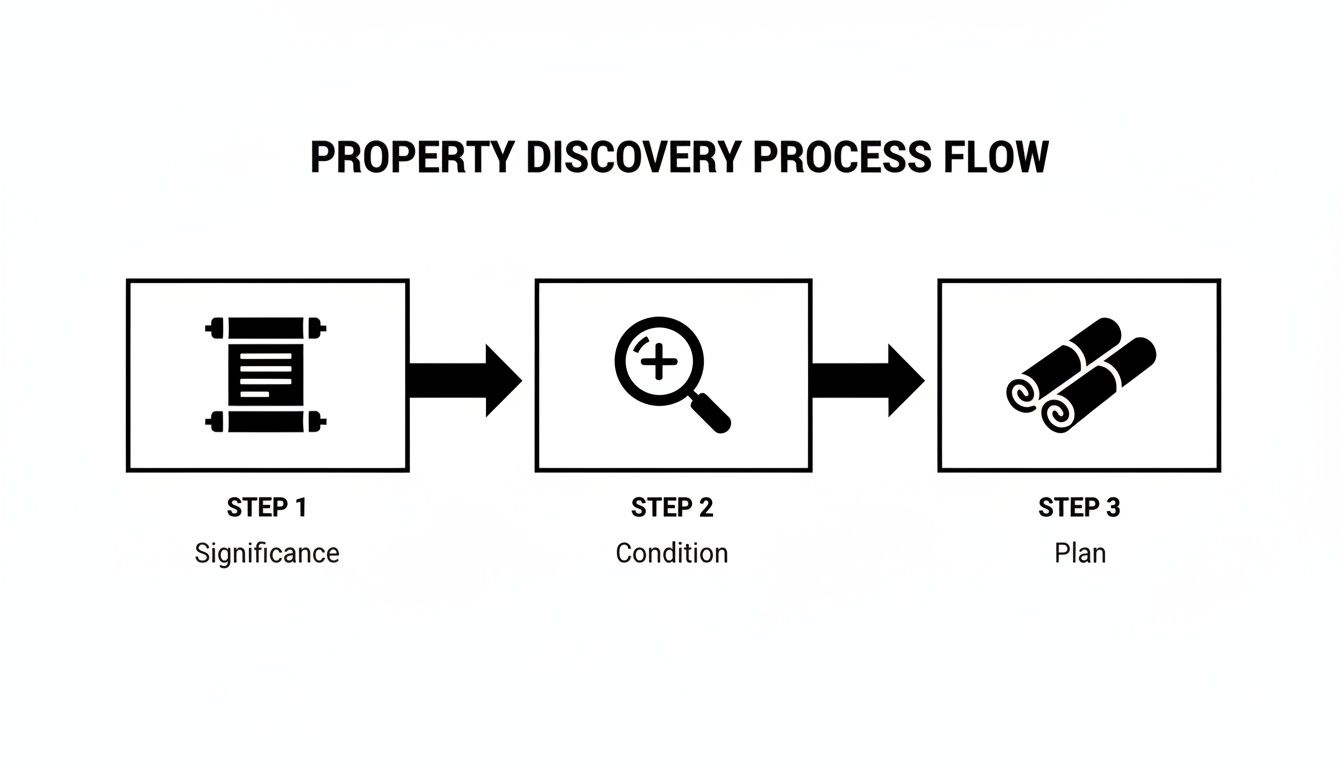
It’s a great visual reminder that a winning application isn't just about beautiful drawings; it's built on a deep, evidence-based understanding of the property's history and physical state.
Working With Council and Heritage SA
It’s easy to see the council's heritage advisor as an adversary, but that's a mistake. Their job is to help you achieve a fantastic outcome that aligns with sound conservation principles. I always recommend engaging with them early in the design phase, well before you even think about lodging the DA.
A pre-lodgement meeting is your chance to float initial concepts and get invaluable feedback. This collaborative approach often brings potential issues to the surface before they become major roadblocks, saving you a world of time and money down the track. Remember, their goal is the same as yours: to protect and enhance a significant piece of local history.
A successful negotiation with council is built on transparency and mutual respect. When you show a genuine understanding of your property's heritage value and a commitment to preserving it, advisors are far more likely to work with you to find practical, elegant solutions.
For properties of state significance, you'll also be liaising with Heritage SA. The approach is exactly the same: clear communication, robust documentation, and a collaborative mindset will get you across the line.
Understanding What Level of Consent You Need
Not all work requires the same hoop-jumping. The type of consent you’ll need hinges on the scope of your project and the specific heritage controls protecting your property.
- Minor Works and Repairs: True like-for-like repairs, such as replacing a few cracked slate tiles with identical new ones or repainting a fence in its previously approved colour, might be exempt or require only minimal paperwork. Always check with your local council first—never assume.
- Alterations and Additions: Any change to the building’s footprint, internal layout, or external appearance will demand a full DA. This covers everything from a new extension to removing an internal wall or changing the size of a window.
- Demolition: Demolishing any part of a heritage-listed building is, rightly, a very big deal. You will need to present a watertight structural or conservation-based argument proving that demolition is the only feasible option.
Getting these regulations right is a non-negotiable step in your heritage building restoration. A well-prepared, transparent, and collaborative approach will always get you the best result, ensuring your vision for the future can coexist beautifully with the preservation of Adelaide's past.
Assembling Your Specialist Restoration Team
A successful heritage building restoration is never a one-person show. It's a team sport, and trying to tackle it without the right experts is like sailing a ship in a storm without a crew. You need professionals who don’t just build; they need to understand the unique language of old buildings—their quirks, their vulnerabilities, and their specific material needs.
Pulling this team together is one of the most critical decisions you'll make. It directly impacts your project's quality, budget, and timeline. The real key is finding people who see heritage work not as a problem to solve, but as a craft to be honoured.
Your Core Professional Team
Before a single hammer swings, you need to get your core advisory team in place. These are the experts who will take your vision and shape it into a viable, council-approved plan. Getting them involved early is absolutely critical for setting your project on the right path.
While a standard renovation might just need an architect and a builder, heritage work calls for a much deeper bench of expertise. You’ll be leaning heavily on professionals who live and breathe old buildings.
Finding Specialist Trades and Vetting Your Builder
With your plans taking shape, the focus shifts to the hands-on experts. Heritage restoration often demands skills that are becoming harder and harder to find. You’re not just looking for a carpenter; you need a joiner who can painstakingly restore an original sash window. You’re not just after a plasterer; you need an artisan who knows how to work with traditional lath and lime plaster.
So where do you find these craftspeople? A great starting point is asking your heritage architect or builder. They almost always have a trusted network of specialist subcontractors they've worked with before.
When it comes to picking your builder, you simply can't cut corners on due diligence.
A builder's genuine passion for heritage work often shines through in their portfolio. Look for someone who speaks with pride about the challenges they’ve overcome on similar projects, not just the glossy photos of the finished product.
Make sure you ask any potential builder these specific questions:
- Can you show me at least three similar heritage projects you've completed right here in the Adelaide area?
- How do you approach sourcing 'like-for-like' materials for repairs?
- What's your process when you uncover an unexpected structural issue behind a wall?
- Can I speak to the owners of your last two heritage restoration projects?
Their answers will tell you far more about their experience and suitability than a simple quote ever could.
Getting the right specialists on board is the foundation of a successful project. Each professional brings a unique and non-negotiable skill set to the table. Here's a look at the essential players you'll need.
Essential Specialists for Your Heritage Restoration Project
| Specialist | Primary Role | Why They Are Essential |
|---|---|---|
| Heritage Architect | Designs the project with a deep understanding of historical methods, conservation principles, and council regulations. | Unlike a standard architect, they know how to blend modern needs with heritage constraints, ensuring designs are both beautiful and compliant. |
| Structural Engineer | Assesses and designs solutions for the building's structural integrity, from footings to roof frames. | An engineer with heritage experience knows how to work with old structures, avoiding aggressive modern fixes that can cause more harm than good. |
| Building Surveyor | Ensures all work complies with the Building Code of Australia and other regulations, issuing necessary certifications. | They are the independent check and balance, crucial for legal compliance. Find out more about the crucial role a building surveyor plays in your project. |
| Specialist Trades | Includes stonemasons, tuck-pointers, traditional plasterers, and specialist joiners who execute the hands-on restoration work. | These artisans possess rare skills needed to work with original materials like lime mortar, slate, and old-growth timber, ensuring authentic repairs. |
Having this team in place ensures every decision is informed by deep expertise, protecting both your investment and the building's historical integrity.
The Importance of Authentic Materials and Techniques
A core principle of good conservation is using 'like-for-like' materials. This isn’t just about aesthetics; it’s about replacing damaged elements with materials that are physically and chemically compatible with the building's original fabric. Using the wrong products can cause irreversible damage.
For instance, slapping a modern, impermeable cement mortar onto an old bluestone wall is a classic and disastrous mistake. The original lime mortar was designed to be soft and breathable, allowing moisture to escape naturally. Cement traps that moisture inside the stone, causing it to fret and decay from the inside out. The 'fix' quickly becomes the cause of a much bigger problem.
This commitment to authenticity is what separates a true restoration from a simple renovation. It involves going the extra mile to source:
- Reclaimed Timbers: Finding period-correct hardwoods for repairing floorboards or joinery.
- Traditional Lime Mortars: Mixing mortars to match the strength and porosity of the original.
- Specialist Masonry: Sourcing the right stone or brick for repairs that blend in seamlessly.
This kind of specialist work is also a huge driver of local economies. A detailed 2020-21 study of Western Australia’s restoration sector found that work across surveyed organisations totalled $69.6 million and directly employed 774 people. Researchers estimated the wider WA Restoration Economy to be worth around $720 million annually, supporting about 5,100 jobs. These numbers really highlight the vital economic and employment role heritage building restoration plays. You can explore the full findings of the Western Australian Restoration Economy study to learn more. Building your team with these principles in mind ensures your home's history is respected right down to the last nail.
Balancing Conservation with Modern Living and Sustainability
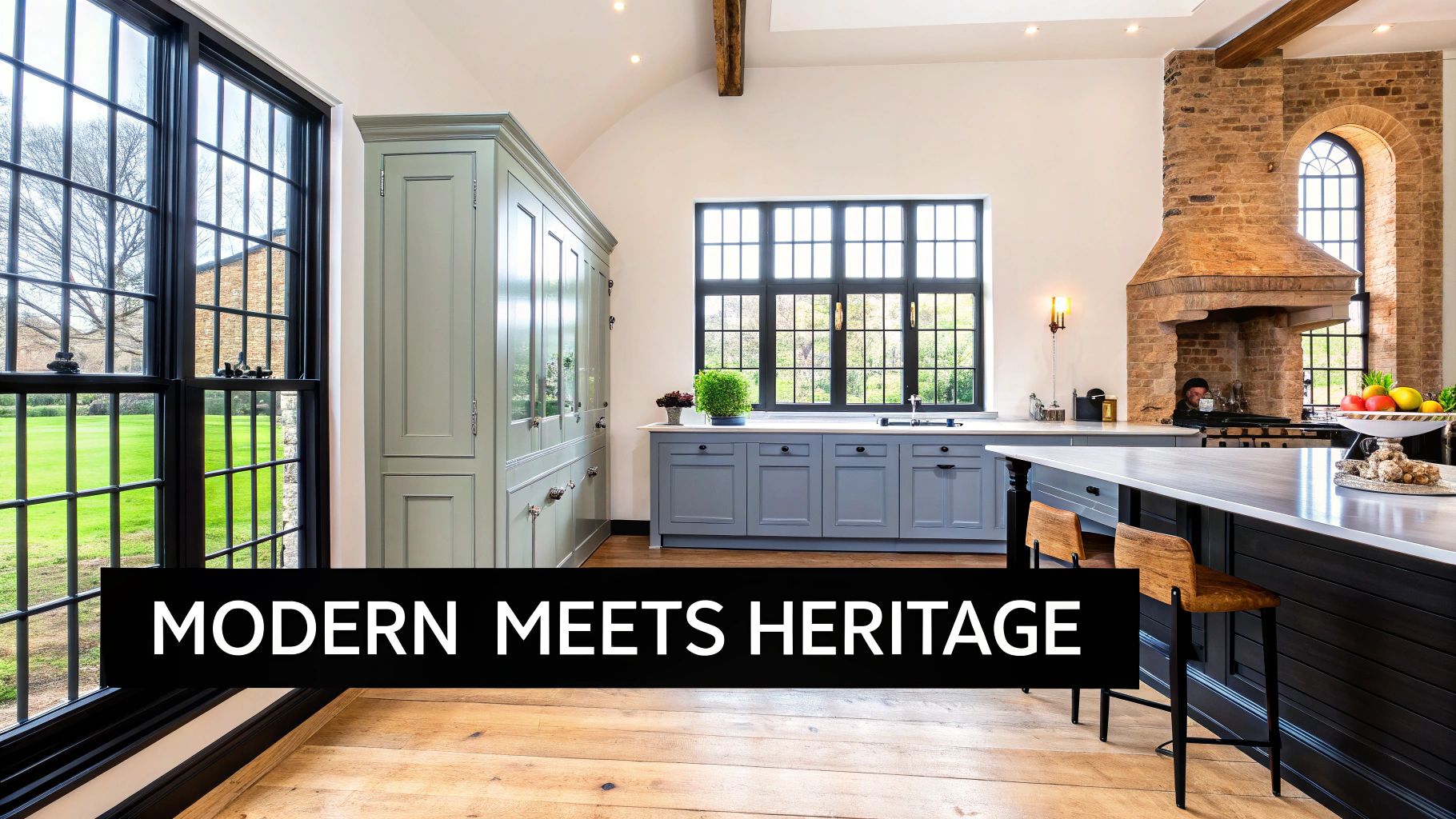
How do you install a dream kitchen in a 19th-century villa without tearing out its soul? This is the question at the very heart of any heritage restoration project. It’s all about finding that perfect, sometimes elusive, balance between preserving the historical character of a home and making it a functional, comfortable, and sustainable place to live today.
This isn’t about creating a museum piece. We’re talking about thoughtful adaptation, where modern conveniences are woven in so seamlessly they feel like they were always meant to be there. This practice, often called 'adaptive reuse', is about giving historic buildings a vibrant new life and purpose.
Integrating Modern Services Sensitively
One of the biggest practical hurdles is threading modern services—plumbing, electrical, heating, and cooling—through the building without scarring its historic fabric. Ripping through original plasterwork or ornate cornices is simply not an option.
Instead, the approach demands creativity and meticulous planning. We often look for clever pathways, like running new wiring through existing floor cavities or using custom skirting board ducts. For heating and cooling, high-velocity small-duct systems can be a fantastic solution; their flexible, narrow tubes can be snaked through walls and ceilings with minimal disruption.
The goal is for modern services to be felt but not seen. A successful integration is one that provides all the comfort of a new home without leaving a visible trace on the historic character of the old one.
Designing Sympathetic Extensions
When your family needs more space, adding an extension to a heritage home requires a delicate touch. Councils in Adelaide generally favour designs that are clearly contemporary but complementary to the original structure. This approach avoids creating a "false history," where a new addition tries too hard to mimic the old and ends up devaluing both.
A successful modern addition often hinges on a few key principles:
- Subtle Connections: Using a glazed link or a recessed connection creates a clean visual break between the original building and the new extension.
- Material Harmony: We choose materials that echo the colours and textures of the original home without directly copying them. For example, a charcoal-coloured metal cladding can beautifully complement the tones of an old bluestone wall.
- Respectful Scale: It’s crucial that the new structure doesn't dominate the original. The extension should typically be smaller and set back from the primary facade.
This thoughtful design strategy allows the home's story to be read clearly, honouring its past while fully embracing its future.
Boosting Sustainability and Energy Efficiency
There's a common misconception that heritage buildings are inherently inefficient. While they certainly have their challenges, their original construction—think thick masonry walls and well-placed windows for cross-ventilation—often provides a great head start for sustainability.
Improving energy efficiency is a key part of modernising any heritage home. This 'reuse first' mindset is central to sustainable development. In fact, alterations and additions to residential buildings are a massive part of Australia's construction activity, reaching $3.7 billion in a single recent quarter. This just goes to show the huge national investment in upgrading existing homes, a practice that is far more sustainable than demolition and new construction.
Making meaningful upgrades involves focusing on sensitive interventions that work with the building, not against it. When figuring out how to achieve both conservation and modern living, exploring energy-efficient roofing solutions can help balance historical preservation with contemporary sustainability goals.
Other critical upgrades we focus on include:
- Window Draught-Proofing: Carefully restoring and draught-proofing original timber sash windows is far more effective and appropriate than replacing them. This retains character while dramatically reducing heat loss.
- Effective Insulation: Installing high-performance insulation in roof spaces and under floors is a must. For walls, breathable insulation materials are essential to prevent moisture from getting trapped within the historic masonry. You can learn more in our guide to choosing the right eco-friendly building materials.
- Smart Systems: Integrating modern, efficient hot water systems, solar panels (sensitively placed out of sight), and energy-efficient appliances makes a huge difference to the home's overall environmental footprint.
By weaving these strategies together, you create a home that is not only historically significant but also wonderfully comfortable and sustainable for modern family life.
Taming the Beast: Keeping Your Project on Budget and Schedule
Let’s be honest: keeping a heritage restoration on track, both with money and time, is one of the toughest parts of the job. New builds are predictable. Heritage projects? They’re full of surprises. After years in the trenches, I can tell you that sharp planning and staying ahead of the game are the only ways to navigate the chaos without pulling your hair out.
Your budget isn't just a spreadsheet; it's your most critical tool. It needs to be detailed, honest, and built with a heavy dose of reality. Think of it as the financial roadmap that keeps you from getting lost in the woods.
Crafting a Bulletproof Budget
The first rule of budgeting for a heritage project is simple: always, always expect the unexpected. I've lost count of the times we've pulled back a wall lining to find something we weren't bargaining for. This is precisely why a contingency fund of 15-20% of the total project cost isn't just a suggestion—it's essential.
This isn't just slush money. It's a calculated buffer for the kind of gremlins that commonly pop up in old buildings:
- Hidden structural issues, like rotted-out floor joists or crumbling footings.
- The sudden discovery of rising damp or a termite buffet once the walls are open.
- Needing more intricate material matching for slate tiles or custom-milled timbers than you first thought.
Your contingency is your project's insurance policy. You hope you never have to cash it in, but knowing it’s there gives you the breathing room to fix problems properly instead of cutting corners.
And a quick tip: never accept a single lump-sum quote from a builder. You need a detailed, itemised breakdown. This transparency lets you see exactly where every dollar is going and gives you the power to make smart trade-offs if you need to pull back on costs.
Getting the Sequence Right to Avoid Costly Rework
The order you do things in is absolutely critical. Get it wrong, and you'll find yourself paying to undo and redo work—a soul-destroying and expensive exercise. A well-run heritage restoration has a natural, logical flow, almost always moving from the outside in and from the ground up.
The sequence should always be about stabilising the building's bones first.
- Foundations and Structure: Start here. Deal with any dodgy footings, subfloor problems, or wall integrity issues. It’s pointless putting a perfect new roof on a building that’s on the move.
- The External Envelope: Next, make the building waterproof. This means sorting out the roof, gutters, downpipes, window repairs, and any masonry work like repointing. Lock the weather out.
- Internal Services (Rough-in): Once you're watertight, the sparkies, plumbers, and air-con guys can get in to run all their pipes and wires through the walls and floors.
- Linings and Finishes: Now for the fun part. With the messy stuff done, the beautiful finishing work can begin: plastering, installing joinery, tiling, and finally, painting.
Communication is Everything
At the end of the day, the smoothest projects are built on a bedrock of clear, constant communication. This is where your relationship with your builder truly shines. You need to set up a regular rhythm for check-ins and site meetings right from the get-go.
A weekly on-site catch-up with your builder and key trades is gold. It’s the perfect forum to see progress firsthand, ask questions, and make decisions on the spot. This simple habit stops tiny misunderstandings from snowballing into massive headaches. When you combine this with regular progress photos and open-book budget tracking, everyone stays on the same page, turning a potentially stressful build into a truly collaborative and rewarding journey.
Your Heritage Restoration Questions Answered
If you're thinking about restoring a heritage home in Adelaide, you've probably got a lot of questions spinning around your head. It's a big undertaking, and it's completely normal to feel a bit overwhelmed at first. Let's tackle some of the most common queries we get from homeowners just like you.
What's the Real Cost of a Heritage Restoration?
This is always the first question, and the honest answer is: it truly depends. Every heritage property is unique, with its own history and set of challenges. The final cost comes down to the building's current condition and what you're hoping to achieve.
Unlike a standard renovation, you're dealing with specialist tradespeople, hard-to-source materials, and often, decades of hidden surprises. That’s why a detailed initial assessment is non-negotiable for creating a realistic budget.
Crucially, you must factor in a healthy contingency fund. We always advise clients to set aside an extra 15-20% of the total budget. This isn't just a "nice to have"; it’s an essential buffer for things like uncovering rotted timbers, damp issues, or unexpected structural problems once work begins.
Can I Build a Modern Extension onto My Heritage Home?
Absolutely! Adding a modern extension is a fantastic way to make a historic home practical for contemporary life without sacrificing its soul. It’s all about creating a thoughtful conversation between the old and the new.
The trick is to design an addition that complements the original building's character, scale, and materials, rather than trying to imitate it. Most council planners actually prefer this approach, as it avoids creating a "pastiche" or a false sense of history. A good heritage architect can design a stunning, light-filled modern space that honours and even elevates the original home.
Restoration vs. Renovation: What’s the Difference?
Restoration is about meticulously returning a building to its state at a specific point in time. Renovation is focused on updating a space for new use. A great heritage project is often a careful blend of both. You might restore the original pressed-tin ceilings and ornate fireplaces while thoughtfully renovating the kitchen and bathrooms for modern living. This is often called adaptive reuse.
Ready to start your own restoration journey with a team that truly understands Adelaide's unique heritage? Contact Templeton Built today to discuss how we can bring your vision to life with care and expertise.


Leave a Reply