

How to Budget for Renovations: Budgeting for Renovations:
You’re probably in the same spot many Adelaide homeowners reach sooner or later. The house still works, but only just. The kitchen feels tight, the living area doesn’t suit the way your family uses it, and you’ve started wondering whether an extension or renovation would be smarter than moving. Then the excitement is followed by the question that stops most projects in their tracks. What is this going to cost, and how do we stop it getting out of hand?
That concern is justified. Renovation budgets rarely fail because people don’t care. They fail because the scope is loose, the early assumptions are optimistic, and local risks get missed until the build is underway. In Adelaide, two of the big ones are material volatility and approval delays. Generic renovation advice tends to flatten those risks into broad tips that don’t help much when you’re pricing a character home extension, planning a kitchen upgrade, or trying to work out whether your contingency is enough.
A workable renovation budget isn’t a guess with a round number at the bottom. It’s a decision-making tool. It tells you what you can build, where the pressure points sit, what needs to be locked in early, and which upgrades are worth paying for.
Your Renovation Dream Meets Financial Reality
A common scenario goes like this. A family in Adelaide loves their suburb, likes their block, and doesn’t want the disruption of moving. They start talking about opening up the back of the house, adding a bedroom, fixing the old bathroom, and making the kitchen feel like the centre of the home instead of a cramped afterthought. The ideas are sensible. The uncertainty sits in the budget.
One partner wants a number before committing to anything. The other has started saving inspiration photos and assumes they’ll “work it out” as they go. That’s usually where trouble starts. Renovations punish vague thinking.
In Australia, the average cost of a full house renovation in 2023 ranged from AUD 60,000 to AUD 150,000, with kitchen renovations averaging AUD 30,000 to AUD 70,000 depending on scope and materials, based on data cited from hipages and ABS construction cost movements in the verified data provided. Those ranges matter because they show how far outcomes can shift once scope, finishes, structure, and approvals come into play.
Renovation budgeting gets easier when you stop asking for one magic number and start asking better questions about scope, timing, and risk.
That’s the practical shift. Before you chase quotes, choose tiles, or compare loan options, you need to pin down what you’re trying to build and why. A budget has to reflect the project you want, not a vague version of it.
For Adelaide homeowners, that means budgeting with local conditions in mind. Older homes can hide asbestos and structural surprises. Council pathways can slow momentum. Materials can move faster than your spreadsheet. But none of that means you can’t plan confidently. It means the budget needs to be built properly from the start.
Laying the Groundwork Your Renovation Scope and Vision
The best renovation budgets begin before any pricing happens. They begin with scope control. If you don’t define the job clearly, every number that follows is soft.

Start with needs and wants
A simple needs-versus-wants list sounds basic, but it does heavy lifting. It forces you to separate what the renovation must solve from what would be nice to include if the budget allows. That distinction protects you later when quotes come back higher than hoped.
A verified planning note states that Australian homeowners typically underestimate costs by 20 to 30% due to hidden issues like asbestos in pre-1990s Adelaide homes, which is why a detailed needs-versus-wants list is an essential first step, as noted in this renovation planning guide.
Write your list in plain language. Don’t write “improved functionality”. Write “add a second toilet”, “fit a full-size island”, “create a bedroom with built-in storage”, or “bring laundry inside”. Specific requirements lead to specific pricing.
A useful way to sort it:
- Must-have outcomes. More bedrooms, better flow, safer access, structural repairs, weatherproofing, storage, energy compliance.
- Would-like inclusions. Skylights, custom joinery upgrades, feature lighting, premium appliances, decorative wall finishes.
- Can-wait items. Landscaping, built-in outdoor kitchen, wine storage, decorative upgrades that don’t affect the core build.
Turn the wish list into a project brief
Once you’ve got priorities, turn them into a short written brief. This doesn’t need architectural language. It needs clarity.
Include:
- Rooms affected. List each room or area in scope.
- Main objective. What problem is this renovation solving?
- Non-negotiables. Items you won’t compromise on.
- Preferred finishes. Broad direction only, not every product selection.
- Site realities. Access, slope, heritage character, existing cracks, old services, drainage concerns.
- Lifestyle constraints. Whether you’ll live in the home during works, school terms, work-from-home needs, pets, parking.
Practical rule: If a builder can’t tell from your brief what you’re trying to achieve, your quotes will be harder to compare and easier to dispute later.
Scope changes cost more than most people expect
Not all renovations are equal, even when the final area looks similar on paper. A kitchen refresh inside the existing footprint is one thing. A rear extension that changes the roofline, relocates drainage, and triggers planning review is another.
In Adelaide, local context matters. A character extension in Norwood or Prospect can carry very different design, access, and approval implications compared with updating a newer home in Glenelg or the Hills. A villa with original masonry, uneven floors, and heritage expectations behaves differently from an eighties home where you can rework openings and services more freely.
Here’s where homeowners often trip up. They price the visible ambition, not the construction reality. They budget for “a new kitchen” when the actual project is “a new kitchen plus wall removal, steel, rewiring, flooring continuity, upgraded windows, and a reconfigured pantry”.
A good scope is detailed, but not bloated
You don’t need to decide every tapware finish before getting early pricing. You do need enough information to stop the project drifting.
A solid first brief should answer these questions:
| Scope question | Why it matters |
|---|---|
| Are you changing the footprint? | This affects structure, approvals, and site works |
| Are wet areas moving? | Plumbing relocation often changes cost and complexity |
| Are walls being removed? | Structural work can shift the whole budget |
| Are you matching an older house? | Existing conditions and detailing often add labour |
| Are you staying during the build? | Staging and temporary works may be needed |
Clear scope provides a strong advantage. It makes early pricing more realistic, reduces misunderstandings, and helps you decide where to spend properly and where to simplify.
Estimating Your True Renovation Costs in Adelaide
Early estimating is where the dream meets arithmetic. This isn’t the final contract price. It’s the stage where you test whether the project, as currently imagined, sits inside a realistic range.
Use local benchmarks, not generic online guesses
South Australian renovations often come in lower on labour than some national averages, but that doesn’t automatically make projects cheap. Verified data notes that costs in South Australia are often 5 to 10% below the national average due to lower labour rates, while timber and steel surged 25% locally in 2022 to 2023, making material estimating critical, as referenced in this cost guide.
That trade-off matters. A homeowner might save on local labour rates and then lose ground through poor estimating on structure, imported finishes, or delayed selections that leave them exposed to price movement.
If you want a broader local reference point before engaging a builder, Templeton Built’s guide to the average cost to renovate a house is useful for sense-checking the likely range against your scope.
Know what usually sits inside the total
Most first-time renovators focus on the visible items. Cabinetry. Tiles. Appliances. Benchtops. Those matter, but the unseen categories often decide whether the budget holds.
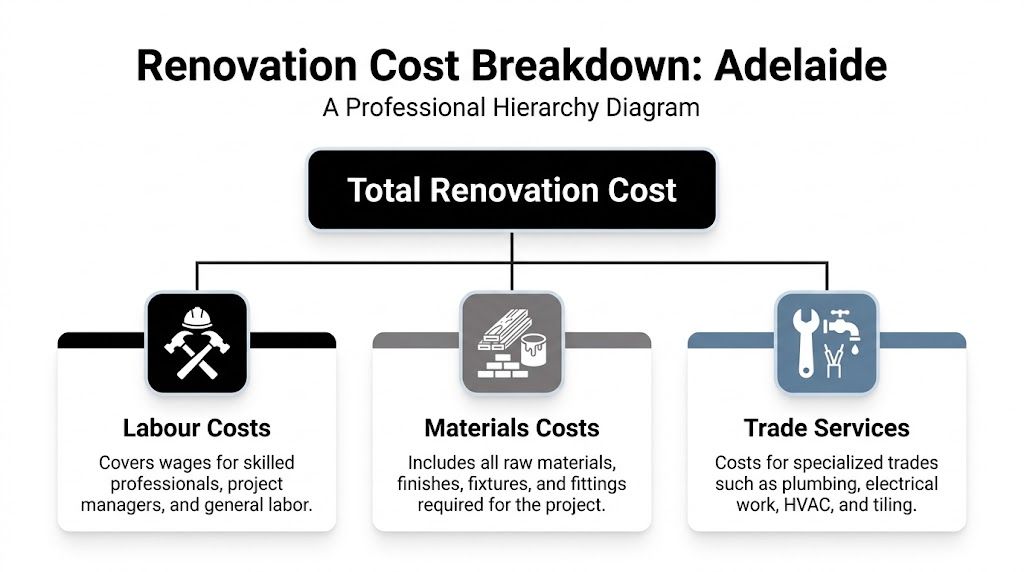
At a high level, verified data supports this rough structure for renovation budgeting:
Typical cost split: around 50% materials, 30% labour, 10% fees, and 10% contingency, based on the verified renovation budgeting data provided.
That’s a forecasting tool, not a fixed rule. Some projects will lean harder into labour if the work is detailed and complex. Others will push materials higher if the specification is premium. The point is to stop treating the budget as one lump sum.
The cost centres that deserve attention
Structural and demolition work
Hidden risks are a critical aspect of renovation budgeting. Removing walls, altering rooflines, fixing discovered defects, underpinning, or making older parts of the house line up with new works can move a budget quickly. Older Adelaide homes often carry surprises once demolition begins.
Structural spending is rarely glamorous, but it’s the money that makes the rest of the renovation possible.
Labour and trade services
Builders, carpenters, electricians, plumbers, tilers, plasterers, painters, and installers all shape the final number. The bigger issue isn’t just the hourly or trade rate. It’s how efficiently the job has been documented and sequenced. Loose plans lead to more site questions, rework, and downtime.
Materials and fixtures
This category is the one homeowners tend to engage with first because it feels tangible. But materials need discipline. A budget can absorb a single premium item chosen on purpose. It struggles when every decision subtly upgrades the specification.
Think in layers:
- Base build materials. Timber, steel, plasterboard, insulation, fixings, windows, doors.
- Finish materials. Flooring, tiles, paint, benchtops, cabinetry fronts.
- Fixtures and fittings. Tapware, basins, appliances, lighting, handles, mirrors.
Fees and approvals
Professional documentation, engineering, planning advice, and council-related costs belong in the budget from day one. If they’re left out, the build quote can look artificially low.
For Adelaide projects, this matters even more when extensions, façade changes, or overlay issues are involved.
Adelaide examples that change the estimate
A modern kitchen overhaul in Glenelg, kept within the same footprint, is generally easier to estimate than a character addition in a tightly held suburb where matching existing details matters. The first project may be driven by joinery, services, and finishes. The second may involve more uncertainty around structure, external materials, compliance, and approvals.
Another common issue is ground conditions and site access. If trades can’t get materials in easily, if site storage is limited, or if excavation is constrained, labour productivity changes. Those aren’t dramatic line items when written on a quote, but they affect the total.
Price the project in bands, not false precision
Early budgeting works better when you estimate in layers:
| Estimate layer | What it tells you |
|---|---|
| Core build cost | Whether the project is fundamentally viable |
| Selection allowance | Whether your taste sits above or below the base scope |
| Approval and consultant costs | Whether front-end expenses are properly covered |
| Risk allowance | Whether the project can absorb surprises |
A budget built this way gives you room to have a sensible conversation with designers, builders, and lenders. It also helps you test alternatives without starting from zero each time. If the extension is too ambitious, you can reduce footprint, simplify glazing, hold the kitchen layout, or stage secondary works later.
That’s far more effective than choosing one arbitrary number and hoping the quotes line up.
Building Your Detailed Renovation Budget Template
Once you’ve got a realistic estimate range, build a line-by-line budget. With this, control starts. A rough figure is useful for deciding whether to proceed. A detailed budget is what helps you stay organised once decisions and invoices begin.
Verified data shows that 52% of Australian renovation projects overrun their budgets, with the average overrun at 16%, and that’s why a structured budget with a dedicated contingency is the main defence, as noted in this CoreLogic renovation report.
Build the spreadsheet before construction starts
Use a spreadsheet with separate sections for each stage of the project. Keep it simple enough to update weekly. If it’s too complicated, you won’t maintain it.
At minimum, include:
- Pre-construction. Design, drafting, engineering, surveys, approvals
- Site preparation. Demolition, skip bins, temporary protection, site establishment
- Build and structure. Framing, roofing, windows, external cladding, insulation
- Trades. Plumbing, electrical, heating and cooling, waterproofing, tiling
- Internal finishes. Plastering, painting, flooring, skirtings, doors
- Fixtures and joinery. Kitchen, laundry, wardrobes, appliances, tapware, lighting
- External works. Decking, paving, drainage rectification, reinstatement
- Contingency
- Variations and owner-supplied items
If you want a ready-made starting point, a practical resource is this Ultimate Home Renovation Budget Template. It’s useful as a framework, especially if you’ve never tracked a renovation budget before.
For a fast local sense-check, Templeton Built also offers a home renovation cost estimator that can help align your first-pass budget with your renovation type.
Use a contingency that matches the risk
Not every project needs the same buffer. A cosmetic update in a newer home is different from opening up a pre-1990s house with unknown services and possible asbestos. Your contingency should reflect that.
Verified guidance in the provided data recommends 10 to 15% of total project cost for contingencies in one dataset, while other verified planning guidance points to 15 to 20% contingency for projects facing supply chain delays and hidden conditions. The practical lesson is simple. The older and less certain the house, the stronger the contingency needs to be.
Don’t use contingency to upgrade finishes. Keep it for genuine unknowns, scope clarifications, and unavoidable corrections discovered during the work.
A sample budget layout
Below is a simple example of how to track a kitchen renovation budget.
Sample Budget for an Adelaide Kitchen Renovation
| Item/Category | Estimated Cost (AUD) | Actual Cost (AUD) | Variance |
|---|---|---|---|
| Design and planning | |||
| Demolition and disposal | |||
| Electrical works | |||
| Plumbing works | |||
| Cabinetry and joinery | |||
| Benchtops | |||
| Appliances | |||
| Splashback and tiling | |||
| Flooring | |||
| Painting and finishes | |||
| Contingency | |||
| Total |
Leave room for notes beside each line item in your working spreadsheet. That’s where you record whether an amount is quoted, estimated, paid, or still pending. Those notes become critical when you’re comparing options or checking whether a claimed variation is outside scope.
Track decisions, not just dollars
A good budget file does more than total costs. It records decision points. If you swap laminate for stone, or choose custom joinery over modular, note the reason and the budget effect immediately. Small upgrades feel harmless in isolation. In combination, they’re what push projects off course.
The discipline that works best is weekly review. Update committed spend, actual invoices received, and outstanding selections. If something has drifted upward, decide what comes back out before the increase becomes permanent.
Smart Financing and Proactive Cost Control Strategies
A renovation budget only works if the money arrives when the project needs it and the spending stays under active control. That means treating finance and cost management as part of the same system.

Choose a funding approach that matches the project
Verified data provided for this brief notes that 45% of Australian renovations are funded by savings, while 28% use equity release. Neither is automatically better. The right choice depends on your cash flow, tolerance for debt, and how likely the scope is to move.
Savings can give you tighter spending discipline because every decision feels immediate. Equity can improve flexibility, but only if the drawdown, repayment pressure, and holding costs have been thought through. If the project includes approvals, staged works, or any chance of delay, cash flow planning matters just as much as total budget.
Think through three questions before committing:
- How much cash needs to be available before site work starts?
- Can you cover both progress payments and normal household costs at the same time?
- What happens if approvals or selections take longer than expected?
Cost control starts before demolition
The biggest cost-control wins usually happen before anyone picks up a tool. They come from locking selections early, reducing ambiguity in the documents, and avoiding structural scope creep.
Verified Adelaide-specific data notes that construction costs in South Australia rose 8.2% year-on-year to March 2025, driven by timber and steel price surges, and that homeowners can reduce risk by working with builders who use fixed-price material contracts, a strategy used in 65% of successful SA renovations in 2025, according to the provided verified dataset and this material cost overview.
That’s one of the most practical local lessons. If your project relies on timber, steel, or imported items, early procurement and material lock-ins can be more valuable than chasing minor savings on decorative finishes.
Make value decisions where they count
Every renovation budget needs hierarchy. Spend where replacement would be painful and save where upgrades are easy later.
A sensible pattern often looks like this:
- Spend properly on structural work, waterproofing, windows, insulation, layout improvements, and core joinery function.
- Be selective on appliances, benchtop upgrades, premium tapware, feature lighting.
- Save on decorative hardware, some light fittings, mirrors, paint colour experimentation, and non-built-in styling layers.
Better budgeting doesn’t mean choosing the cheapest option. It means knowing which decisions are expensive to revisit once the project is complete.
If your renovation shares walls or affects neighbouring properties, early legal and surveying clarity can also prevent expensive friction later. For anyone dealing with boundary-adjacent work, this guide on strategies to keep party wall costs down is worth reviewing as part of your front-end planning.
Track live spend during the build
Once the project is underway, your budget becomes a live document. It should show four things clearly:
| Budget status | Meaning |
|---|---|
| Estimated | Early placeholder, not yet formally priced |
| Quoted | Builder or supplier has provided pricing |
| Approved | You’ve committed to the spend |
| Paid | Invoice settled |
That framework helps stop one of the most common mistakes in renovations. People confuse prices they’ve seen with money they’ve committed. Those are not the same thing.
A short explainer can help visualise how to think about finances through the life of a project:
Hold a buffer outside the build cost if you can
The build budget isn’t the only pressure on your finances. Depending on the job, you may also face temporary accommodation, storage, takeaway meals, cleaning, or interest costs while waiting on approvals or milestone payments. Those aren’t always part of the contract, but they’re very real.
The homeowners who stay calm through a renovation usually do one thing well. They separate the project budget from the household buffer. That way, an issue in one doesn’t immediately destabilise the other.
Working with Your Builder to Protect Your Budget
The builder relationship has more impact on your final spend than most homeowners realise. Not because the builder controls everything, but because documentation, sequencing, approvals, and variations all flow through that relationship.
Understand the difference between an estimate and a quote
A rough estimate is a planning tool. It helps you test feasibility. It is not a promise that the project can be delivered for that exact figure.
A detailed quote should reflect clear scope, inclusions, exclusions, and assumptions. If those elements are missing, the price may look attractive but still leave plenty of room for future extras. Budget protection comes from clarity, not optimism.
Look for these points in any serious quote or contract package:
- Defined scope. What is included, and what is not
- Selection allowances. Which items are provisional because final choices aren’t locked
- Approval assumptions. What planning or consultant steps are expected
- Variation process. How changes are priced and approved
- Progress claims. When payments fall due and what they relate to
Variations need a written process
Most budget blowouts don’t come from one dramatic mistake. They come from untracked small changes. A moved window, a different splashback, upgraded flooring, an extra power point, revised joinery internals. Each one may feel minor. Together they can reshape the job.
The fix is simple. Don’t approve variations verbally on site. Require written pricing and written approval before the work proceeds wherever possible. That protects both sides and keeps the budget visible.
A renovation stays more stable when every change has three things attached to it. Scope, cost, and timing.
Local builder input helps before council gets involved
In Adelaide, planning and documentation delays can put direct pressure on your finances. Verified local data for this brief notes that DA approval processing times hit 14 weeks in 2025, adding thousands in holding costs, and that early engagement with an experienced local builder can reduce that pressure through pre-DA feasibility work, as reflected in this SA budgeting article.
That’s one reason early builder involvement matters. It can reveal whether the design intent is likely to create avoidable approval friction, awkward detailing, or unrealistic allowances before the project has absorbed too much time and money.
If you want to understand how cost planning is measured professionally on more complex projects, this overview of what a quantity surveyor does helps explain the role and where it fits.
Templeton Built uses an in-house design-and-construct model, which is relevant here because integrated design and construction teams can review feasibility, selections, and buildability together rather than in separate silos. That doesn’t remove every risk, but it can make scope and pricing easier to reconcile early.
From Budget on Paper to Your Beautiful New Home
A good renovation budget doesn’t limit the project. It gives it shape. It turns a loose ambition into a buildable plan and helps you make hard decisions while they’re still affordable to make.
The pattern is straightforward. Define the scope properly. Estimate with Adelaide conditions in mind. Build a detailed budget that separates known costs from risk. Set up finance and cash flow so the project isn’t starved midway through. Then work with a builder who treats documentation, approvals, and variations as budget issues, not just construction issues.
That’s how to budget for renovations without relying on guesswork. You don’t need perfect certainty before you begin. You do need a process that respects uncertainty and prices it realistically.
The homeowners who come through renovations with the least stress usually aren’t the ones with unlimited budgets. They’re the ones who made decisions early, kept records, and understood where the financial pressure points sat.
If you're planning a renovation, extension, or custom project in Adelaide and want a clearer path from early ideas to a workable budget, speak with Templeton Built. Their team handles design and construction under one roof, which can help bring scope, pricing, approvals, and delivery into the same conversation from the beginning.


Leave a Reply