

Is Building a Custom Home Worth It? An Adelaide Guide
You're probably weighing this up because your current home no longer works, and none of the obvious alternatives feels simple.
Maybe the kids are sharing rooms that are too small. Maybe you're working from the dining table. Maybe you've looked at established homes across Adelaide and found yourself paying for someone else's compromises. Renovation seems possible, but you're wary of opening walls and discovering problems you didn't budget for. Building from scratch sounds appealing, but it also sounds expensive, slow, and full of unknowns.
That's the essential version of the question. Not just whether a custom home looks better on paper, but whether is building a custom home worth it for your money, your time, and your day-to-day life in Adelaide.
The Custom Home Question in Adelaide
A lot of Adelaide families reach the same fork in the road. They've outgrown the house they bought years ago, but moving into another established property often means trading one set of frustrations for another. The floor plan is wrong. The orientation wastes natural light. The kitchen is dated. The block is good, but the house isn't.
That's usually when custom building enters the conversation. Not as a luxury fantasy, but as a practical response to a house that no longer fits the people living in it. In Adelaide, that decision has to be made with local realities in mind. Land availability, council processes, energy rules, and site conditions all shape whether a project makes sense.
Four things that decide whether it's worth it
For most households, the answer comes down to four tests:
- Financial fit. Can you fund the build properly, including the costs that don't show up in glossy display home marketing?
- Time tolerance. Are you prepared for a longer path than buying an existing home?
- Lifestyle gain. Will the design solve real problems in the way you live?
- Long-term value. Will the finished result hold up better, cost less to run, and suit you for longer?
A local track record matters because custom homes are rarely straightforward. Adelaide-based builder Templeton Built has been operating since 2001 and has completed 64 bespoke custom homes, more than 400 renovations, and 200+ extensions as of 2026, which gives useful context for how established and viable this style of building is in South Australia (Business Context).
A custom home is worth far more when it solves a specific problem well, not when it simply adds more floor area.
That distinction matters. Bigger isn't always better. Better planned is.
The Financial Equation of a Custom Build in Adelaide
The first mistake people make is treating a custom build like a simple construction quote. It isn't. The true cost sits across land, design, approvals, site preparation, construction, finishes, external works, finance, and the inevitable surprises that show up once the project is moving.
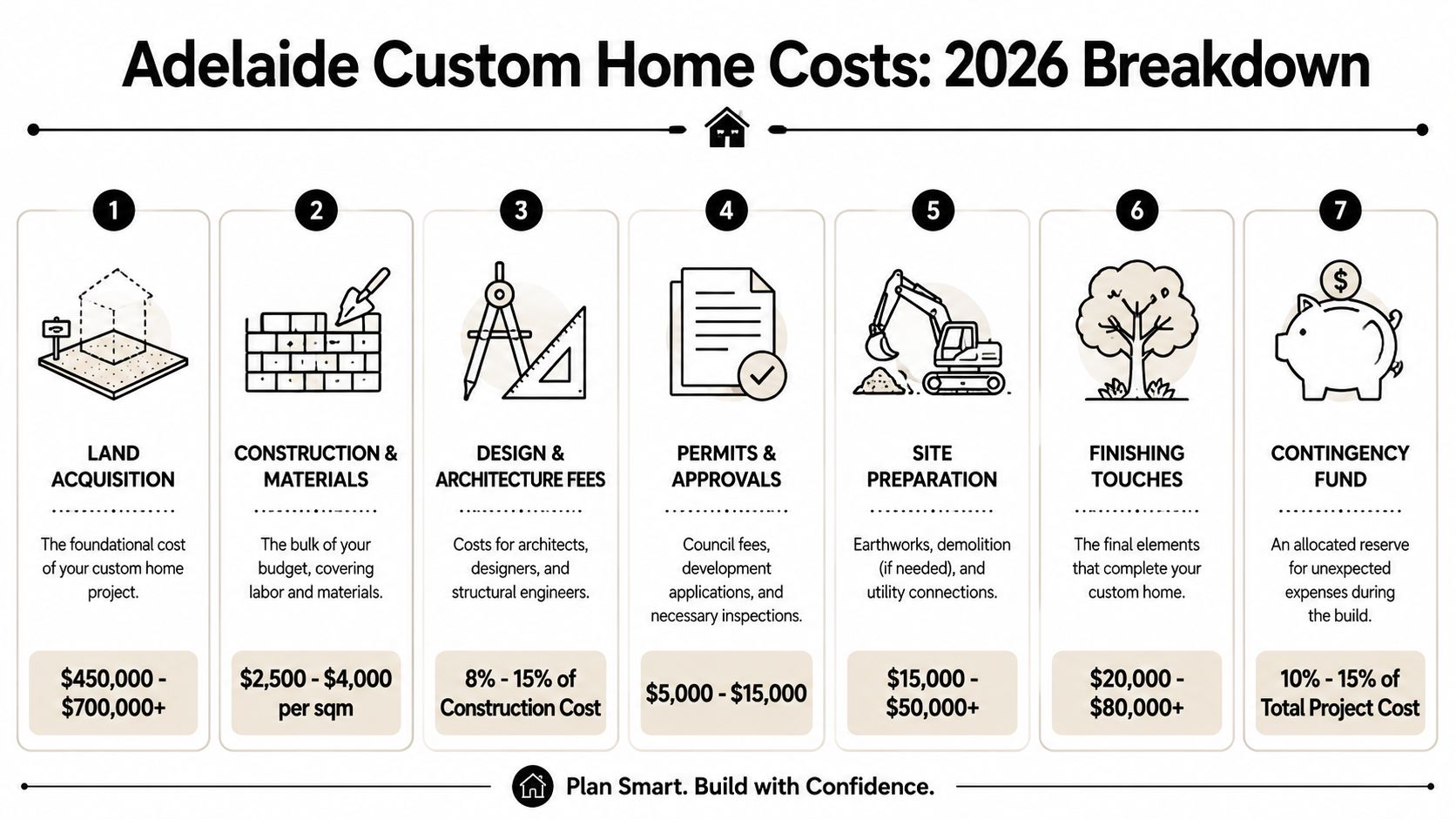
In South Australia, construction costs have risen sharply. ABS data shows SA construction costs surged 12.4% in the last year, yet custom homes in premium Adelaide suburbs such as Prospect and Walkerville can still achieve 15 to 20% higher resale premiums, and many households now budget with a 20% contingency because the RBA cash rate is currently 4.35%. Those are not reasons to panic. They're reasons to plan properly.
Where budgets usually move
Three areas cause the most stress.
First, the site itself. Adelaide blocks can look straightforward until engineering, stormwater, retaining, or soil conditions are assessed. Reactive ground, slope, access, and service connections can shift a project quickly. If your block needs retaining, it helps to review practical references on budgeting for Australian concrete sleeper projects early, because retaining walls are one of those items people often underestimate.
Second, selections. Joinery, glazing, cladding, appliances, flooring, wet area finishes, and external paving all affect cost. None of them is wrong in itself to upgrade, but every premium choice compounds.
Third, time. Holding costs don't stop while drawings, approvals, and documentation are being completed.
What works and what doesn't
What works is setting the budget before the design runs away from it. Good custom projects have a clear brief, a target figure, and disciplined decision-making. The design responds to the budget, not the other way around.
What doesn't work is starting with a wish list and hoping value management will fix it later. By that point, compromises are often more painful because they affect the parts of the home you cared about most.
Practical rule: If a project only works financially with no buffer, it doesn't work yet.
A realistic Adelaide custom build budget should account for:
- Borrowing pressure. Higher rates affect borrowing capacity and monthly comfort, not just headline affordability.
- Site complexity. Soil, slope, demolition, and retaining can change the spend well before the slab goes down.
- Specification drift. Clients often upgrade the details they touch every day. Kitchens, bathrooms, windows, and storage are common examples.
- Approval-related holding costs. Delays cost money, even if the construction quote itself hasn't changed.
For a clearer local breakdown, it's worth reading this guide on the cost to build a house in Adelaide, especially if you're still trying to compare broad estimates with what a custom project involves.
Is the premium justified
Sometimes yes, sometimes no.
If you're stretching to build a home with features you don't need, the answer is probably no. If you're building in a location where design quality, performance, and layout matter to future buyers, or you plan to stay long enough to benefit from the house you're creating, the equation changes.
A custom home tends to make the most sense when the block is strong, the brief is specific, and the household wants a result that can't be bought off the shelf.
Beyond the Price Tag The Long-Term Value
The upfront cost gets most of the attention. The longer-term running cost usually deserves more.
A well-designed custom home in Adelaide isn't just new. It's built to modern energy and construction standards with deliberate decisions around orientation, glazing, insulation, ventilation, and materials. Those choices can reduce the pain of ownership over many years.
Lower running costs through better performance
In South Australia, a custom home with a 7-star NatHERS rating can reduce annual heating and cooling costs by 25 to 35%, saving an Adelaide family $1,200 to $1,800 yearly. That's not a decorative benefit. It changes how the house feels and what it costs to live in.
A home that performs well stays more stable through summer heat and winter cold. Rooms are more usable across the day. You rely less on mechanical heating and cooling to make the place comfortable.
That's where custom design often beats standard stock. The orientation can respond to the block. The glazing can be placed and shaded properly. The layout can put the most-used spaces where they'll get the best natural light and thermal benefit.
Fewer repair surprises over time
The second long-term advantage is maintenance. Custom homes built to modern standards have 30 to 50% lower lifecycle maintenance costs compared to pre-2000s homes.
That matters in Adelaide because older homes often come with hidden issues that aren't obvious at inspection stage. Movement, outdated detailing, ageing roofs, poor drainage, and inefficient windows can all become recurring expenses. Renovated homes can still carry inherited weaknesses behind new finishes.
The cheapest way to own a house is rarely the cheapest way to buy one.
A good custom build doesn't remove maintenance forever. Nothing does. What it can do is reduce the frequency and severity of expensive surprises by starting with current standards and better detailing.
Where the long-term value is real
The strongest long-term value usually comes from a combination of these factors:
- Efficient envelope design that cuts ongoing heating and cooling demand
- Durable material choices that stand up to daily wear and Adelaide conditions
- Smarter planning that avoids future renovation pressure because the home works properly from the start
- Modern compliance that reduces the gap between your home and changing buyer expectations
Custom building often proves its worth here. This value stems not from a lower initial contract, but from the fact that the home keeps performing after handover.
Your Time and The Building Process What to Expect
Money gets measured carefully. Time often doesn't, until the project starts.
A custom build asks more from you than buying an existing property. You'll make more decisions, wait through approvals, review drawings, and balance excitement with patience. That's normal. The key is understanding the sequence so delays don't feel like chaos.
The stages that shape the timeline
A custom home in Adelaide usually moves through several distinct phases.
Brief and concept
At this stage, the home is defined properly. Not just room counts, but how you live, what the site allows, and what the budget can support.Design and documentation
Plans become more detailed, consultants get involved, engineering is coordinated, and the project becomes buildable on paper.Development approval and compliance
In Adelaide, DA approval can average 6 to 9 months, which can add significant holding costs. At the same time, SA's mandatory 8-star energy efficiency baseline, effective July 2025, increases upfront costs by 10 to 15%, so the planning phase needs to account for energy performance from the beginning.Construction and handover
Once approvals, documentation, and selections are in place, the build itself becomes far more predictable.
What slows projects down
The biggest delays usually come from indecision, incomplete documentation, and redesign late in the process.
If clients change layouts after engineering, or postpone key finish selections, the job gets harder to schedule and price cleanly. If the builder, designer, and consultants aren't aligned, communication gaps appear quickly.
This short video gives a useful sense of how the early planning mindset affects the build journey:
How to keep the process manageable
The most successful projects usually share the same habits:
- Resolve the brief early. Changes on paper are cheaper than changes on site.
- Make selections on time. Joinery, tiles, tapware, appliances, and windows all affect documentation and procurement.
- Expect approvals to take time. In Adelaide, impatience doesn't make councils move faster.
- Treat energy compliance as a design input. Don't leave NatHERS and related performance decisions until the end.
Clients handle the process best when they know which decisions are urgent, which decisions can wait, and which changes will trigger redesign.
A custom build is worth it for people who want control and are prepared to engage with the process. If you want the fastest path into a home, buying established will usually win. If you want the house to fit the block and your life properly, this longer route often pays off.
Designing a Home That Fits Your Life
The strongest argument for custom building usually isn't financial. It's practical.
People choose a custom home when standard layouts keep failing them. Not in dramatic ways, but in the daily irritations that wear you down. No storage where you need it. Bedrooms in the wrong part of the house. A kitchen that turns its back on the living area. Harsh western sun in the rooms you use most.
Real lifestyle problems a custom design can solve
A multi-generational family often needs both connection and separation. That might mean a private suite for parents or grandparents, better acoustic separation between sleeping zones, and shared spaces that still feel calm when the house is busy.
A couple working from home may need two quiet work areas, not one study squeezed beside the entry. They may also want those spaces to disappear after hours so the house doesn't feel like a workplace all week.
Families with changing mobility needs usually benefit even more from building to suit. Wider circulation, step-free access, thoughtful bathroom layouts, and easier transitions between inside and outside are much simpler to get right from day one than to retrofit later.
Why off-the-plan often falls short
Project homes and established houses tend to assume a generic household. Real households aren't generic.
One family needs a mudroom because kids come in from sport every afternoon. Another needs direct pantry access from the garage. Another wants the main bedroom separated from children's rooms because shift work affects sleep. Those aren't luxury requests. They're design responses to real life.
For ideas on how that process comes together, this page on custom home design and build shows the kind of thinking that matters most. Not just the façade, but how design decisions support the way a household lives.
The best custom homes feel obvious once they're finished. Every room sits where it should have been all along.
The features that usually matter most
The most successful custom homes rarely chase every trend. They prioritise things that improve everyday use:
- Kitchen and living connection that suits how the family gathers
- Natural light control so the house feels comfortable across the day
- Storage in the right places rather than just more cupboards
- Flexible rooms that can change as children grow or work habits shift
That's the value many buyers miss when comparing square metres alone. A well-planned home can feel easier, calmer, and more useful every day, even without being larger.
Exploring the Alternatives Renovate Buy or Build
A custom build isn't automatically the right answer. The right answer depends on what problem you're trying to solve.
Sometimes a renovation is enough. Sometimes buying established makes sense because speed matters more than precision. Sometimes the only sensible move is to start fresh because the house, site, and budget no longer align.
Adelaide Housing Options At a Glance
| Factor | Custom Build | Major Renovation | Buy Established |
|---|---|---|---|
| Design control | Highest. You shape the plan around the block and your routine. | Moderate. Existing structure limits what's practical. | Lowest. You choose from what already exists. |
| Timeline feel | Longest and more involved. Approvals and documentation take time. | Often unpredictable once demolition starts. | Fastest path to occupation. |
| Budget certainty | Better when documentation is complete and selections are resolved early. | Often vulnerable to hidden conditions in older homes. | Clear purchase price, but future upgrades may follow quickly. |
| Risk of surprises | Mostly front-loaded into design, engineering, and site assessment. | High once walls, floors, and services are opened up. | Hidden defects may not appear until after settlement. |
| Lifestyle fit | Highest if the brief is strong. | Can improve substantially, but compromises usually remain. | Depends on what you can find and afford. |
| Long-term efficiency | Strongest opportunity to build to modern performance standards. | Mixed. Some upgrades help, but the original shell still matters. | Varies widely by age, orientation, and previous work. |
| Emotional strain | High decision load, but with a clean path once underway. | Often hardest if you stay living in the home during works. | Lower during purchase, higher later if the house isn't right. |
Renovating isn't always the middle ground people expect
Many people assume renovation is the safer compromise. Sometimes it is. Sometimes it isn't.
Older homes can conceal structural movement, outdated services, water damage, and awkward framing that only becomes visible after demolition begins. That's one reason renovation budgets can become difficult to hold. If you're assessing an older property and want a practical look at how age affects wet area work, this guide on upgrading bathrooms in historic Melbourne properties is useful because the same logic applies broadly to many character homes.
A simple way to choose
If your block is excellent and the current house is the problem, renovation or rebuild can both be viable.
If your household needs are highly specific, custom building usually offers the cleanest result.
If your priority is speed and certainty of move-in date, buying established often wins, provided you're honest about the compromises you're accepting.
The mistake is choosing based on the shortest spreadsheet only. The better question is which option leaves you with the least regret five years from now.
Your Decision Checklist and Questions for Your Builder
By the time people are seriously asking whether is building a custom home worth it, they usually already know the emotional answer. What they need is a practical filter.
Your decision checklist
A custom build is usually a strong option if most of these statements are true for you:
- You can fund the project with a proper buffer rather than hoping nothing changes.
- You plan to stay long enough to benefit from the design, comfort, and lower running costs.
- Your site or lifestyle needs are specific enough that a standard home won't solve them well.
- You're prepared for a slower process in exchange for more control.
- You value long-term fit more than getting into any house as quickly as possible.
If several of those don't apply, another path may suit you better.
Questions that reveal whether a builder is right
The builder matters as much as the design. A polished estimate isn't enough. You need to understand how that builder thinks, communicates, and handles pressure.
Ask questions like these:
- How do you manage budget variations once documentation is complete?
- What site investigations do you recommend before final pricing?
- Who handles consultant coordination and approvals?
- How early do you address energy performance and compliance requirements?
- What items are commonly excluded or misunderstood in custom home quotes?
- What warranties do you provide, and how do defects get handled after handover?
- Can you explain your communication process during construction?
A practical builder should answer clearly, not defensively. If you want a fuller interview list, this guide on questions to ask a custom home builder is a worthwhile starting point.
Why experience across complex work matters
One of the best indicators of quality is a builder's experience with difficult projects, not just straightforward new builds. Templeton Built's experience across 400+ renovations gives deep familiarity with Adelaide's housing stock, site conditions, and council nuances, which is especially valuable when planning a new custom home.
That broader lens matters because custom building still draws on the same core judgement. How a builder reads a site. How they anticipate issues. How they sequence trades. How they protect the quality of the finished home.
For readers also comparing smaller secondary dwelling paths or prefabricated options, this article on how to find reliable ADU manufacturers is useful as a contrast. It highlights many of the same evaluation themes: transparency, process, specifications, and accountability.
A good builder doesn't just promise a result. They make the path to that result understandable.
If you can answer the checklist truthfully and your builder can answer the hard questions clearly, you're already in a much better position than most.
If you're weighing up a custom home, renovation, or extension in Adelaide, Templeton Built can help you assess the trade-offs before you commit. Their team handles design and construction with a practical, transparent approach, so you can make decisions with clearer numbers, better planning, and confidence in the result.


Leave a Reply