

Kitchen Renovation ROI: An Adelaide Homeowner’s Guide
A lot of homeowners still assume the bigger the kitchen renovation, the better the return. The numbers say otherwise. Recent benchmarking cited by Zillow shows a minor kitchen remodel averaging 112.9% cost recoup, while a major upscale remodel may return only 36%, and Australian renovation advice noted in the same reference says major remodels can fall to roughly 38% ROI when budgets climb too far via Zillow's kitchen remodel ROI guide.
In Adelaide, that tracks with what buyers respond to. They notice a kitchen that feels clean, current, practical, and well finished. They don't always pay extra for the hidden cost of moved plumbing, steel beams, custom internals, or imported features that push the job well beyond the suburb's ceiling. That's the core truth behind kitchen renovation roi. Spend where buyers can see it, use it, and compare it.
Decoding Your Kitchen Renovation ROI
Many hear ROI and think only about resale. That's only half the story.
A kitchen renovation has financial ROI and lifestyle ROI. Financial ROI is the value you might recover when you sell. Lifestyle ROI is what you get every day from a kitchen that works better, feels better, and causes less friction in the house.

Financial return and lived return
It's similar to upgrading a car. New tyres, a tidy interior, and a proper service usually help resale because the next owner sees immediate value. A racing exhaust and expensive custom work might suit your taste, but they won't necessarily lift the sale price enough to cover the spend.
Kitchens work the same way. New cabinet fronts, better lighting, updated appliances, and a durable benchtop often improve both presentation and function. A full redesign with structural work can still make sense, but usually because the house needs it for how you live, not because it's the fastest route to profit.
If you want to pressure-test the numbers before you build, it helps to calculate property investment returns alongside renovation costs, likely holding period, and your suburb's current value range.
Practical rule: If your main goal is resale, treat the kitchen like a value-positioning exercise, not a dream-spec wish list.
Why smaller renovations often win
The strongest lesson from published benchmarking is simple. Minor remodels often beat major ones on return because they modernise the room without loading the budget with expensive hidden works. That's especially relevant in Adelaide suburbs where buyers compare your home against nearby sales, not against prestige homes in a different market.
A sensible brief usually starts with three questions:
- What do buyers see first: Cabinetry condition, benchtops, splashback, flooring transitions, appliance age, and lighting.
- What frustrates you daily: Lack of storage, poor prep space, awkward traffic flow, or not enough power points.
- What's the property likely to support: A renovation should still feel in proportion with the rest of the home.
If you're planning broader resale-minded upgrades, this guide to best renovations to increase home value is a useful companion to kitchen planning.
The Cost Spectrum of an Adelaide Kitchen Renovation
Before you can judge kitchen renovation roi, you need a realistic sense of spend. Nationally, Australian homeowners commonly spend about A$25,000 to A$50,000 on a kitchen remodel, while larger projects can reach A$65,000 or more, especially once structural change and higher-end selections enter the job according to this Australian renovation cost reference.
That national range is broad, but it reflects a real pattern in Adelaide. The closer a project stays to the existing footprint, the easier it is to control cost. Once you start shifting walls, windows, plumbing points, or major electrical runs, the budget rises quickly.
Three common renovation tiers
Here's the practical way to think about it locally.
| Renovation tier | Where the money usually goes | Best fit |
|---|---|---|
| Cosmetic refresh | Painting, cabinet door replacement or refacing, benchtop swap, tapware, splashback, lighting, selected appliances | Kitchens with a workable layout but dated finishes |
| Mid-range gut and replace | New cabinetry, new benchtops, appliance package, updated services within the same general footprint | Tired kitchens that need a full visual and functional reset |
| High-end structural remodel | Layout change, wall removal, service relocation, custom joinery, premium finishes | Homes where the existing kitchen genuinely fails the household |
The reason the lower and middle bands so often perform better is simple. Buyers pay for what they can appreciate quickly. They don't usually match your spend on hidden infrastructure unless it produces a dramatic, obvious improvement in how the house lives.
What usually pushes cost up
Some decisions have an outsized impact on budget:
- Changing the layout: Moving the sink, cooktop, or fridge position can mean more plumbing, electrical, patching, and joinery adjustment.
- Choosing fully custom joinery: Sometimes it's the right call. Sometimes a standardised cabinet system with smart sizing gives nearly the same visual result.
- Upgrading every finish at once: Stone, feature splashbacks, integrated appliances, designer tapware, and custom lighting all add up fast.
- Fixing old-house surprises: Uneven floors, non-compliant wiring, or damaged wall linings can force scope changes after demolition.
A kitchen budget rarely blows out because of one dramatic choice. It usually happens through ten small upgrades agreed to one after another.
For a deeper Adelaide-specific breakdown of what different project levels tend to include, this page on the average cost of kitchen renovation is worth reviewing before you finalise a brief.
The local Adelaide reality
In suburbs with solid family demand, a clean and cohesive kitchen often does more heavy lifting than an extravagant one. If the renovation looks appropriate for the house, buyers feel reassured. If it looks overbuilt relative to the bathrooms, flooring, and outdoor areas, it can create imbalance.
That's why the smartest kitchen budgets are usually set in relation to the whole property. A kitchen shouldn't feel cheap. It also shouldn't look like the only room where the money went.
Key Factors That Drive Kitchen Renovation ROI
The strongest kitchen-renovation ROI is usually achieved by a minor refresh, with national guidance for 2025 showing minor remodels returning around 113%, while major remodels recover only about 36% to 51% as noted in this kitchen ROI report. The spread comes down to one issue more than any other. Structural work adds cost faster than it adds resale value.
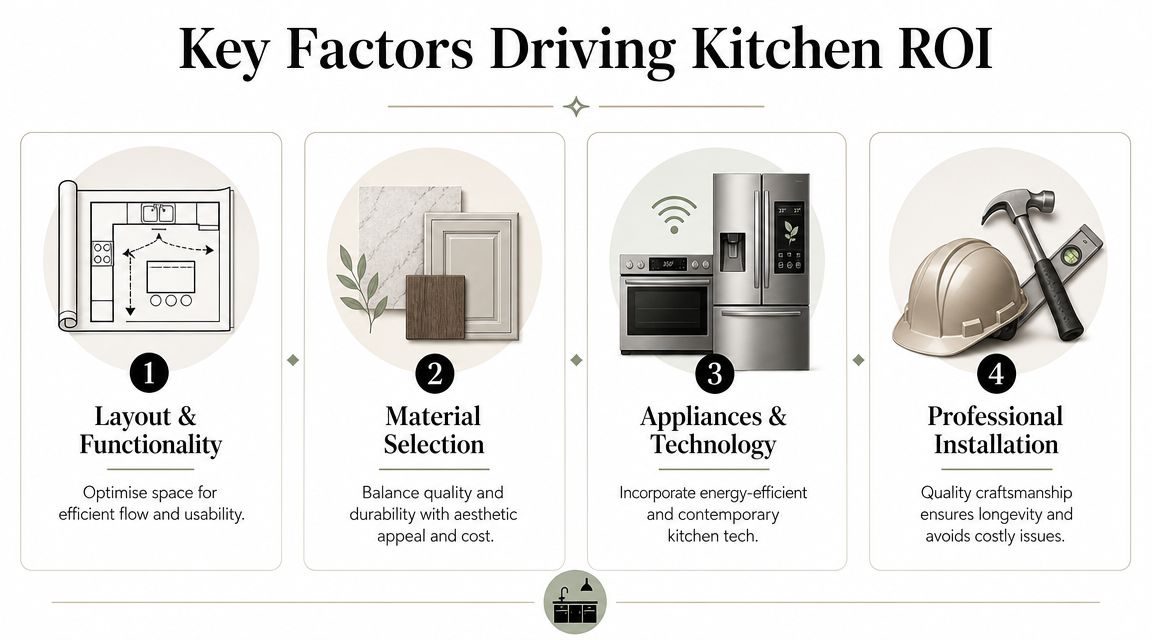
Finishes that buyers notice immediately
If the layout is serviceable, finishes usually carry the highest visible impact.
Cabinet fronts, benchtops, splashback tile, tapware, handles, paint colour, and lighting tell the buyer whether the kitchen feels current or tired. In Adelaide homes, a restrained palette generally travels better than highly personalised colour choices. Warm whites, soft neutrals, timber accents, and durable surfaces tend to age better than trend-heavy combinations.
A buyer doesn't inspect a kitchen the way a builder does. They walk in and make a fast judgement. Does it feel bright, clean, organised, and easy to maintain? Finishes answer that question before anything else.
Appliances that support value without overspend
Appliances sit in the middle ground between style and practicality. Old appliances can drag down the whole room, even if the cabinetry is sound. Good replacement choices help the kitchen feel complete.
What usually works best is a cohesive appliance package that suits the property level. Not entry-level if the rest of the home is polished. Not ultra-specialised if the likely buyer won't pay extra for niche features.
A few sound principles hold up well:
- Match the house: A family home usually benefits from reliable, easy-to-use appliances rather than novelty.
- Keep the look consistent: Mixed finishes and mismatched brands can make a new kitchen feel pieced together.
- Choose serviceable products: Long-term reliability matters to owners and future buyers alike.
Buyers reward kitchens that look resolved. They hesitate when the room feels like three different budgets were spent at three different times.
Layout changes that can help or hurt
Layout is where judgement matters most. Some kitchens are merely dated. Others are awkward. If the room has poor circulation, no landing space near appliances, or storage in the wrong places, a layout change may be justified.
But many Adelaide kitchens don't need a full rethink. They need better use of the existing shell. Extending cabinets to the ceiling, widening drawers, improving the pantry setup, and reallocating the fridge position can sharpen function without rebuilding the room from scratch.
Use this comparison as a guide:
| Choice | Typical ROI effect | Why |
|---|---|---|
| Work within existing footprint | Usually stronger | Lower trade complexity, less waste, easier cost control |
| Refine storage and workflow | Often positive | Daily usability improves in a way owners and buyers notice |
| Reconfigure entire plan | Mixed | Can solve major problems, but cost rises quickly |
| Move services and structure | Usually weaker financially | Hidden works absorb budget without equal visual payoff |
Structural changes that need a clear reason
Removing a wall can transform a home. It can also soak up budget that would have delivered more visible value elsewhere. The same applies to relocating plumbing, enlarging openings, or changing windows just for the kitchen.
That work makes sense when the existing setup is actively harming how the house functions. It doesn't make sense motivated only by an open-plan image on Pinterest looking appealing.
If you're weighing structural changes, ask two questions. First, does this solve a genuine problem in how the family uses the home? Second, is the improvement large enough that a future buyer in this suburb would recognise it as value, not just cost?
Smart Strategies to Maximise Your Return
The best kitchen renovation roi rarely comes from spending more. It comes from spending in the right order.
A technically efficient strategy targets items with shorter payback and lower disruption. Benchmark analysis cited in renovation commentary reports cabinet refacing at roughly 75% to 96% ROI, energy-efficient appliance replacement at about 60% to 75%, while moving walls or relocating plumbing commonly recoups less than 40% because the spend disappears into hidden infrastructure rather than buyer-visible value as discussed in this renovation ROI video reference.
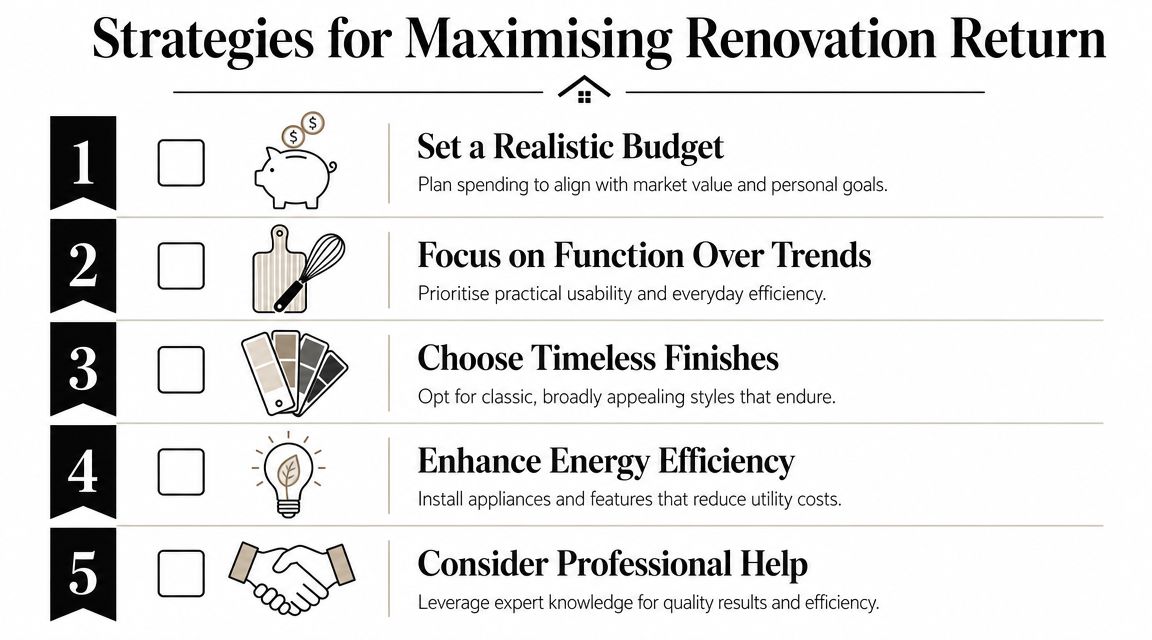
Spend on visible impact first
If the carcasses are sound and the layout works, refacing or replacing fronts can be a smarter move than a total rebuild. The same logic applies to benchtops, splashback, tapware, and lighting. These are the elements people register immediately.
That doesn't mean cutting corners. It means understanding what changes perception fastest. A dated kitchen can look substantially better with crisp joinery fronts, a durable benchtop, better task lighting, and a coordinated appliance set, even if the plumbing stays where it is.
Use an impact-versus-effort filter
Every renovation decision should be tested against two questions. How much difference will this make? How disruptive and expensive is it to execute?
A simple builder's filter looks like this:
- High impact, low disruption: New fronts, benchtops, splashback, sink, tapware, pendants, under-cabinet lighting.
- Moderate impact, moderate disruption: Full cabinet replacement within the same footprint, appliance upgrades, pantry redesign.
- Potentially high impact, high disruption: Wall removal, window changes, relocating sink or cooktop, new bulkheads.
When owners skip this filter, they often chase expensive complexity before fixing obvious visual and practical issues.
Builder's advice: Start with what the next owner will see in the first thirty seconds and what your family will use every single day.
Keep the design consistent
A kitchen loses value when it looks patched together. You might save money by reusing some items, but if the old floor clashes with new joinery, or the appliance finish doesn't match the rest of the palette, the room can feel unresolved.
Consistency matters more than luxury. A modest kitchen with good proportion, a restrained material palette, and quality installation usually lands better than a more expensive one with too many competing ideas.
Lighting is one of the most underrated examples. Good task lighting over benches, soft ambient light, and pendants scaled correctly to the island can sharpen both function and mood. If you want practical ideas before locking in fixtures, this guide on how to transform your home with expert lighting is a solid reference.
Value-engineer without cheapening the result
Value-engineering gets misunderstood. It doesn't mean stripping quality out of the job. It means substituting intelligently.
Examples include choosing a simpler door profile, standard cabinet depths where possible, a more practical splashback format, or a durable engineered surface instead of a premium natural one if the visual outcome still fits the brief. In many Adelaide projects, those choices protect the budget without changing how the kitchen feels to live in.
The other side of this is knowing where not to compromise. Poor installation, weak hardware, bad lighting layout, and awkward storage planning can drag down both lifestyle and resale. Cheap fixes in those areas often become expensive frustrations later.
Adelaide Case Studies The Templeton Built Approach
Theory matters, but real kitchens make the trade-offs clearer. Adelaide projects tend to fall into two camps. One is resale-led, where the brief is to sharpen presentation without overspending. The other is lifestyle-led, where the family plans to stay and wants the house to work properly for years.
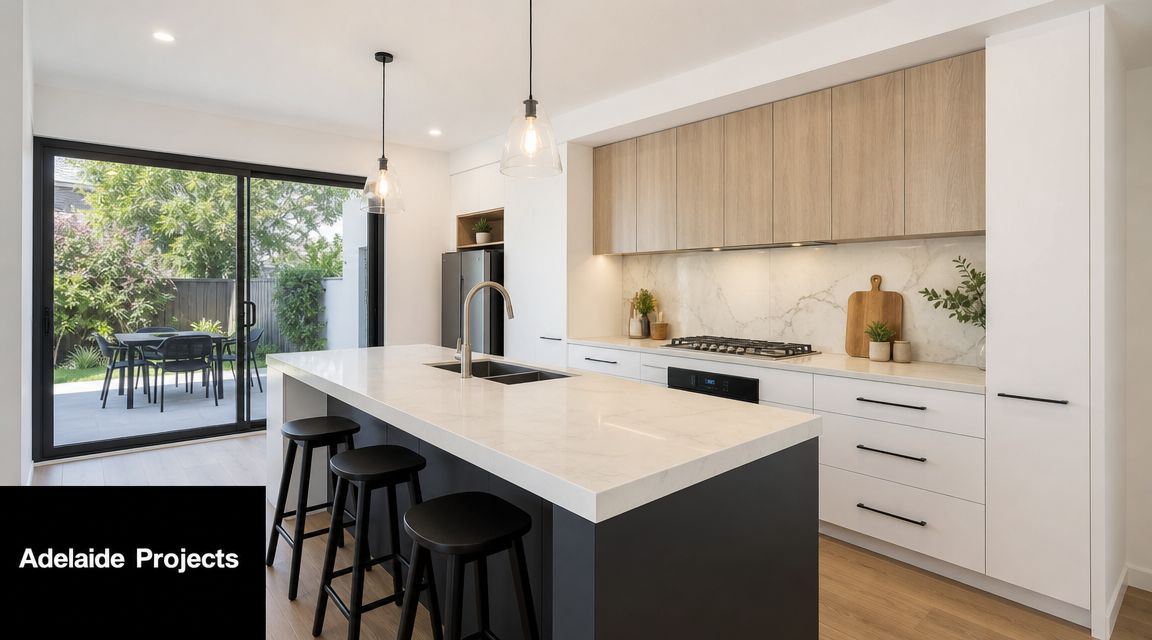
A controlled upgrade for sale readiness
A typical resale-focused project in an inner-east suburb starts with a kitchen that isn't structurally bad. It's just dated. Timber-toned laminate doors, tired handles, old tile splashback, bulky overheads, and appliances that make the whole room feel older than the house.
The smart move in that scenario is usually restraint. Keep the plumbing and appliance positions broadly where they are. Replace the cabinetry or fronts, install a clean stone-look or stone benchtop, simplify the splashback, update the sink and mixer, and improve lighting. If the flooring outside the kitchen still presents well, work hard to maintain continuity rather than create awkward patched transitions.
That sort of project tends to support financial return because buyers can see a modern kitchen without inheriting a price tag that feels inflated for the suburb. The room reads as fresh, practical, and ready to move into.
A family kitchen designed for daily use
A different brief comes up in established family suburbs. The owners aren't preparing for sale. They're tired of cooking in a closed-off room while the rest of life happens elsewhere.
In that case, the right answer can be more ambitious. A wall comes out. The kitchen opens to living and dining. The island becomes breakfast bar, homework station, serving bench, and social hub. A walk-in pantry or hidden scullery reduces bench clutter and helps the family keep the main space calm.
That kind of renovation doesn't always chase peak financial ROI. It chases better mornings, easier entertaining, better sightlines to children, and less congestion at the busiest times of day. That's lifestyle ROI, and for long-term owners it can be the right call.
A project video helps show how these decisions play out on site:
Some kitchen decisions make sense on a spreadsheet. Others make sense at 6:30 pm when everyone is home and the old layout stops working.
The key is honesty about the brief. If the home is likely to be sold soon, the controlled upgrade often wins. If the owners are building around the way they live, a bigger intervention can still be excellent value, just measured differently.
Your Kitchen Renovation Decision Framework
Before you commit to plans, answer the questions that shape the return.
The shortlist that keeps decisions honest
Ask yourself:
Is my main goal resale, lifestyle, or a mix of both
If it's resale, keep a tighter grip on scope. If it's lifestyle, make sure the extra spend solves a real daily frustration.What is the likely value ceiling for my suburb and street
Your kitchen should feel appropriate for the home and the area. If it overshoots, recovery gets harder.What is the single biggest problem in the current kitchen
Lack of storage, poor workflow, bad lighting, not enough prep space, or visual age. Fix the biggest problem first.Can I improve function without moving services
If the answer is yes, your budget usually works harder.Will the new kitchen match the rest of the house
A polished kitchen in a tired home can create imbalance instead of value.Who is going to design and build it clearly from start to finish
Builder involvement early helps keep design ambition aligned with buildable cost. If you're weighing who to speak with, review experienced kitchen renovation contractors before locking in your team.
Write your answers down. That becomes your brief. A clear brief is what stops a kitchen renovation from drifting into expensive decisions that don't improve either resale or daily life.
If you're planning a kitchen renovation in Adelaide and want clear advice on scope, cost, and what will add value, Templeton Built can help you shape a brief that suits your home, your suburb, and the way you live.


Leave a Reply