

Payment Schedule Construction: A Builder’s Guide for SA
You're probably in one of two spots right now. Either you've just received a building contract and your eyes have gone straight to the payment schedule, or you're a builder trying to write one that's fair, clear and hard to argue with later.
That anxiety is normal. In residential construction, most disputes don't begin with bad intentions. They begin with vague wording, poorly timed claims, or a schedule that asks one side to carry too much risk too early. In Adelaide, that risk gets sharper because local rules and common market habits matter. A generic national template won't always protect you.
A solid payment schedule construction process does more than tell people when to pay. It sets the rhythm of the project. It helps clients see what they're paying for, helps builders fund labour and materials at the right time, and gives both sides something objective to refer back to when pressure rises.
Why Your Construction Payment Schedule is a Pact of Trust
A renovation usually starts with excitement. Then the practical questions arrive. When is the deposit due? What happens after demolition? Why is the next claim bigger than expected? If nobody answers those questions properly at the start, trust starts leaking before the site even gets moving.
That's why I treat a construction payment schedule as more than an admin document. It's the financial version of the plans. It tells both parties what progress looks like, what evidence supports a claim, and when money should move. Without that structure, people fill the gaps with assumptions.

Why trust breaks down so easily
On most residential jobs, clients are funding a major personal investment. Builders are carrying staff, trades, suppliers and programme pressure. Both sides feel exposed in different ways.
A homeowner worries about paying too much before enough work is visible. A builder worries about ordering materials, booking subcontractors and then waiting too long for a legitimate claim to be paid. A fair schedule balances both realities.
Practical rule: If a payment stage can't be explained clearly in one sentence and verified on site, it's not ready to go into the contract.
In Australia's residential construction sector, a standard staged model commonly allocates 10 to 15% of the contract value at the base or slab stage and 15 to 20% at the frame stage, tying payment to actual physical progress rather than guesswork, as outlined in Builtly's guide to Australian progress payment schedules.
What a good schedule actually does
A good schedule creates discipline. It makes the builder define milestones properly. It makes the client assess claims against completed work, not emotions or site noise. It also reduces those awkward moments where someone says, “I thought that was included,” or, “I assumed that stage meant something else.”
The strongest schedules usually share the same traits:
- They tie money to visible progress rather than dates on a calendar.
- They define each milestone precisely so nobody has to argue over whether a stage is “nearly done”.
- They support cash flow without overexposing the client early in the build.
- They leave a clean paper trail if a disagreement ever needs to be resolved formally.
That's the value. A payment schedule construction document isn't about mistrust. It's about building trust that can survive stress.
Core Components of a Bulletproof Payment Schedule
A payment schedule fails in real life for predictable reasons. The stage is vague. The due date is fuzzy. The variation is agreed on site but never written down. Then the claim arrives, and both sides are sure they are being reasonable.
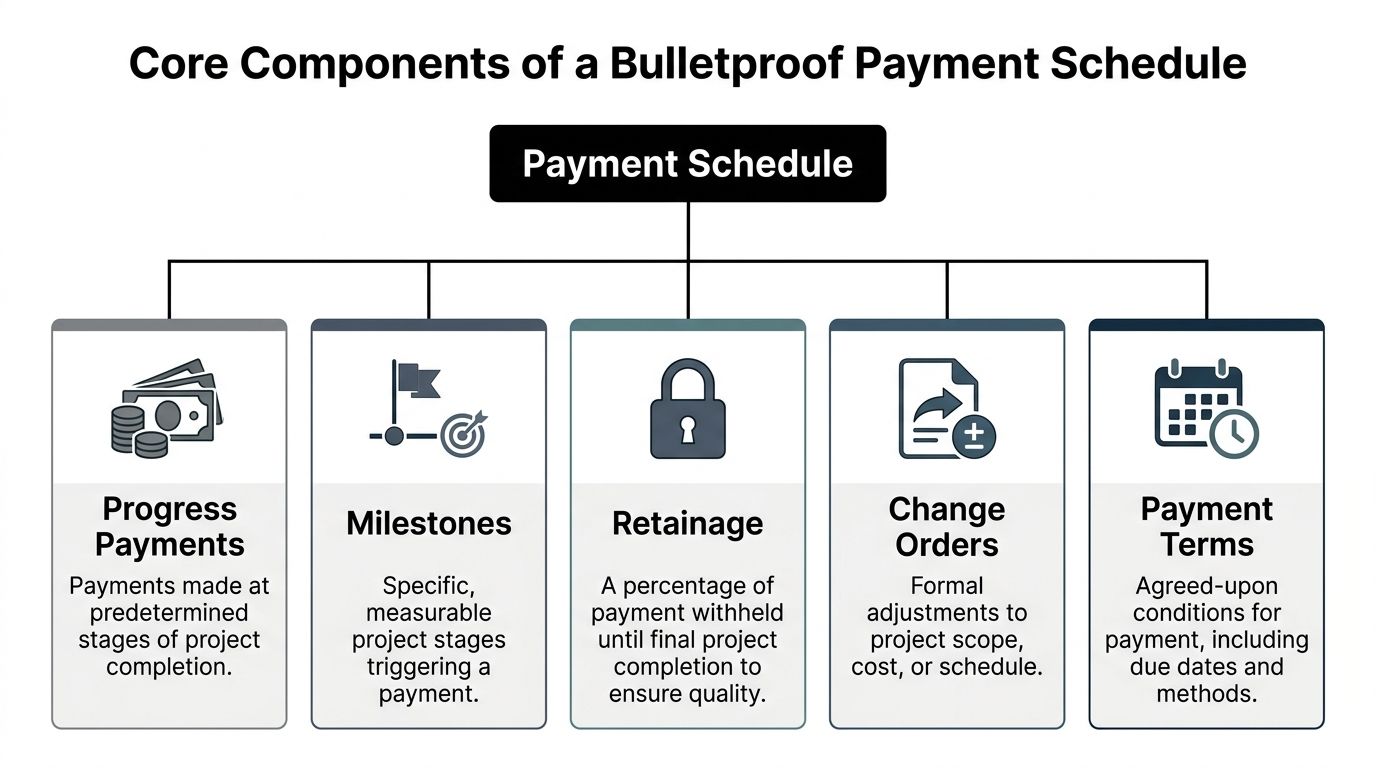
In South Australia, the paperwork matters as much as the work on site. A well-built schedule needs to match the contract, the scope, and the timing rules that apply to residential building claims. If you are in Adelaide, that also means being realistic about how renovations behave. Renovation jobs often carry demolition, investigation, latent conditions and service changes early on. That is exactly where poor schedules get front-loaded and clients end up paying too much before enough value is fixed in place.
Progress payments and milestones
Progress payments should follow completed work that can be checked on site. They should not be tied to dates alone, and they should not be triggered by work that is only partly underway.
Milestones are the checkpoints that justify each claim. Good milestone wording is specific enough that a homeowner, site supervisor or contract administrator can verify it without an argument. “Roof covering installed and external windows fitted” is clear. “Lock-up underway” is not.
Each milestone should answer three practical questions:
- What work is included
- How completion is confirmed
- What documents or approvals must exist before a claim is made
That third point gets missed regularly. On Adelaide jobs, a stage can look complete to the eye while an approval, certificate or supplier item is still outstanding. If the contract is silent, that gap becomes a payment dispute.
Deposit, payment terms and variations
The deposit needs to be stated separately from progress claims. It covers early commitments such as drafting, engineering, permits, procurement and booking trades. It does not justify inflated early-stage claims once the physical work starts.
That distinction matters on renovations. I have seen schedules where demolition and preliminary works carry far too much of the contract sum because the builder is trying to protect cash flow against unknowns. The risk is understandable. The structure is not. In South Australia, a front-loaded schedule can become a problem fast if the job slows down, the scope changes, or the relationship turns sour.
Payment terms also need plain wording. Set out when the claim can be made, what must accompany it, how long the other party has to assess it, and when payment falls due. South Australian builders and owners should also check those terms against the 15-business-day rule that applies under the Building and Construction Industry Security of Payment Act 2009 (SA), because a contract cannot ignore the statutory timing framework.
Then come variations. With variations, tidy schedules usually come off the rails. Hidden termite damage, sewer relocations, upgraded finishes, structural steel added after engineering review, heritage surprises in older Adelaide suburbs. If a variation is not priced, approved and linked to a payment pathway in writing, someone ends up arguing about whether it sits inside an existing stage or should be claimed separately.
The payment schedule should reflect the job being built now, including approved changes, not the version priced at tender.
Retention and close-out
Retention can still serve a purpose on residential work, but only if the release conditions are precise. Holding money back without clear rules creates just as much friction as having no retention at all.
Spell out what has to happen before retained money is released. That might include practical completion, handover documents, final certificates, defect rectification, or the end of the defects liability period. If those steps are blurred together, the last payment often becomes a bargaining exercise rather than a contract event.
For Adelaide homeowners, finishing items are often a source of trouble. Cabinet adjustments, paint touch-ups, cracked tiles, missing compliance paperwork, stormwater sign-off. None of those should be left to goodwill. They should be tied to a defined close-out process.
A bulletproof schedule usually includes five parts working together:
- Progress payments linked to completed work on site
- Milestones written as clear, verifiable checkpoints
- Deposit terms separated from construction stage claims
- Variation procedures that require written approval and pricing
- Retention and close-out conditions that define exactly when final money is released
If one part is vague, the whole schedule gets harder to enforce.
Sample Milestones for Adelaide Renovations and Custom Homes
A homeowner in Norwood signs off on a renovation contract, pays a large deposit, and sees a skip bin, some demolition, and a few days of site activity. It feels like the project is well underway. Financially, it may not be. In Adelaide renovations especially, that gap between visible activity and real contract value is where poor milestone drafting causes trouble.
The right schedule changes with the job. A villa renovation in Parkside does not move the same way as a custom home in the Adelaide Hills. An extension over reactive soil has different pressure points again, particularly once footing costs, engineering responses, and hidden conditions start shifting the early stages. Generic milestone templates miss those realities.
A practical way to set milestones
Use milestones that describe a completed result on site, not a trade that has merely started. "Demolition complete and site cleared" is better than "demo underway". "Roof on and external openings installed" is better than "lock-up in progress".
That wording matters in South Australia because payment claims need to stand up if they are ever challenged. Clear stage definitions also make it easier for both parties to check whether a claim matches the work completed within the timeframes set by the contract and the Security of Payment process, including the 15 business day response period that often catches Adelaide homeowners off guard.
Here is a practical benchmark for sample construction payment milestones and percentages in SA. The exact split should still match the job, the contract type, and the builder's real cost exposure.
| Stage | Description of Works Completed | Typical % of Contract Price |
|---|---|---|
| Deposit | Contract signed, approvals pathway confirmed, insurances and pre-start administration in place | Keep within South Australian legal limits |
| Demolition and make-safe, where applicable | Existing affected areas demolished, temporary protection in place, site ready for structural work | Project-specific |
| Base or slab stage | Excavation, footings, slab or base completed to the relevant contract stage | 10 to 15% |
| Frame stage | Structural frame completed to defined contract scope | 15 to 20% |
| Enclosed stage | Roof covering, wall framing or cladding, windows, and external doors installed to the point the building is substantially weather-tight | Project-specific |
| Rough-in stage | Plumbing, electrical, mechanical, and other in-wall services rough-in complete where applicable | Project-specific |
| Fixing stage | Internal linings, waterproofing where required, carpentry fix, joinery installation, and internal fit-off progressed to the contract definition | Project-specific |
| Practical completion | Works substantially complete and ready for handover, subject to minor defects and omissions | Project-specific |
| Final payment or retention release | Defects list addressed to the agreed level, certificates and manuals provided, handover complete | Final balance stated in the contract |
How milestones change by project type
A kitchen or internal renovation usually needs more milestone detail than owners expect. The risky parts are often early. Demolition can expose outdated wiring, out-of-square walls, termite damage, or plumbing that was never where the plans suggested. If the schedule is too front-loaded, the owner can pay heavily before cabinetry, stone, waterproofing, and final fit-off are in place.
A large extension benefits from splitting out the early structural work with care. Demolition, excavation, footing completion, slab, framing, and weather-tight enclosure are often worth separating because each one changes the builder's cost position and the owner's risk. On renovation work, I prefer to avoid broad labels like "lock-up" unless the contract states exactly what must be installed before that claim can be issued.
A custom home can usually follow a cleaner staged sequence, but it still should not be copied straight from a display-home template. Site works in the Hills, bushfire requirements, retaining, stormwater upgrades, and long lead-time window packages can all justify different milestone wording. If the project is being run under a cost plus contract for residential building work, the payment structure also needs tighter reporting so the owner can see how actual cost and margin are being claimed.
What fair milestone drafting looks like in Adelaide
Good milestones do three things.
- They match real value delivered on site.
- They give the owner something clear to inspect.
- They keep variations and provisional cost items from being buried inside a progress claim.
That last point matters more in Adelaide renovations than many standard guides admit. Existing homes in suburbs like Unley, Hyde Park, and Glenelg often carry hidden-condition risk from day one. The cleanest approach is to keep contract milestones for contract work, and deal with approved variations as separate, written adjustments. Once those two streams are mixed together, payment arguments get harder to sort out.
Builders should support each claim with photos, a short stage summary, and a clear reference to the contract milestone reached. Owners should check the claim against the site, the drawings, and any approved variations. That habit prevents a lot of grief before it starts.
Red Flags and Common Pitfalls to Avoid in Adelaide
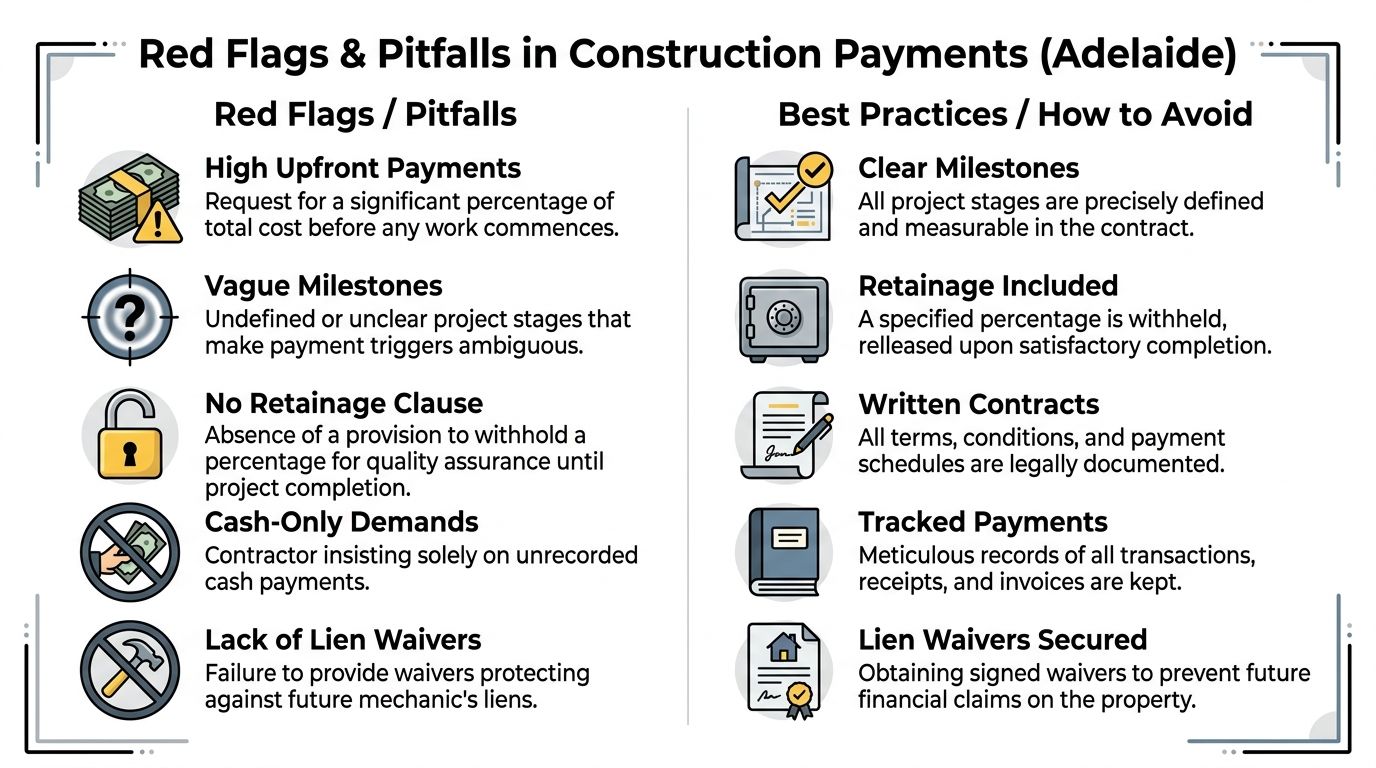
The most dangerous payment schedule isn't always the obviously dodgy one. It's often the respectable-looking schedule with vague wording, uneven front-end claims and no clean process for checking value on site.
That risk shows up often in Adelaide renovations, where demolition and early structural work can make a project feel advanced before the value on site has really caught up. That's where front-loading becomes a problem.
The front-loading trap
Front-loading happens when early payments are too large compared with the actual value delivered. In practice, a homeowner can end up heavily committed before the project has passed the riskiest early stages.
Recent industry analysis indicates that 22% of residential payment disputes in South Australia stem from overpayment at early stages due to ambiguous milestone definitions, as discussed in this Adelaide-focused progress payment analysis. That's not a small issue. It's a sign that the wording of the schedule matters just as much as the percentages.
A bad early-stage claim often sounds reasonable on first read. It might refer to “site establishment”, “preliminaries”, “demolition and prep”, or “structural commencement” without separating what has been completed from what is merely planned or partially underway.
A simple value-verification check
Before approving an early claim, match the invoice to visible progress and contract wording. Don't just ask, “Has work started?” Ask these instead:
- What has been physically completed on site right now?
- What documents support the claim such as approvals, photos or inspection records?
- Does the milestone describe a completed state rather than an activity in progress?
- Has any part of this amount already been covered by the deposit or an earlier claim?
If those questions don't produce clean answers, the schedule probably needs work.
For projects with evolving scope, it also helps to understand how the contract model affects claims. This overview of cost plus contracts is useful if you're comparing fixed-price progress claims against a more flexible pricing structure.
Other warning signs people ignore
Front-loading gets the most attention, but it's not the only problem. These red flags show up repeatedly in residential work:
- Vague milestones such as “plumbing started” or “fit-off underway”. These are hard to verify and easy to argue about.
- Handshake variations where extra work is approved verbally and invoiced later. That usually ends badly.
- Cash-only pressure because it strips away the paper trail both sides need.
- No hold-back at the end which weakens influence around defects and close-out.
- Claims without backup such as photos, variation forms, or inspection evidence.
Later in the process, watch this short overview before signing off on a schedule or claim.
If the schedule depends on trust alone, it will struggle the moment the programme slips or an unexpected variation lands.
What works better in Adelaide projects
Better schedules are plain, specific and boring. That's a compliment. They don't rely on broad labels. They identify the trigger, the evidence, and the payment timing. They also leave space for the reality that renovations uncover surprises.
If you're reviewing a contract, the safest question is often the simplest one. “What exactly will be finished when this claim is made?” If nobody can answer that cleanly, don't approve the wording as it stands.
Understanding Your Legal Rights and Obligations in South Australia
South Australian construction payment rules aren't something you can afford to treat casually. A lot of online advice mixes state rules together, and that's where homeowners and smaller builders get caught. The contract may look familiar, but the response time and legal consequences can be very different.
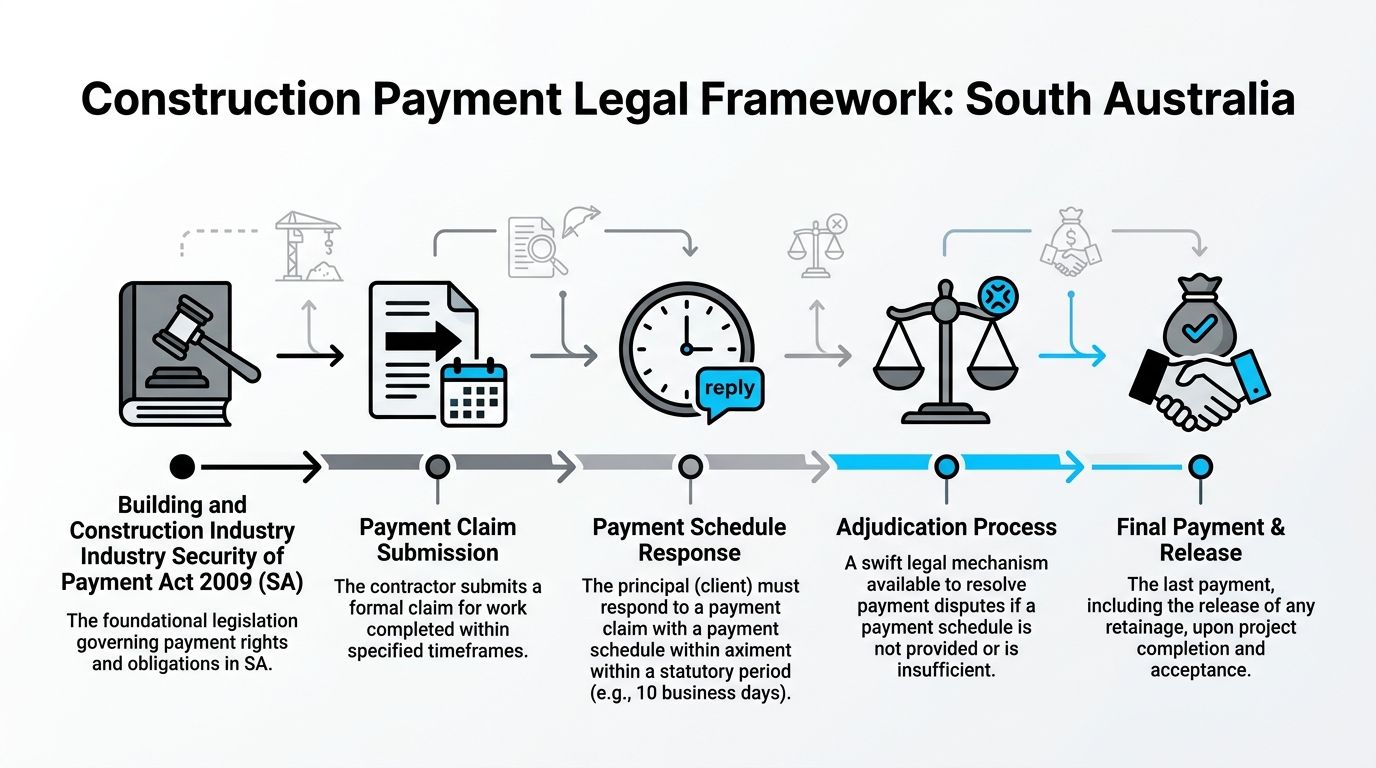
The most important local issue is the 15 business day response window. In South Australia, homeowners must serve a valid Payment Schedule rejecting a claim within 15 business days to avoid automatic liability for the full amount. Data also shows that 35% of homeowners in SA lose adjudication rights by missing this deadline, according to Becker Watt's guide to building progress payment schedules.
Why the 15-day rule matters
A lot of people assume they can “sort it out later” if they disagree with a claim. In South Australia, that assumption can cost you. If a payment claim lands and you don't respond properly within the statutory window, your position weakens fast.
That doesn't mean every claim will be disputed. Most shouldn't be. It means you need a process. Open the claim, compare it to the contract, assess the milestone, and respond in time if anything is contested.
Legal reality: A good argument delivered late is often less useful than a concise response delivered on time.
Government payment terms and contract discipline
Payment timing also matters on the contractor side. The South Australian government's Department for Trade and Investment updated its Building Projects contract templates to enforce 15-day payment terms, effective from 18 July 2024, as set out in the DIT fact sheet on government 15-day payment terms.
That same fact sheet states that approximately 70% of construction invoices in Australia are paid on time. It also notes that in March 2026, Australia's total construction work done rose 3.4% to $83.4 billion, with building work contributing $44.7 billion. Treated as a source-reported future-dated figure, it shows the scale of work moving through these payment systems.
For residential clients and builders, the practical point is simpler. Don't leave due dates implied. Don't assume “standard terms” will protect you. The contract should say how claims are made, when they're due, and what a compliant response looks like.
National advice can mislead if you apply it blindly
Interstate confusion causes real trouble. A lot of search results talk about New South Wales procedures, deadlines and adjudication language as if they apply everywhere. They don't.
If you need a comparison point, this resource on getting paid in NSW construction is helpful for understanding how another state handles payment rights. It's useful precisely because it shows why you shouldn't assume NSW timing and SA timing are interchangeable.
When you're reviewing the underlying contract, these checkpoints matter:
- The claim process is written clearly and matches the contract form.
- The response period is understood by both sides before work starts.
- Milestones are defined tightly enough that a payment claim can be assessed against actual completion.
- Variation procedures are written down so the schedule stays aligned with the changing job.
- The contract itself has been reviewed properly before signing.
This guide on what to look for in a building contract is worth reading if you want a practical checklist before you commit.
The legal framework doesn't replace good communication. It catches problems when communication fails. That's why a clear payment schedule construction process is part legal protection and part project management.
From Contract to Handover A Smooth Payment Process
A job can run well for months and still hit trouble at payment time. In Adelaide, I see it happen when a builder sends a claim that does not match the contract wording, or when a homeowner gets a bill for a stage that feels ahead of the work on site. On renovations, that tension usually starts with front-loading. Too much money is claimed early, then the trust on the job starts to slip.
The fix is disciplined admin from day one. Every progress claim should tie back to a defined milestone, describe what is complete, and include enough support for the other party to assess it properly. Photos, signed variation forms, inspection records and a short site summary usually prevent arguments before they start. If you want a practical example of how that process works, this guide to a progress claim in construction is a useful reference.
Timing matters just as much as paperwork. In South Australia, parties need to stay alert to the contract terms and the 15 business day response period that often catches owners and contractors off guard. A late reply can create avoidable pressure. A vague claim can do the same. Clear documents and prompt review keep both sides out of that position.
On site, a few habits make the process easier:
- Match each invoice to the contract milestone wording exactly
- Approve variations in writing before the extra work is carried out
- Attach photos or records that show the claimed stage is complete
- Review and respond quickly so payment timeframes are not missed
- Watch early-stage claims closely on renovation work, where front-loading is more common
Builders also need their back office in order. Good accounting keeps retention, variations, supplier bills and client claims aligned, which is often where cash flow pressure starts. If that side of the business needs work, this expert guide to construction business accounting is worth reading.
A smooth payment process is built, not hoped for. The jobs that finish cleanly usually have the same pattern throughout. Clear milestones, current records, written approvals, and no surprises at the end.


Leave a Reply