

Progress Claim Construction: A Client’s Simple Guide
You're probably here because a build is underway, a payment request has landed in your inbox, and the document looks more like a spreadsheet than a simple invoice. That reaction is normal. For most homeowners, progress claims are unfamiliar until the first one arrives, and by then the stakes feel high because you're approving real money against work happening in real time.
The good news is that progress claim construction isn't meant to confuse you. At its best, it's a transparent way to match payment with visible progress. If you understand what you're looking at, the process becomes much less stressful and much more practical.
What Is a Progress Claim in Construction
A payment request arrives after a busy week on site. You open it expecting a simple invoice, but instead you see trade descriptions, percentages complete, GST, credits, and references back to the contract. For many homeowners, that first progress claim feels more formal than expected.
A progress claim is a request for payment for the work your builder says has been completed up to a certain date or milestone. On Australian residential projects such as renovations, extensions, and custom homes, this is how payment is usually managed. Rather than paying the full contract sum upfront, you pay in agreed portions as the job moves ahead.

A progress claim works like a project checkpoint
The document is doing more than asking for money. It is showing you where the project has reached financially and physically at that point in time.
A clear progress claim usually lets you confirm four things:
- What work has been completed so far, such as demolition, framing, roofing, waterproofing, or joinery.
- What that completed work is worth under the contract and any approved variations.
- What has already been paid on earlier claims.
- What amount is now due for this claim period.
That is why a progress claim is different from the kind of invoice you get for everyday services. A standard invoice often gives you a total and a due date. A progress claim ties that amount back to the building contract, the stage of works, and the running total across the job.
If you want a clearer sense of how those totals are broken up before claims start arriving, RBA Home Plans' construction cost breakdown is a useful reference.
Why this system exists on residential projects
From the client side, progress claims are there to keep payment aligned with progress. From the builder side, they help cover labour, materials, subcontractors, and the day-to-day cost of keeping the site active. The system is meant to be fair to both sides when it is set up clearly from the start.
The best time to understand that setup is before work begins. Your payment stages, claim timing, and rules around variations should all be spelled out in the contract. If you want to check how that language is usually framed, this guide on what to look for in a building contract will help.
On many residential jobs, claims are issued at agreed milestones such as slab, frame, lock-up, or completion. On others, especially larger renovations and custom builds, the contract may allow monthly claims based on the value of work completed during that period. Many builders now support this with cloud accounting, site photos, digital approvals, and client portals, which makes it easier for homeowners to match the paperwork to what is happening on site.
Practical rule: A good progress claim should tell a clear story. You should be able to match the figures on the page to work you can see, approvals you have already given, and the contract you signed.
For you as the person paying the bills, that is the primary purpose. A progress claim is a checkpoint you can review with confidence, not just a number to approve blindly.
The Legal Safety Net Security of Payment
A common client-side scenario goes like this. Your builder sends a progress claim on Friday afternoon. You are not sure one item is ready to be paid, but you assume you can sort it out next week after a site meeting. Under Security of Payment laws, that delay can create real risk if the claim needs a formal response within a set time.
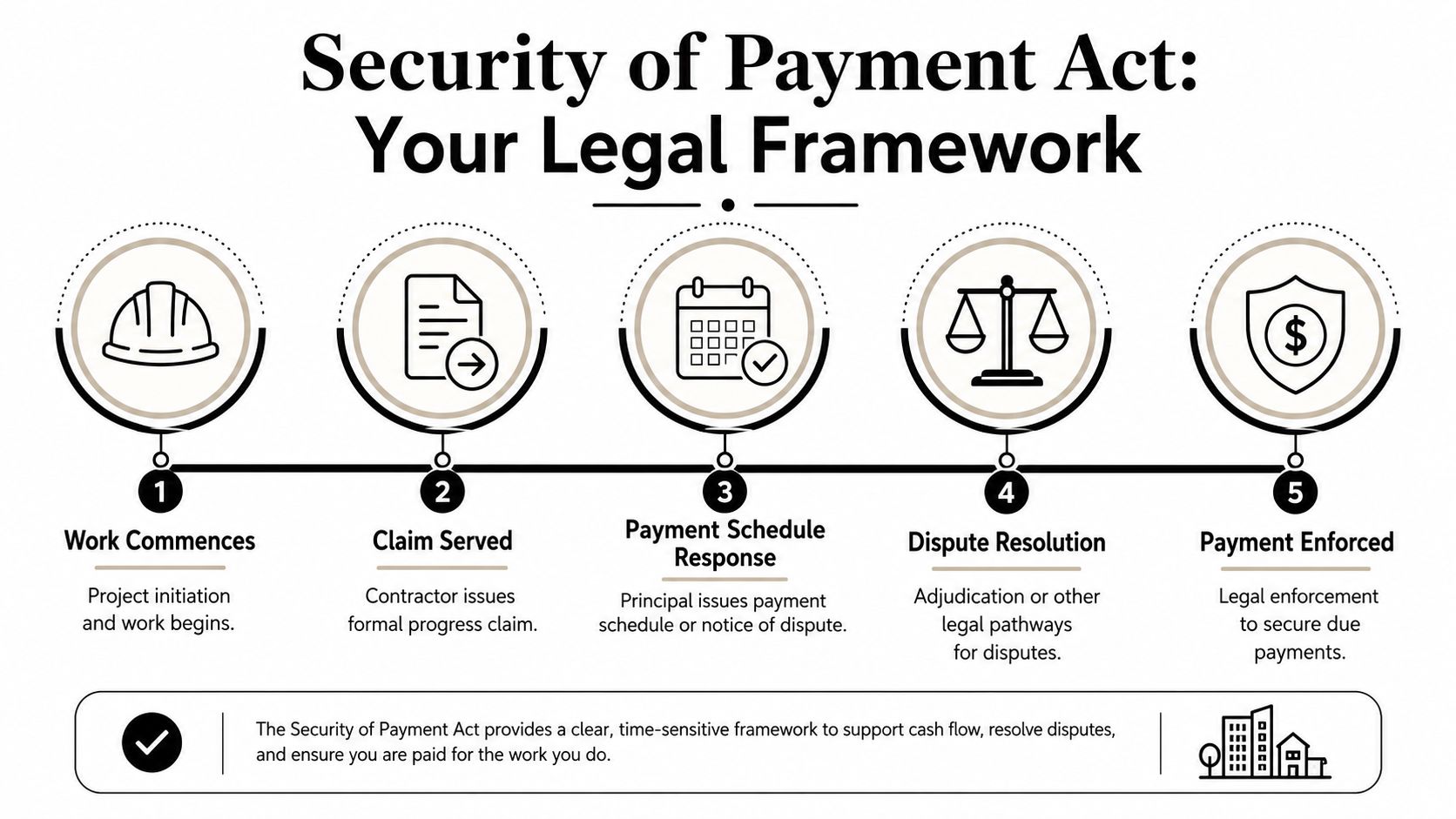
In Australia, Security of Payment is the legal framework that sets rules for construction payment claims and disputes. For a homeowner funding a renovation, extension, or custom build, it helps to view it as the project's payment rulebook. It does not replace your contract. It works alongside it, setting out how a claim can be made, when a response is due, and what process applies if the parties disagree.
What the law is trying to do
Construction runs on cash flow. Builders need to pay staff, trades, and suppliers while the job is still underway. Clients need a clear process so they are not paying early, paying twice, or arguing about vague paperwork months later. Security of Payment laws were designed to keep that cycle orderly and to give both sides a faster path than a full court fight when a payment dispute arises.
For you as the person paying the bills, the practical point is simple. A payment claim should never sit in your inbox unanswered if there is a problem with it.
The exact rules and deadlines differ by state and territory, and residential building contracts can have carve-outs or special treatment depending on where the project is and who occupies the home. That is why the contract and the project location both matter. A builder who is being transparent should be able to explain which payment process applies to your project, what timeframes are relevant, and what form a response needs to take.
What this means for a homeowner
If you disagree with part of a claim, the safest response is a written one that states what you are paying, what you are disputing, and why. That document is commonly called a payment schedule.
A payment schedule works like marking up an invoice before approval. You are creating a clear record. If a tile selection was changed but the variation was never approved, say that. If the claim includes a stage that is only partly complete, identify the item and the reason you are withholding part of the amount. Casual comments on site or a quick phone call are easy to forget and hard to prove later.
A steady review process helps:
- Record the date the claim was received. Time limits often run from that date.
- Check the claim against the contract, approved variations, and current site progress.
- Ask questions in writing as soon as they arise.
- If you dispute anything, issue a formal written response within the required timeframe.
- Keep your records in one place. That includes emails, signed variations, site photos, certificates, and payment receipts.
Digital tools make this much easier than it used to be. Client portals, e-signed variation approvals, dated site photos, and cloud-based claim records give you a cleaner paper trail. On residential projects, that can be the difference between a calm discussion based on records and a stressful argument based on memory.
Fair process works both ways
Security of Payment can sound intimidating because the name feels legal and remote. In practice, it is a structured way to keep payment discussions from drifting into confusion. Builders get a defined path to claim and pursue payment. Clients get a defined path to review, question, and dispute items properly.
Good contract setup makes that process easier from day one. If you want a plain-English view of the clauses that shape claim timing, milestone payments, and variation approvals, this guide on what to look for in a building contract is a useful starting point.
The goal is not to turn every claim into a legal event. The goal is to make sure, if a disagreement does come up, both sides know the rules and the paperwork already tells a clear story.
Anatomy of a Progress Claim Decoding the Document
A progress claim usually lands in your inbox as a PDF, portal notification, or lender form, and at first glance it can feel more like an accounting sheet than a building update. Once you know how to read the layout, though, it becomes much less mysterious. For a homeowner funding a renovation, extension, or custom build, the aim is simple. You want to see what work is being charged, how the amount was calculated, and whether it matches the contract and any approved changes.
At the centre of that document is usually the Schedule of Values, or SOV. The SOV breaks the total contract sum into smaller work items so the claim can show progress line by line, rather than presenting one large figure with no explanation. For clients, that breakdown matters because it turns a payment request into something you can check.
The key parts of the document
A well-prepared claim often starts with a summary page. This gives you the headline figures first: job name, claim number, claim period, original contract amount, variations, amounts previously claimed, the amount now being claimed, total claimed to date, retention, and GST.
Then you get into the working detail.
- Schedule of Values: Lists the main parts of the job and the value allocated to each one.
- Percentage complete: Shows how far each item has progressed.
- Amount claimed: Converts that progress into a dollar figure.
- Previously paid amounts: Helps prevent the same work being charged twice.
- Variations: Adds or adjusts approved changes to the original scope.
- Retention: Shows any amount being held back under the contract.
- GST: Separates the tax component clearly.
- Supporting evidence: May include photos, supplier invoices, drawings, approvals, inspection records, or certificates.
On projects funded through a lender, the figures in the claim often need to line up with the bank's release process as well. If you're financing works, this construction loan draw schedule guide is useful for understanding why your bank may ask for similar milestones in a slightly different format.
A simple SOV example
Below is a plain-English example of how a residential renovation claim might be broken down.
| Work Item | Total Value | % Complete This Period | Amount Claimed This Period |
|---|---|---|---|
| Demolition | $12,000 | 100% | $12,000 |
| Cabinetry manufacture | $38,000 | 35% | $13,300 |
| Plumbing rough-in | $10,000 | 50% | $5,000 |
| Electrical rough-in | $8,000 | 50% | $4,000 |
| Tiling preparation | $6,000 | 25% | $1,500 |
| Site supervision | $9,000 | 20% | $1,800 |
Sample Schedule of Values (SOV) Breakdown for a $150,000 Kitchen Reno
For a client, this explains why a claim can feel more detailed than expected. You may think in terms of one stage, such as "kitchen works," while the claim separates that stage into the pieces that create it. That is helpful. It gives you a cleaner way to compare the invoice against actual progress on site.
Where clients often get confused
The first sticking point is percentage complete. A work item does not always move from zero to one hundred in a single claim. Cabinetry is a good example. There may be measurable progress at shop drawings, manufacture, delivery, and installation. The same applies to electrical work, where rough-in and fit-off are distinct steps.
The second is variations. A variation is an approved change to the original contract scope, price, or method. If you moved a wall, changed tile selections, added skylights, or upgraded fixtures, the cost needs to appear somewhere in the paperwork. The progress claim is often the place where that approved change is brought into the running total.
The third is retention. Retention works like a small amount set aside under the contract until later in the project. It is not a surprise fee and it is not the builder charging extra. It is part of the agreed payment structure.
A clean claim lets you trace every dollar back to one of three places: the original contract, an approved variation, or a clearly documented entitlement under the contract.
Good digital systems make this easier to verify. A client portal, e-signed variation approvals, dated site photos, and cloud-stored claim records create a clearer trail than scattered emails and memory. For wider context on how these records fit together, see our guide to the construction documentation phase.
From Builder to Bank The Progress Claim Lifecycle
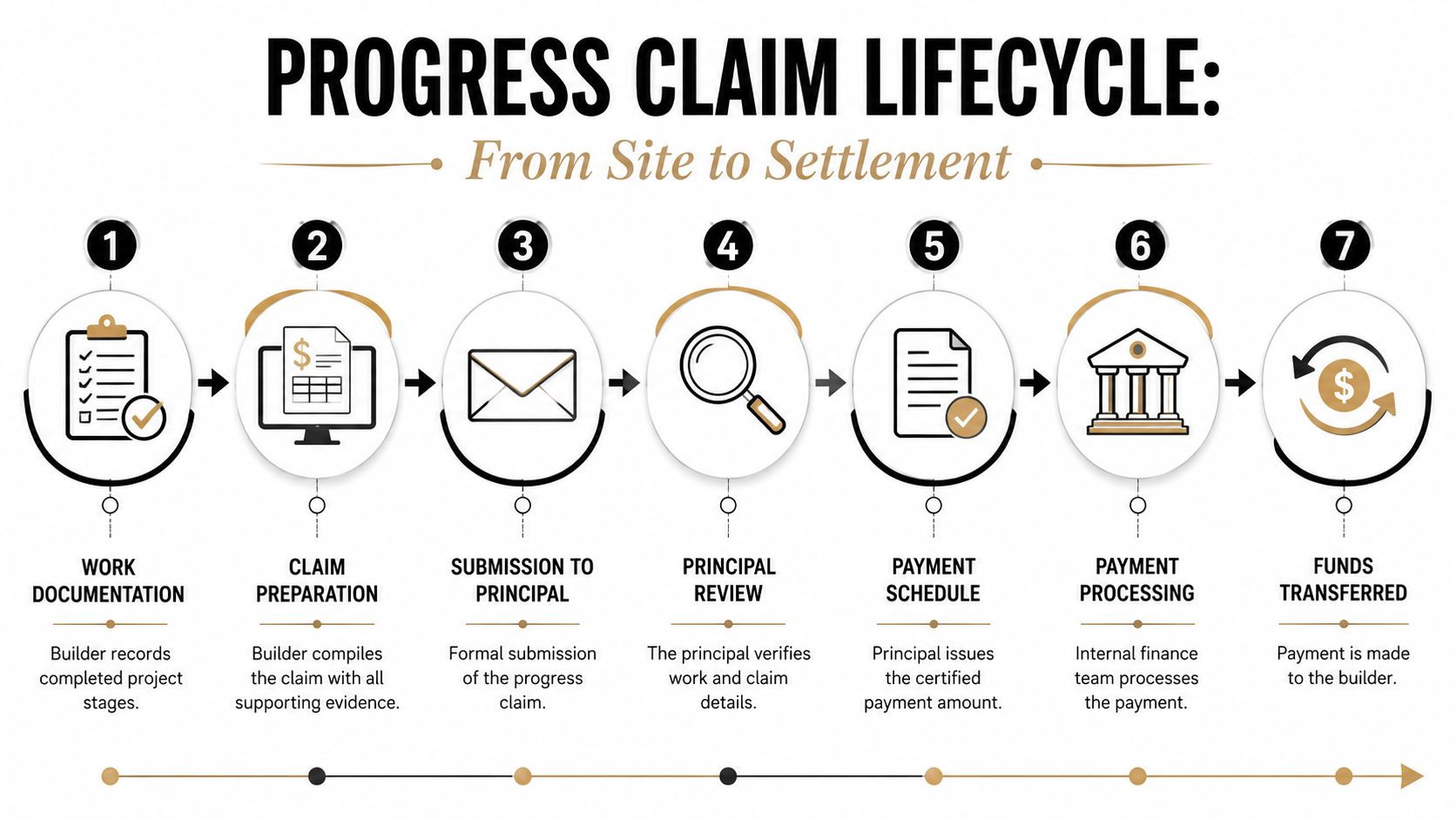
A progress claim doesn't begin in the office. It begins on site. By the time a claim reaches you, there has usually been a chain of site records, internal checks, contract references, and supporting documents assembled behind the scenes.
That matters because a good claim isn't only a payment request. It's the final step in a documentation process.
What happens before you see the claim
On site, the builder or supervisor records work completed. That might include dated photos, delivery dockets, trade confirmations, timesheets, inspection records, and notes about approved variations. In modern progress claim construction, digital records are becoming much more important because they provide time-stamped evidence that is easier to verify later.
Then the office team prepares the claim. They line up the work done against the contract or SOV, apply any approved variations, check previous claims, calculate retention and GST, and compile the backup documents.
At that point, the claim is submitted to the client, contract administrator, or lender, depending on the project setup.
A short video can help visualise how staged claims move through the payment system:
The client and lender review stage
From a homeowner's point of view, this is the most visible part of the process. You receive the claim and start comparing it to what you've seen on site and what you've approved in writing.
If your project is funded through a construction loan, your bank may also become part of the chain. Banks often rely on draw schedules and valuation checkpoints before releasing funds. That's why your builder's claim timing and your lender's draw process need to stay aligned. If you want a plain-English explanation of how staged lending works, this construction loan draw schedule guide is a practical companion.
The seven practical checkpoints
Work is documented on site
Photos, dockets, site notes, and approvals are captured as the job progresses.The claim is assembled
The builder ties completed work back to the contract breakdown and supporting records.The claim is formally submitted
This is the point where contractual and legal timeframes begin to matter.You review the content
You check completed work, totals, approved changes, and any supporting evidence.A response is issued if needed
If something is disputed, it must be identified properly and promptly.Finance processing happens
This may involve your own accounts, your lender, or both.Funds are released
Payment reaches the builder and the project keeps moving.
The smoothest projects aren't the ones with no questions. They're the ones where questions are asked early, answered clearly, and backed by records.
That's also why digital workflows matter. A claim supported by organised photos, signed variation approvals, and easy-to-follow evidence is much easier for a homeowner or lender to trust.
Your Guide to Reviewing a Progress Claim
A careful review isn't a sign of mistrust. It's basic stewardship of a major investment. The healthiest client-builder relationships usually come from clear checking, quick clarification, and clean records.
The mistake many homeowners make is treating a progress claim as either fully right or fully wrong. Most of the time, it's neither. It's a working financial document that should line up with the contract, the site, and your written approvals.
Your practical review checklist
When a claim arrives, use this short list.
- Match the claim to visible progress: Does the work claimed broadly reflect what's been completed on site or clearly documented off site?
- Check the claim period: Make sure the dates fit the agreed claim cycle.
- Review line items, not just the total: A total might feel reasonable while one line item is out of step.
- Confirm variations were approved: If extra work appears, ask where the signed approval sits.
- Scan retention and GST: These are common areas where clients get lost, so it's worth slowing down.
- Look for evidence: Photos, certificates, invoices, and delivery records should support the story the claim is telling.
- Ask questions quickly: If something looks unclear, don't wait until the end of the response window.
Why modern documentation makes review easier
Australian quantity surveyors often recommend a weekly workflow of capturing site photos, logging variations as they occur, and allocating costs daily, because that proactive approach can speed up payment release by an average of 7 to 14 days, according to PBA Quantity Surveyors' guidance on progress claims.
From a client's side, that matters for one reason above all others. A well-documented claim is easier to verify. You're not relying on memory or verbal summaries from three weeks ago. You're looking at a record.
That's where digital dockets, photo-logging apps, and AI-linked documentation tools are changing the feel of residential projects. Instead of scattered phone photos and loose email threads, the evidence can be tied back to dates, deliveries, variation approvals, and progress records in one place. For clients, that usually means fewer grey areas.
If you're budgeting or reviewing whether claimed value still matches the bigger picture of your renovation, a tool like this kitchen renovation costs estimator can be useful as a rough comparison point for scope and cost logic.
When to ask for extra help
Some claims are straightforward. Others involve many trades, staged manufacture, or several approved changes. If you're unsure how percentages, cost allocation, or certification should be assessed, an independent quantity surveyor can help you read the claim objectively. This primer on what a quantity surveyor does is a good starting point if you're deciding whether that support would add value.
Good review habits protect both sides. The client gets confidence in what they're paying for, and the builder gets clear, timely decisions that keep the site moving.
A practical mindset helps. Don't ask, “Do I trust this builder completely?” Ask, “Can I trace this claim clearly?” That question leads to much better decisions.
Frequently Asked Questions About Progress Claims
What is retention, and when do I get it back
Retention is an amount withheld under the contract as a form of security. It isn't a penalty and it isn't money that disappears. The contract should explain when retention is released, often by reference to completion stages or the end of the defects period. The important thing for clients is to check that retention is shown clearly in each claim and handled consistently.
What should I do if I disagree with part of a claim
Respond in writing as soon as possible. Be specific about which item you dispute and why. Keep your language factual. Point to the contract, the approved scope, site condition, or missing evidence. If needed, get advice quickly. Silence is the worst option because it can create legal and payment problems.
Can a builder claim for materials not yet installed
Sometimes, yes, if the contract allows for stored materials and the claim is properly supported. In practice, clients should expect proof such as invoices, delivery records, photos, or clear identification of where those materials are being stored. If a claim includes materials, the supporting evidence matters a lot.
How do bank valuers use progress claims
Bank valuers typically use the claim as one piece of the puzzle. They may compare the claim amount to the value of work completed on site before recommending release of loan funds. That's why clear line items, visible progress, and consistent records help everyone. The cleaner the claim, the easier it is for the bank process to keep pace.
Why does the claimed percentage sometimes differ from what looks finished to me
Because some work is partly visible and partly not. Rough-in services behind walls, shop fabrication happening off site, or preparatory work for finishes can all carry value before the space “looks done” to a homeowner. If the percentage feels ahead of what you can see, ask how it was measured and what evidence supports it.
Should I approve a claim if one small item looks wrong
Not automatically, but don't assume the entire claim needs to be rejected either. Often the sensible path is to identify the specific item in dispute and deal with the rest according to the contract and written response requirements. That keeps the project moving while preserving your position on the item you're questioning.
What makes a progress claim easier for a client to trust
Clarity. A claim is easier to trust when the summary is tidy, the SOV lines up with the contract, variations are already approved, evidence is attached, and the numbers can be followed without guesswork. Homeowners usually don't expect perfection. They do expect logic, transparency, and records.
If you're planning a renovation, extension, or custom home and want a builder who treats payment clarity as part of good project management, Templeton Built is worth speaking to. Their Adelaide team works across design and construction, with a strong focus on transparent documentation, clear communication, and residential projects that feel organised from first concept to final handover.


Leave a Reply