

Master Project Budget Management: Avoid Cost Blowouts
You've got the plans open on the kitchen table, the builder's number is in front of you, and the question is the same one every homeowner asks once the excitement settles. How do you keep the renovation moving without watching the budget drift every time a detail changes? Good project budget management starts before the first hammer swing, because the money usually gets away from people long before the slab is poured or the joinery is ordered.
The fix isn't a bigger guess. It's a tighter process, a clearer scope, and a budget that's treated like a live document instead of a number you lock in once and hope for the best.
Defining Your Vision and Building Your Baseline Budget
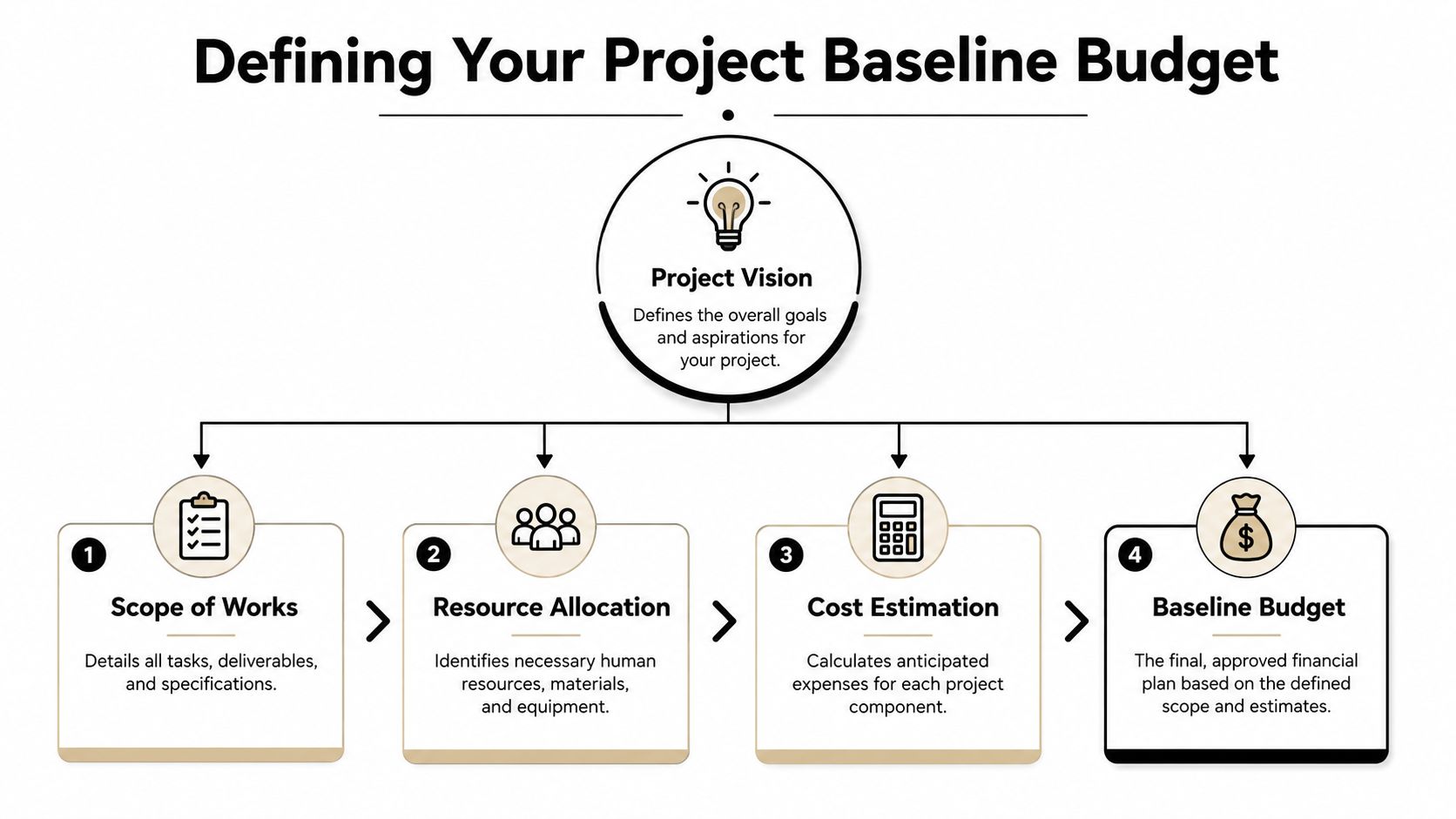
A renovation budget only holds together when it is built on three things, a clear scope, a realistic cost estimate, and a detailed spreadsheet. Leave one of those loose and the whole structure starts to wobble. The first job is writing down exactly what the project includes and, with equal emphasis, what it excludes.
Start with scope, not wishful thinking
A written scope of works is where project budget management becomes practical. It should describe the rooms, finishes, fixtures, structural changes, access constraints, and any exclusions that could later turn into assumptions. If the brief says “new kitchen” but does not define cabinetry style, appliance allowances, or whether the layout changes, the budget inherits those blanks.
That level of detail matters because early estimation errors are where large losses begin. Analysts at McKinsey found that large-scale projects often run over budget and over time, with the cost of delay rising further as projects drag on McKinsey's large-scale project research. The point is not that a renovation is an IT project. The point is that weak baselines cause damage before the work even starts.
Practical rule: if you cannot explain the scope in plain language, you cannot budget it properly.
Build the baseline like a job file
A proper budget spreadsheet should track demolition, structural works, framing, roofing, windows, doors, plumbing, electrical, plastering, waterproofing, flooring, joinery, finishes, landscaping, and soft costs such as design fees, engineering, and council-related items. Homeowners often under-allow for these items because the visible finishes get all the attention while the invisible costs sit outside the first draft.
A good builder or designer will turn the vision into measurable trade packages. That is the stage where a feasibility review helps you test whether the dream fits the site, the scope, and the market before the budget hardens. If you are at that point, Templeton Built's feasibility study guide is a useful reference for understanding how the early numbers get shaped.
Guidance from project management experts also suggests setting explicit price-escalation assumptions so the budget reflects local market conditions. The baseline must separate estimate from quote. An estimate is a working figure based on the current brief. A quote is a priced offer against a defined scope. If the brief keeps moving, the estimate can only be treated as a guide, not a promise.
Keep the baseline tied to the real market
Inflation and supply volatility make static budgeting risky in Australia. Material prices do not behave like a fixed line item, so a budget built on one early number can drift quickly once selections, lead times, and supplier pricing are locked in. The practical answer is to keep the baseline current as the project definition becomes more exact, and to record where a figure is an allowance rather than a firm price.
A clear baseline also makes scope creep easier to catch. When every line item has a purpose, the extra items stand out early, before they turn into a dispute at contract stage or mid-build. That is the discipline that keeps the budget readable, the decisions visible, and the renovation moving on a financial footing you can trust.
Planning for the Unexpected with Smart Contingency
Contingency gets misunderstood because people treat it like spare cash for any problem. It isn't. A decent budget sets aside money for different kinds of uncertainty, and the distinction matters when the builder opens a wall and finds a hidden problem, or when the client decides to upgrade a finish halfway through the job.
Separate the money by purpose
A builder's contingency covers genuine unknowns, such as hidden site conditions, unexpected structural issues, or access problems that only show up once the work starts. A client-held contingency is different. That's the money set aside for changes the owner may choose to make, such as upgrading tapware, adding joinery, or altering a finish after selections have been made.
If both are lumped into one figure, the budget loses meaning. A single percentage looks tidy on paper, but it hides whether the money is there for surprise repairs, design evolution, or a mix of both. In a renovation, that distinction is not a nice-to-have. It's how you avoid arguing about whether a change should come out of “the contingency” when the contingency was never meant for that purpose.
Templeton Built tip: renovations usually need a tighter process around contingency than new builds, because existing homes can reveal issues that weren't visible in the first walk-through. The answer isn't to guess a bigger number. It's to decide which risks sit with the builder, which sit with the client, and which need formal approval before the work changes.
PC items and provisional sums need close attention
Prime Cost (PC) items and Provisional Sums (PS) are where many budgets start to blur. A PC item is an allowance for something not yet selected, often a fixture or fitting. A PS is an allowance for work or supply that can't be accurately priced yet. Both are useful, but both can move once the final product or scope is chosen.
A kitchen renovation shows the difference clearly. Tapware might sit under a PC item if the final brand and model haven't been selected. Custom joinery can sit under a PS if the exact design, finish, or internal detailing isn't fully resolved yet. The danger is not the allowance itself, it's pretending the allowance is a fixed price.
Think of contingency like a toolbox, not a wallet you crack open whenever the mood changes. The right tool depends on the risk. A surprise behind a wall is one tool. A selection upgrade is another. Keeping them separate makes every conversation sharper and every approval cleaner.
Structuring Payments and Managing Project Cashflow
The smartest budget can still cause stress if the payment flow is badly timed. Cashflow is where homeowners feel the project most directly, because the numbers stop being theoretical and start matching real invoices, real milestones, and real lender draws. A clean payment structure keeps the builder paid, keeps the job moving, and keeps the client from scrambling at the wrong moment.
Fixed-price and cost-plus contracts shift risk differently
A fixed-price contract gives more certainty at the start because the builder agrees to deliver the defined scope for an agreed amount, subject to variations and allowances. That suits clients who want a clearer financial line, especially when the design is well resolved. The trade-off is that if the scope changes, the paperwork has to change too.
A cost-plus contract is more flexible, because the client pays the actual cost of labour, materials, and agreed margins or fees. That can work well when the design is still evolving, but it gives less certainty and demands more active monitoring from the client. It rewards transparency, but it does not protect you from paying for poor control if the project drifts.
The right choice depends on how complete the brief is before work starts. If the scope is firm, fixed price can give good discipline. If the project is still evolving, cost-plus can fit better, but only if the reporting is tight and the approval process is strict.
Milestone payments keep the work and money aligned
Progress payments are usually tied to milestones such as slab down, frame complete, lock-up stage, fit-off, and practical completion. That structure is useful because payment follows completed work rather than guesswork. It also helps homeowners plan lender drawdowns and household cash commitments around known stages rather than surprise invoices.
For a home extension, that rhythm matters. The slab payment lands when foundation work is complete. The frame payment comes when the shell of the project is visible and measurable. Lock-up means the building can be secured, which is a major threshold for both progress and funding.
If you want a practical reference for this side of the process, Templeton Built's payment schedule overview is a helpful place to see how milestone-based payments are commonly structured.
A good payment schedule doesn't just protect the builder. It protects the client from overpaying before work is genuinely complete.
The best cashflow plans don't wait for stress to show up. They map the lender, the contract, and the site milestones together before the first payment falls due.
Tracking Costs and Controlling Scope Variations
Most budget blowouts do not come from one major failure. They come from a string of small changes that were never properly logged, priced, or approved. That is why disciplined variation control matters more than a large contingency fund. A buffer can soften a shock, but it will not stop the budget from leaking if the scope keeps moving.
Variation control keeps the budget honest
Any change to the original scope, even something that sounds minor, needs a written variation before the work starts. That includes adding a window, changing a tapware range, upgrading cabinetry, moving a power point, or adjusting a finish after selections have been locked. If the change affects price or time, it needs to be documented.
The reason is simple. Budget control depends on monitoring scope change alongside committed and actual cost, which is a core principle of effective construction cost management, not just tracking what has already been spent. In residential work, the problem usually shows up when a client keeps refining the brief after the build has already begun. That is where scope creep turns a tidy budget into a moving target.
Templeton Built checklist before approving a variation
- What exactly is changing? Get the scope described in plain words, not a vague label.
- What is the cost impact? Confirm whether the change affects labour, materials, subcontractors, or all three.
- What is the time impact? Ask whether the change pushes sequencing, ordering, or trade access.
- What gets removed? If something new is added, check whether another item is being deleted.
- Who has approved it? Make sure the decision is signed off before the work proceeds.
Follow the paper trail, not the memory
A solid variation process starts when someone identifies a change, then it gets documented, priced, reviewed, approved, and communicated to everyone involved. That sounds formal because it is formal. Once trades are on site, memory is too weak to run a budget. Written approvals are what stop a casual conversation from becoming an expensive dispute.
The mistake many homeowners make is assuming the contingency will catch every change automatically. It will not. A contingency should handle the unexpected, not become a blank cheque for an evolving brief. The stronger system is to keep the original budget intact, then add only the variations that have been properly approved.
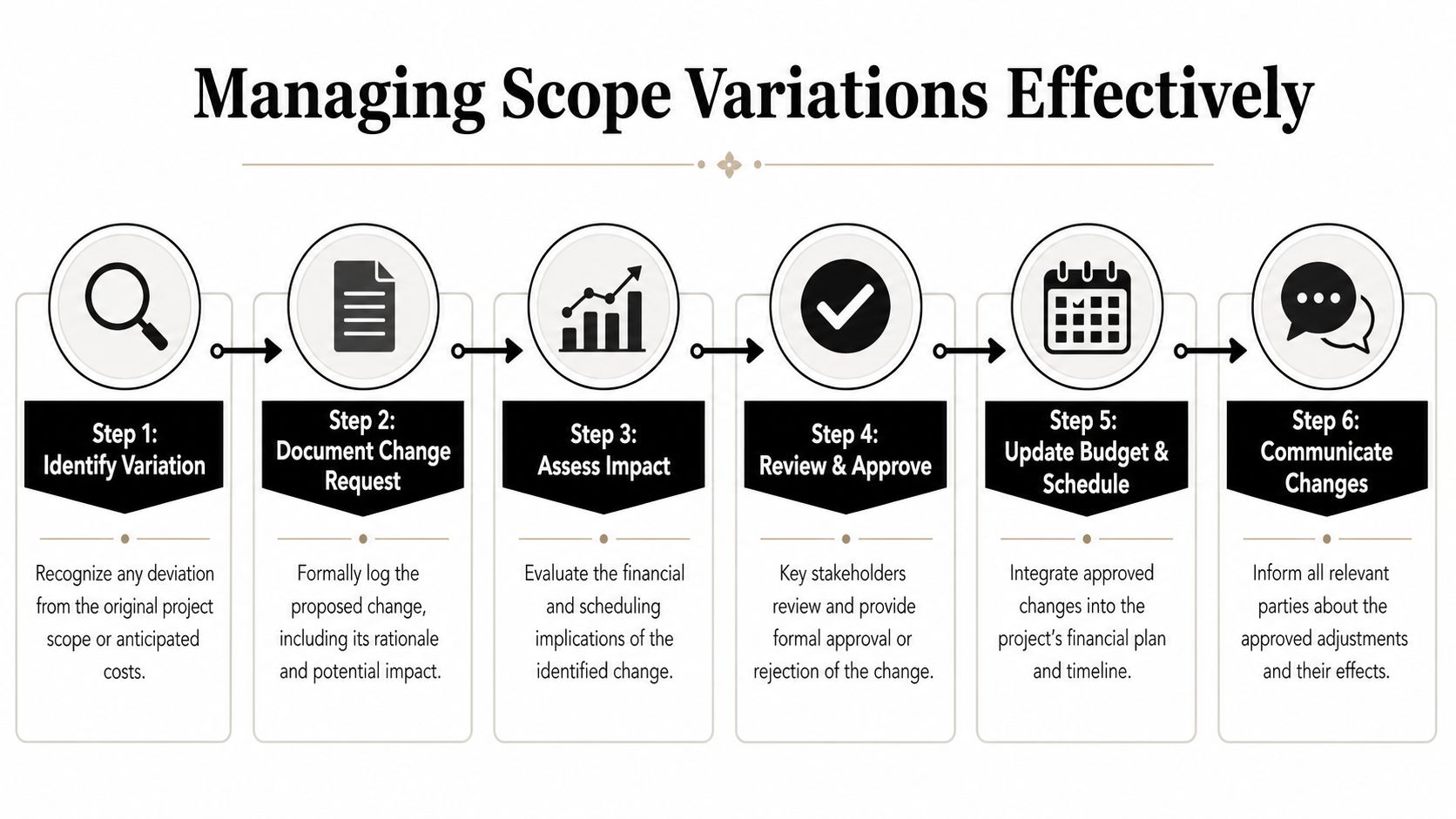
That system gives you clarity. You know where the money went because every change has a name, a cost, and an approval attached to it.
Communication and Financial Closeout
Good communication is not a soft skill on a building project. It's a financial control. If the client, builder, and key trades are not talking through budget status regularly, the numbers will drift until the end of the job, where every misunderstanding becomes more expensive to fix.
Run meetings that include money, not just progress
Site meetings should do more than talk about what got done last week. They need a budget review on the agenda, so current spending, pending selections, and any possible variations are discussed openly. That keeps the project honest and gives everyone a chance to correct course while correction is still easy.
The documents matter just as much as the conversation. Homeowners should expect progress claims, a running summary of costs against the budget, and written approval for any changes. If a claim arrives without enough detail to explain what work has been completed, ask for a clearer breakdown before payment moves.
The builder's role becomes part accountant, part translator. A good site meeting leaves the client knowing what was spent, what's pending, and what still sits inside the agreed scope. If the conversation stays vague, the budget will be vague too.
Closeout should finish as cleanly as the build
Financial closeout starts before handover, not after it. The final payment should be tied to completion of the agreed works, any outstanding defects, and the handover of warranties and certificates. That last stage should never feel rushed, because loose ends at practical completion can turn into administrative headaches later.
A proper closeout pack should include the final account summary, the signed variation record, warranty documents, and whatever compliance paperwork applies to the project. The client should know exactly what was included, what changed, and what was finally paid. That transparency protects both sides.
Clear closeout is what turns a project from “finished” into “finished properly.”
If defects remain, they need to be logged and handled through the agreed rectification process, not brushed aside because the job is nearly done. The best projects end with no surprises, no disputed invoices, and no uncertainty about what has been delivered.
Your Project Budget Management Essentials
The work gets easier when the rules are simple and repeated consistently. Templeton Built's essentials for project budget management are straightforward, and they hold up well on real renovation sites:
- Invest heavily in the planning phase. A precise scope and realistic estimate beat a rushed budget every time.
- Treat the budget as a live document. If selections, site conditions, or specifications change, the numbers should change with them.
- Separate contingency types. Keep surprise site issues, design changes, and market escalation in different buckets.
- Approve zero changes without writing. A verbal yes is not a variation, and it won't protect the budget.
- Review spending regularly. Budget control gets weaker when the project team waits too long to talk about cost.
The hardest part for most homeowners is emotional, not technical. You want certainty, but renovation work rarely behaves perfectly, especially when old structures, selections, and supply conditions all interact. A structured process gives you something better than optimism, it gives you control.
That's the Templeton Built approach, clear scope, honest numbers, written variations, and regular financial communication from start to finish. If you're planning a renovation or extension and want a builder who handles budget conversations with the same care as the build itself, visit Templeton Built and start the conversation about your project.


Leave a Reply