

Property Developer Services Explained for Adelaide Investors
You're standing on a parcel in Adelaide, the planning report is on the desk, the architect has sketched a concept, and the numbers still look tight. That's usually the moment people realise property developer services aren't just a nicer way to say “builder support”, they're the system that decides whether the project clears each gate without bleeding margin.
In practice, the job is to turn a patch of land and a rough idea into a project that survives feasibility, approval, construction, and disposal. Each decision at one gate changes the next one, which is why a cheaper-looking site, a cleaner concept drawing, or a lower headline build price can still become the more expensive choice once delay, redesign, and holding costs land on top.
The scale of that risk matters. The Property Council of Australia estimates the property sector contributed $530.3 billion to GDP in 2021–22, with residential property making up 62.5% of direct property activity and supporting around 892,100 FTE jobs. That's the backdrop for why integrated developer services matter, especially in a regulated market like Adelaide, where the wrong sequence can distort an otherwise solid project Property Council economic significance report.
The Real Job Behind Property Developer Services
A common Adelaide scenario goes like this. A small developer buys, or nearly buys, a site with a planning report in hand, a bank has asked for tighter numbers, and the build budget is already stretched by the time the concept gets serious. At that point, the question isn't “who can build this?”, it's “who can keep the whole thing from unraveling as it moves from one decision to the next?”
Risk compounds at every gate
The first gate is feasibility, where the project either makes sense on paper or doesn't. The second is approval, where planning controls, council feedback, and documentation timing can stretch the programme in ways a spreadsheet often ignores. The third is construction, where design coordination and delivery discipline decide whether the project stays on cost and on sequence. The fourth is disposal, where sale timing, lease-up, or settlement strategy can change how quickly capital comes back.
Practical rule: don't buy a build, buy a managed risk profile.
That shift matters because property developer services are really about sequencing decisions well. The site choice influences approval risk. Approval timing influences finance carry. Construction sequencing influences finish quality and holding period. Disposal strategy influences how much flexibility you have in the last 10% of the job, which is often where the best or worst financial outcome gets locked in.
A separate architect, separate project manager, and separate builder can still work. They just tend to make the developer carry the integration risk, which is usually the part that's hardest to price up front and most expensive to fix late.
What Property Developer Services Actually Include
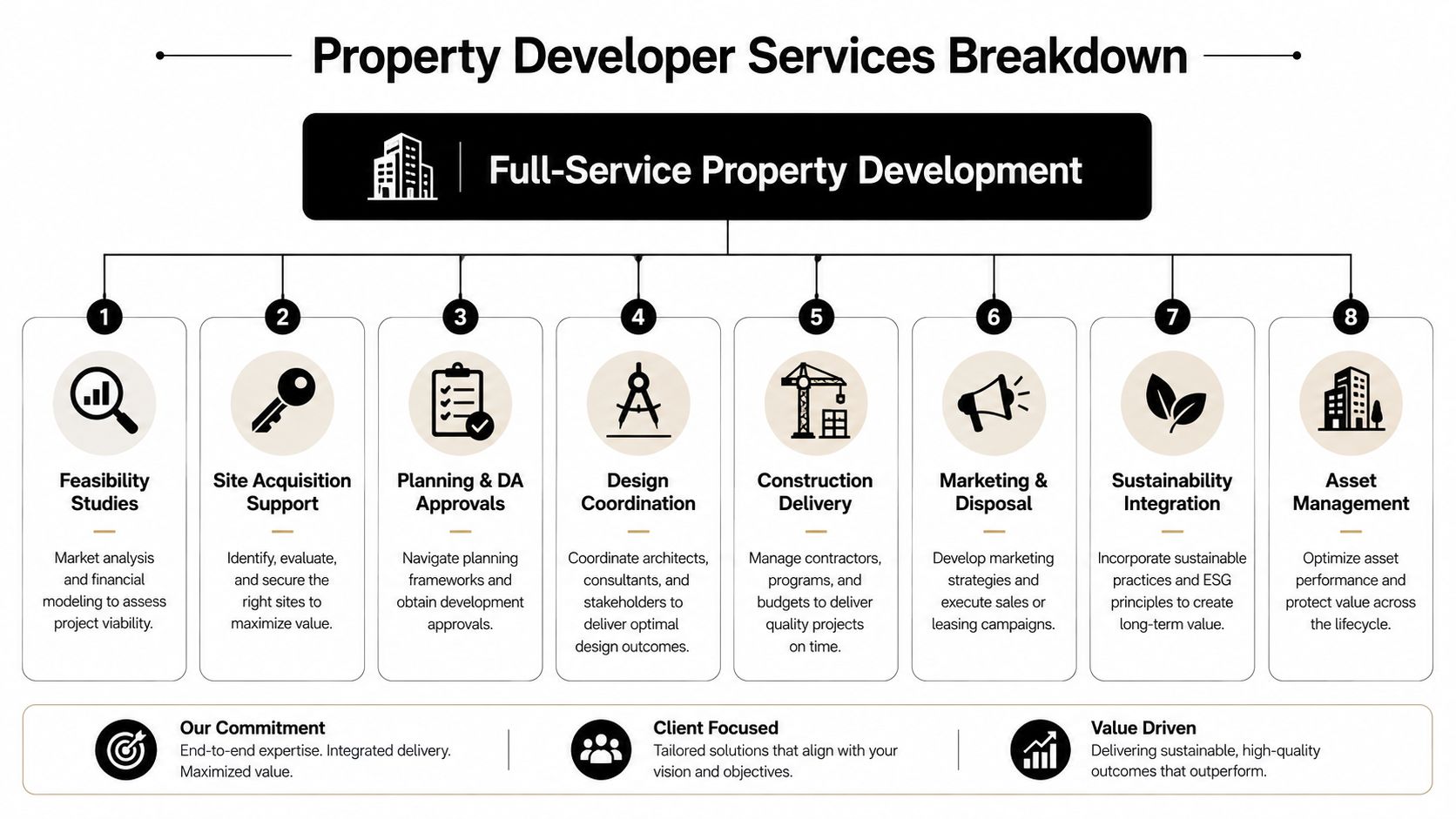
The term gets used loosely, but in Adelaide a full-service developer offering usually covers eight workstreams. Some are advisory, some are technical, and some are delivery-focused. Together they form the stack that keeps a project moving from idea to exit.
The core workstreams
Feasibility studies test whether the numbers stack up before serious money goes out. On a Mount Barker infill block, that means checking revenue against land, build, approval, and finance assumptions, not just asking whether the product will sell.
Site acquisition support helps with due diligence before contracts harden. That can mean checking zoning, access, services, title issues, and council constraints before a developer commits.
Planning and DA approvals cover the paperwork, drawings, and coordination needed to get a proposal through the right channel. On a brownfield site in Prospect, that often means more than submitting plans, it means shaping a scheme that can survive council feedback without a full redesign.
Design coordination aligns architect, engineer, energy assessor, and builder so the concept, structure, compliance, and cost plan point in the same direction.
Cost estimating translates the design into realistic numbers. Done properly, it doesn't flatter the pro forma, it tests it.
Project management keeps the programme, consultants, and site activities aligned so delays don't stack up unnoticed.
Construction delivery is the physical build itself, but in developer work it also includes sequencing decisions, procurement, and quality control.
Marketing and disposal strategy covers how the finished asset leaves the developer's balance sheet, whether that means pre-sale, lease-up, or post-completion sale.
A provider like Templeton Built positions its Adelaide property development offering around feasibility, DA approvals, and construction management, which is the sort of integration many small developers need.
Feasibility Studies That Actually Predict Project Economics
A developer-grade feasibility is not the same thing as a sales agent's optimism sheet. Sales-driven numbers often focus on the exit price and leave too much to chance on the inputs that can wreck the deal after the offer is signed. The stronger model prices the full path from site control to settlement, including risk and time.
What needs to be in the model
The useful feasibility questions are blunt. What is the land cost really? What does the approval pathway add in time and consultant spend? What infrastructure or service assumptions could move? What happens if the build programme slips? What does the holding cost do to the return if the project sits longer than expected?
That's why the developer-grade feasibility needs to include delay risk, holding cost, finance carry, and compliance load, not just build cost. Australian approvals remain a live constraint, with the ABS showing dwelling approvals fluctuate below the pace implied by the National Housing Accord target of 1.2 million homes over five years, so time is not a background variable, it's part of the deal structure ABS housing approval data and National Housing Accord context.
A lot of smaller Adelaide developers still get caught by the false-economy site. The land looks cheaper, but once infrastructure charges, longer DA timeframes, and finance carrying costs are loaded in, the project can end up weaker than a more expensive site with cleaner constraints.
The best feasibility documents don't try to prove the deal. They try to break it early.
A better way to read the numbers
If the feasibility only tells you what the build might cost, it's incomplete. If it tells you what happens when approval drags, design changes, or finance gets harder, it's doing the actual job. The point is not to create a perfect forecast. The point is to expose the sensitivity points before the contract becomes the problem.
Use this feasibility study template as a starting point if you want to pressure-test your own assumptions before you commit capital.
From Site Acquisition to DA Approval in Adelaide
The second gate is where many small projects get stuck. Site acquisition and DA approval look simple from the outside, but Adelaide councils will usually expose weak assumptions quickly if the scheme hasn't been shaped with planning reality in mind.
What to check before you commit
Start with zoning, overlays, setback rules, heritage controls, and any Character Zone requirements that shape what can be approved. Then check access, parking, stormwater, and services, because the site may be physically buildable while still being commercially clumsy.
A builder who understands planning can often save time by identifying where the design needs to bend before the formal process starts. That matters because the goal isn't to win an argument with council, it's to submit a scheme that already makes sense within the planning framework.
Deposit risk is real if a developer waits too long to involve the right people. If due diligence starts after the contract is too tight, finance conditions can become harder to satisfy, and the project can end up chasing approvals on a deadline that's already working against it.
Plain truth: the cheapest site on paper is often the most expensive site to make approvable.
When builder input changes the outcome
Builder-developer involvement adds the most value when design intent has to be locked early enough for a clean DA, but still needs enough flexibility to survive council feedback. That's the sweet spot in Adelaide, especially on smaller sites where one bad assumption can force a redesign that erodes the whole margin.
Read the development application guide if you want a practical sense of how DA timing and documentation affect the project path. The main point is simple. If the architect is working in isolation, the design can drift away from buildability, and once that happens, the developer pays twice, once in rework and once in lost time.
How Developer Fee Structures Compare
Fee structure tells you where the risk sits. It also tells you how honest the quote is about uncertainty. A good contract doesn't remove risk, it places it clearly enough that the developer can make a rational choice.
Three common structures
| Fee Structure | Who Carries Cost Risk | Best Suited For | Watch Out For |
|---|---|---|---|
| Fixed-price contract | Builder carries more of the cost variation risk | Projects with clear drawings, stable scope, and disciplined change control | Scope gaps and variations can become expensive if the brief moves |
| Percentage of build cost | Risk is shared more loosely, but the final price follows the project cost | Jobs where scope may evolve and close collaboration matters | The quote can rise as the build budget rises |
| Cost-plus with a margin | Developer carries most of the cost risk | Complex or uncertain projects where transparency matters early | Design drift can keep expanding the final bill |
A cost-plus arrangement can be useful when the design is still moving and the market is uncertain, but it only works if the developer is comfortable watching the numbers closely. Fixed price can be cleaner for financing and exit planning, but it rewards accurate scope definition and punishes late changes.
See how cost-plus contracts work in practice before assuming a lower headline price means lower risk. In reality, the quote is only half the story. The other half is how much control you keep when the site, design, or programme changes.
The strongest reading habit is to ask where the margin sits, where the contingency sits, and who carries the overrun if the scope shifts. That tells you more than the contract label ever will.
Design Coordination, Construction and Disposal in Practice
A three-townhouse knockdown-rebuild in Norwood is a good example of why integrated delivery matters. Once approval is in hand, the project still has multiple moving parts, and each one can pull the others out of line if nobody is coordinating the full picture.
Keeping the team on one cost plan
Design coordination means the architect, engineer, energy assessor, and builder are working from the same commercial assumptions. The slab detail can't ignore the service layout. The façade can't ignore the budget. The energy response can't arrive after the rest of the design has already locked in the cost base.
That's where the builder-developer model is more useful than the separated model. The builder can flag buildability issues while the design is still flexible, instead of waiting for drawings to be finalised and then re-pricing the project from scratch.
Templeton Built's own delivery history, 400+ renovations, 200+ extensions, and 64 custom homes, shows the value of that kind of sequencing experience in a smaller-scale Adelaide context. The same discipline that keeps a renovation on track often matters just as much in a townhouse or mixed-use development.
Construction doesn't fail at the end. It usually fails earlier, when nobody catches the mismatch between design intent and site reality.
Disposal is part of the build decision
Disposal strategy isn't just a sales question. If the plan is off-plan sale, pre-settlement disposal, or post-completion sale, that affects lock-up timing, finish selection, inspection scheduling, and how much presentation work the site needs before it can leave.
The wrong disposal assumption can make a good build awkward to sell. The right one can shape the build programme so the asset is ready for the market at the point it's most credible, not just the point when the builder is finished.
Sustainability and Compliance as Asset Performance
Sustainability used to be treated like a design preference. In 2025, that's too narrow. For developers, it's a financial variable that affects operating costs, tenant appeal, resale conversation, and in some cases the finance story around the asset.
Why this belongs inside feasibility
Australian buildings remain a major emissions source, and the Clean Energy Regulator's National Greenhouse Accounts keep pressure on the sector to improve performance. NABERS expectations also continue to shape commercial stock, which means energy-efficient buildings are more than a branding exercise, they're part of how the market judges asset quality Clean Energy Regulator National Greenhouse Accounts.
That changes the developer brief. Electrification readiness, thermal envelope decisions, water-sensitive design, and the quality of performance documentation now affect how a project is viewed later. If those choices are left until the end, the developer often has to retrofit around them.
What good service teams do differently
A strong property developer service team prices sustainability early, not as a decorative add-on. It looks at the likely compliance path, the future operating story, and whether the asset can present itself well at lease or sale.
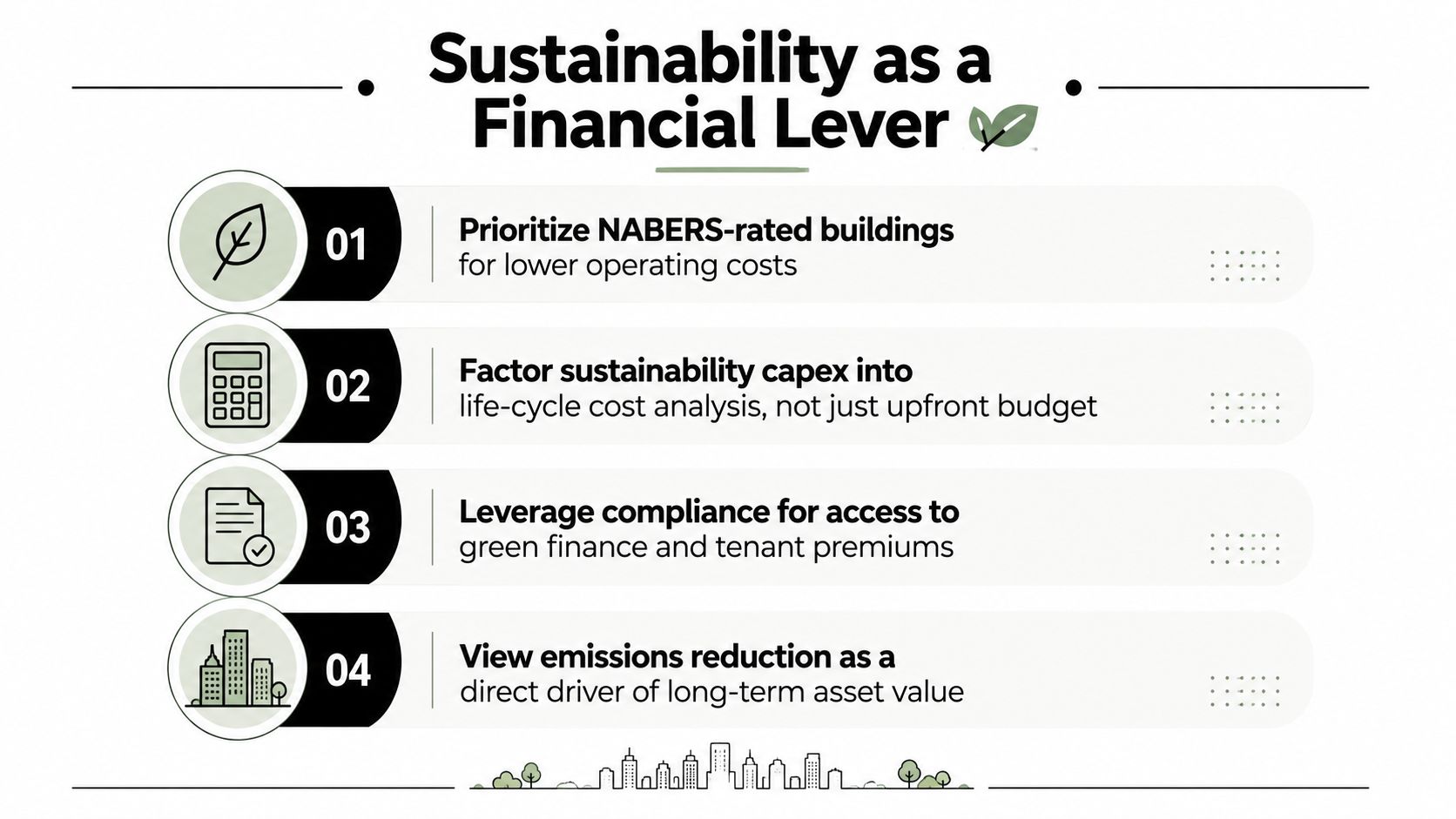
- Prioritise performance early: A building that performs better is easier to explain to buyers, tenants, and finance providers.
- Treat compliance as design input: The energy and services decisions should shape the plan, not patch it later.
- Document the asset properly: Good records help at resale, leasing, and handover.
- Think about long-run value: Emissions reduction is increasingly tied to the market's view of quality, not just ethics.
A developer who waits until completion to think about these items usually pays more to fix them than it would have cost to plan them well in the first place.
Choosing a Developer Partner and What to Ask First
A good developer partner is easy to identify once you know what to look for. Start with the first question, “Have they shown how they handle feasibility, approvals, build, and exit together?”, then move to the more practical ones about programme, fees, and risk.
Red flags that usually matter
- No feasibility input, which usually means the team wants to build the project you've already imagined, not test whether it still works.
- A vague construction programme, because if the sequence isn't clear, delays tend to appear later as “unforeseen” issues.
- No local council experience, which is a real weakness in Adelaide, where planning context matters more than many developers expect.
- No asset-performance conversation, which leaves sustainability and compliance to the end of the job.
- An unclear fee structure, which makes it hard to tell where the contingency sits and who owns the overrun.
The best questions are direct. Who owns the feasibility assumptions? Who speaks to council? Who coordinates design changes? What happens if the scope moves? How is disposal or settlement planned before construction starts?
Templeton Built fits that framework as an Adelaide-based option for developers who want feasibility, DA support, construction, and disposal thinking in one team rather than spread across disconnected consultants.
If a builder can't explain where the risk sits, the developer usually ends up carrying it.
For Adelaide developers, the practical decision is simple. Pick the team that can show you how the project will move through each gate, not just how it will look at the end. If you want a partner that can take a site from feasibility through DA and construction with disposal kept in view, visit Templeton Built and start the conversation with your own parcel, your own budget, and your own deadline.


Leave a Reply