

Recycled Building Materials Adelaide: Top Tips for 2026
You've just pulled down a 1920s bungalow wall, or maybe you're pricing a rear extension and the client wants the character to feel original, not staged. The question lands fast, do you try to reuse what's already on site, hunt down matching brick and timber, or keep the build moving with new materials and forget the salvage headache?
In Adelaide, that choice isn't fringe anymore. Recycled building materials sit inside a real local recovery system, not a boutique side market, and the numbers back that up. South Australia recovered 3.99 million tonnes out of 4.88 million tonnes of waste in 2021 to 22, an 81.9% recovery rate, and about 2.03 million tonnes of masonry were recovered inside that total, with 92.0% of recovered material reprocessed locally in SA, which matters for builders who need a working local loop, not an export chain (Green Industries SA summary).
The hard part is that high diversion doesn't automatically mean high reuse on your job. A project can look excellent on a waste report and still lose the best timber, brick, or fittings because nobody sorted early, no one locked in a destination, or the material got contaminated before it left site. For Adelaide homeowners, builders, and developers, the jobs are simple to say and harder to execute, cut waste, keep quality under control, and stay inside council and building code requirements.
Why Adelaide Builders Are Taking Recycled Materials Seriously
A client rings about a weatherboard renovation in the eastern suburbs. They want the new work to sit naturally beside the old house, and they've already seen a neighbour reuse brick and floorboards, so now they're asking whether the same approach will work on their place too. That's usually the first honest moment in the process, because the decision isn't really about values, it's about whether the old material can survive the next specification, the next trade, and the next inspection.
South Australia has already made recycled material use normal in the building pipeline. The state recovered 4.49 million tonnes of material in 2017 to 18 with an 83.6% diversion rate, and earlier South Australian reporting shows 984,563 tonnes recovered in 2006 to 07, with 80% of that recovered material being concrete (National Waste Report 2010). That history matters because it shows recycled concrete, brick, and soil products aren't experimental in Adelaide, they've been moving through the market for years.
What that means on a live job
A builder still has to separate the idea of recovery from the idea of reuse. Recovery can mean crushing, sorting, or reprocessing into another product. Reuse means the same component keeps a visible or functional role in the build, which is a tougher standard and one that asks more of the demolition crew, the estimator, and the engineer.
Practical rule: if the material can't be named, graded, and accepted before demolition starts, it usually becomes recyclate instead of reusable stock.
That's the key mindset shift this guide asks for. Don't start with, “What recycled material can I find later?” Start with, “What part of this job can be designed around clean salvage, and what part should be crushed, reprocessed, or replaced without drama?” On an Adelaide site, that question saves time, protects the programme, and cuts the chance that a mid-build substitution forces the design off track.
The market also supports a straightforward conclusion. Recycled materials are no longer just a sustainability gesture in Adelaide, they're part of how serious builders manage cost, waste, and compliance at the same time. The win comes from using them where they fit the build logic, not where the mood board says they look good.
Planning Your Project Around Reuse
The best recycled-material projects in Adelaide usually start with a blunt inventory, not a romantic mood board. If the site is being opened up, someone needs to walk it before demolition and mark what can be stripped, what can be sold, what can be crushed, and what should be left alone because it's contaminated, too fragile, or just not worth the labour. South Australia's 2025 to 2030 circular economy strategy puts the region at 96% C&D diversion and targets 98% construction and demolition diversion for metropolitan Adelaide, so the margin for sloppy source separation is already very small (SA Circular Economy Strategy 2025 to 2030).
Four planning moves that actually hold up
Start with a pre-demolition material audit. That means a real list, not a guess, of concrete, brick, timber, plasterboard, metal, joinery, windows, and mixed residue. The value of the audit is simple, it tells the estimator where the clean streams are before the first trade turns up with a sledgehammer.
Set a diversion target that matches the project type. A heritage renovation with original brick and hardwood is a different proposition from a knockdown-rebuild on a cleared block. In the first case, salvage can be part of the design story. In the second, your best result may come from clean demolition, separate bins, and a strong recycling chain.
Decide early what gets salvaged and what gets crushed. Bricks with mortar still attached may be fine for crushing but poor for reuse. Timber that's been painted, wet, or damaged during strip-out can still have value, but not always as a visible finish. Write those calls into the brief so trades aren't making ad hoc decisions on site.
Then brief the trades so the first cut doesn't contaminate the whole plan. Separate skips for concrete, masonry, metals, timber, plasterboard, and mixed residue make more sense than one big bin and a hope. The cleaner the stream, the better the chance the material keeps value.
Good salvage starts before demolition, not after the skip lands.
If you want a practical reference point for waste planning and contractor coordination, this construction waste management guide sits in the right neighbourhood. Keep your handover folder simple, with photos, destination notes, and anything the engineer or certifier may later need to prove where the material came from and how it was handled.
Where to Source Recycled Building Materials in Adelaide
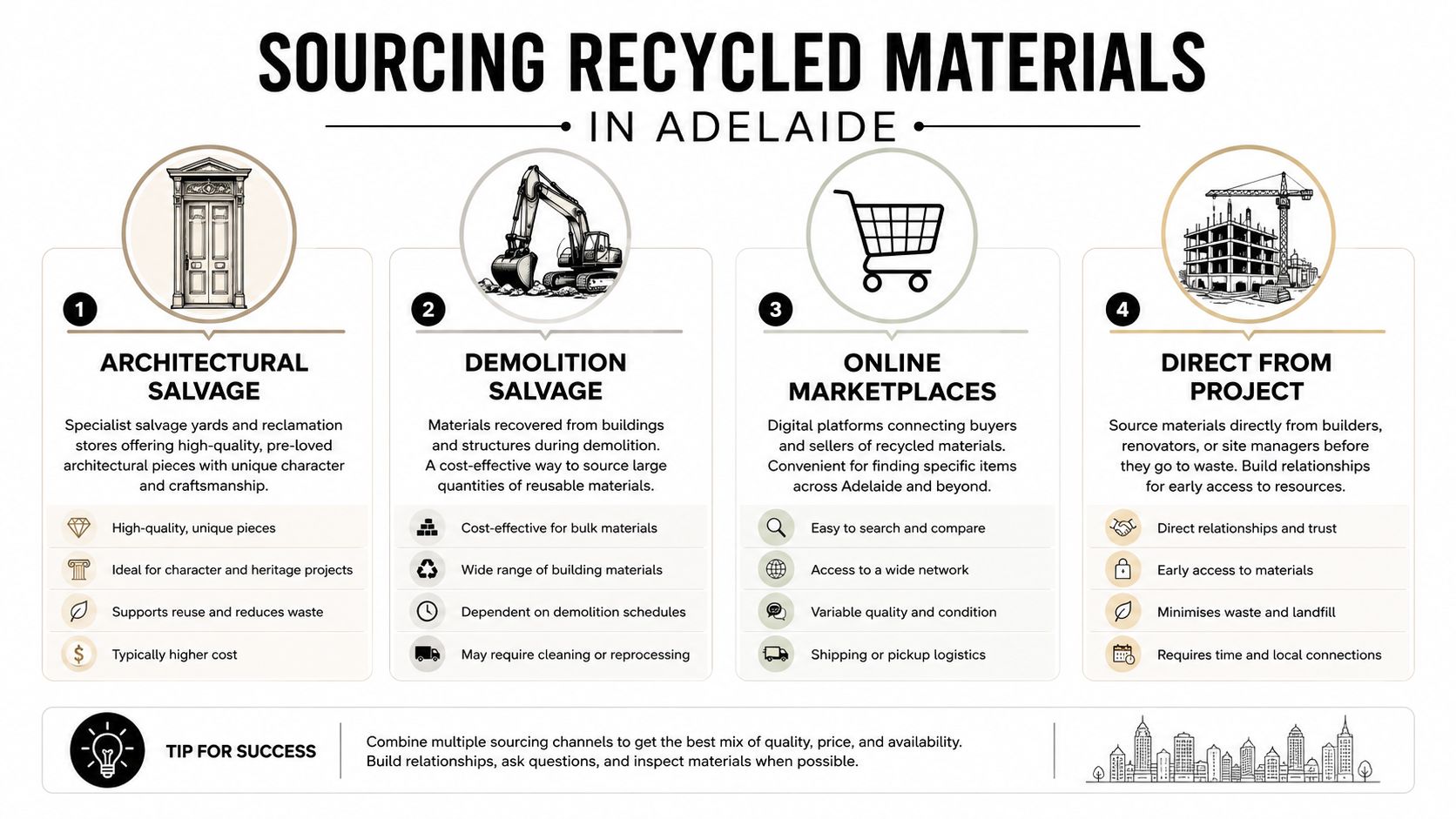
Adelaide doesn't have one recycled-material supply channel, it has several, and they behave very differently once you're buying for a real job. The right source depends on whether you need visible character, bulk fill, a matching replacement, or leftover new stock that can still save the budget without forcing a design compromise.
Architectural salvage yards
Salvage yards are the best place to find reclaimed timber, old bricks, doors, fittings, and the odd one-off piece that can carry a room. They're useful when the brief wants age, texture, and provenance. What they usually won't guarantee is perfect matching, uniform dimensions, or volume on demand.
Ask about provenance, visible damage, and whether the stock is from a single source or mixed from multiple sites. That matters because mixed stock often brings mixed colour and mixed condition. For a fireplace surround, a feature wall, or a restored entry, that variation can be a strength. For a run of identical items, it can become a problem fast.
Demolition salvage operators
These teams strip material before the building comes down, which gives them the best shot at higher-value recovery. They're the better option when a project has original doors, frames, timber, fixtures, or old brick worth saving intact. Their inventory tends to be smaller but cleaner than the random mix you find after demolition has already been rushed.
A local demolition salvage team is usually the right call when timing is locked and you need items removed before strip-out. If you want the old material to come back into the same project, coordination has to happen early.
Recycled aggregate suppliers
For crushed concrete, brick, road base, and similar bulk products, aggregate suppliers are the practical option. They're the channel that suits driveways, slab prep, footings fill, and other hidden work where appearance doesn't matter but compaction and consistency do. Recycled building materials Adelaide projects often rely on these products the most, even if nobody sees them once the pour starts.
Second-hand building material stores
These shops are best for surplus new stock, over-order returns, and leftover fixtures. They're useful when you need a fast, budget-conscious fix and don't need the backstory of a true salvage item. They're less useful for structural components or anything that needs a detailed chain of custody.
The key questions are the same across all four channels. Ask about lead times, contamination, delivery volume, and whether the stock will still be available when your builder needs it. Good stock moves quickly in Adelaide, especially when a heritage streetscape or a clean demolition releases a lot of reusable material at once.
If you're looking for a local restoration and reuse reference point, this Adelaide restoration centre page sits in the right lane. The market is useful, but it isn't endless, and the best pieces don't sit around waiting for a second decision.
Cost, Quality and Availability in the Adelaide Market
Recycled materials are not automatically cheaper. They're cheaper in some places, neutral in others, and more expensive once labour, sorting, and breakage are added back into the job. That's why the romantic version of salvage falls apart on site, because the invoice rarely stops at the purchase price.
Where the savings are real
The clearest wins are usually in feature bricks, feature timber, hard-to-source fittings, and crushed concrete for slab preparation or driveway build-ups. Those items can reduce pressure on supply and sometimes lower disposal costs when a project is organised well. Bulk recycled aggregate is especially straightforward, because it's doing a hidden job and doesn't need to look perfect.
The hidden cost comes from the work around the material. Reclaimed timber needs sorting, de-nailing, and checking. Old brick often carries mortar residue. Smaller pack sizes can also mean more deliveries, which turns a simple purchase into a coordination task.
The quality risks that catch teams out
Recycled timber can bring knots, iron stains, and warped lengths. Reclaimed brick may have inconsistent dimensions or colour variation from batch to batch. Salvaged windows and joinery can look great, then lose time on seals, fixing points, or compatibility with current detailing.
If the material is destined for a visible finish, inspect it with the same discipline you'd use for new stock.
That's the only way to keep the job honest. A client might accept variation in a feature wall or a timber beam, but they usually won't accept avoidable delays because a salvage item doesn't fit the opening once the frame is set.
Trade-offs in plain terms
| Material | Typical Cost vs New | Quality Risk | Best Adelaide Application |
|---|---|---|---|
| Reclaimed brick | Often similar or lower, depending on sorting | Mortar residue, colour variation | Feature walls, repairs in character homes |
| Reclaimed timber | Can be lower for feature stock, higher after preparation | Warping, stains, hidden damage | Flooring, beams, joinery features |
| Crushed concrete and brick | Usually cost-competitive in bulk use | Inconsistent contamination if poorly sourced | Driveways, slab prep, fill |
| Salvaged fixtures | Can be cheaper or premium depending on rarity | Compatibility and condition | Bathrooms, kitchens, character details |
The bigger market pressure is supply. As circular-economy policy pushes more Adelaide projects toward recovery and reuse, good salvage will become less of a bargain and more of a scarce resource. That doesn't make recycled materials less useful, it just means the best projects treat them as planned specification items, not opportunistic extras.
Council, DA and Building Code Rules That Affect Reuse
Recycled does not mean exempt. If a material has to perform structurally, resist fire, manage moisture, or comply with a council heritage condition, it still has to satisfy the same layers of approval and evidence as any new product. That's where a lot of otherwise good ideas stall, because the builder likes the material but can't document it well enough for the certifier or engineer.
The Adelaide rule stack usually starts with local council policy, then moves through Development Approval, then lands on the NCC or BCA for the parts of the build that touch structure, wet areas, cladding, insulation, or fire performance. If reclaimed timber is going to be load-bearing, you need a path to engineering sign-off. If recycled aggregate is being used in a critical application, you need confidence in its contamination and performance profile.
For homeowners, the simplest way to test a proposal is to ask what can be documented. Timber may need species, grade, and treatment history. Aggregate may need evidence around compressive strength and contamination. Linings and insulation need fire and acoustic performance data where the code calls for it.
Burden of proof stays with the builder and designer, not the material label.
That's why recycled products are much easier to use in visible finishes or non-critical elements than in structural or regulated zones. A salvaged door can be straightforward. A reclaimed beam or wet-area lining is a different conversation entirely.
If you're unsure where the approval line sits, this guide to a development application is a useful starting point for the paperwork side of the job. The practical pre-spec checklist is short, and every item should be answered before purchase or demolition starts.
- Council status: Does the site have heritage, streetscape, or demolition conditions that affect removal or reuse?
- Load path: Is the reclaimed item structural, and if so, who is certifying it?
- Product evidence: Can the supplier provide the material history or performance information needed?
- Moisture and fire risk: Is the item going into a wet area, fire-rated wall, or another regulated zone?
- Installation fit: Will current fixings, sizes, and tolerances work without forcing site modifications?
Using Recycled Materials Across the Build Sequence
A rebuild doesn't use recycled materials in one lump. It uses them, or avoids them, stage by stage. The logic changes from demolition to finishes, and the job goes smoother when each stage has its own material rule instead of a single vague sustainability goal.
Demolition and substructure
The cleanest gains happen right at the start. Source-separated concrete and masonry can go to different processors, which keeps the stream useful and reduces the chance that good rubble gets downgraded by mixed waste. In the hidden parts of the project, crushed concrete and brick are the obvious fit for slab prep, footing fill, and driveways.
That's where recycled material is often the least controversial. It does a bulk job, it's not trying to be decorative, and it helps keep valuable landfill space from being eaten up by material that still has a second life.
Frame and envelope
Reclaimed hardwood beams belong here only when they're properly documented and acceptable to the engineer. Otherwise, they're better treated as feature material rather than hidden structure. Salvaged brick can work well in feature walls or repair zones, but matching old and new brick is never as easy as people hope, especially once mortar, colour, and size differences show up in the wall.
Salvaged windows and second-hand roof tiles need more scrutiny. A window can look perfect and still fail on seals or ratings. A roof tile can fit the aesthetic and still create problems if the structure or fixing pattern doesn't suit the existing roof.
Services and finishes
Services are usually the worst place for improvisation. Plumbing, electrical, waterproofing, and insulation are not where you want an unverified recycled part making decisions for you. The better use of recycled materials is in reclaimed timber flooring, repurposed joinery, and selected decorative surfaces such as recycled glass tiles or benchtops.
Put recycled material where the eye lands first, and put proven new product where performance matters most.
That's a sensible Adelaide renovation strategy because it keeps the character where people see it and the compliance where inspectors look. In a heritage extension, the old brick might handle the visible wall, while the hidden layers stay conventional. In a custom home on a cleared block, the recycled story may sit in the finishes and hard landscaping rather than the structure.
The build sequence matters because each stage has a different tolerance for variation. If you match the material to the stage, recycled stock becomes an asset. If you force it into the wrong part of the job, it becomes delay.
Real Adelaide Case Studies and What They Teach
The strongest Adelaide examples all point to the same thing, early planning beats late sorting. Hines Property reported a recyclable success rate of about 98% by weight for the former RAA building demolition, another major Adelaide development achieved over 87%, and a separate South Australian project reported 95.1% of construction waste reused or recycled by weight (Hines Property demolition report). Those results are not accidents, they're the outcome of source separation, pre-strip planning, and locked-in downstream pathways.
What the high performers did differently
The best results started before the demolition machine arrived. A pre-demolition audit identified what could be recovered, the contractor separated material into cleaner streams, and the disposal pathway was known in advance. That's how a project gets close to the high-90s rather than settling in the mid-80s with mixed loads and lower-value fractions.
The practical failures are just as instructive. Mixed demolition loads, wet timber, and unplanned deconstruction can destroy the value of items that might have been reusable. Once they're contaminated or damaged, they move down the chain, and the job loses both material value and flexibility.
The lesson for Adelaide homes and custom builds
Residential projects don't need to copy a commercial demolition to benefit from the same discipline. A renovation with original brick and timber can still use a pre-strip salvage list, and a custom home can still specify crushed concrete, recovered masonry, or second-hand fixtures from day one. The difference between a strong result and a merely decent one usually comes down to whether the builder, designer, and recycler were all briefed before the first wall came out.
For Adelaide homeowners, the takeaway is practical. If the project has character material worth saving, treat it like a planned resource. If it doesn't, use the recycling system properly and let the cleanest streams do the heavy lifting.
If you're planning a renovation, extension, or custom build in Adelaide and you want a builder who understands where recycled materials work, Templeton Built can help you shape the plan around real site conditions, compliance, and supply. Visit Templeton Built to talk through a project that uses the right materials in the right places, without the usual late-stage substitutions.


Leave a Reply