

Renovation Financing Options: Your 2026 Australian Guide
You've probably had the same conversation at the dinner table more than once. The house still suits the street, the school zone, the commute, and the neighbours, but it no longer suits the way your family lives. The kitchen is cramped, the living space is tight, or you need an extra bedroom, a study, or a proper rear extension.
That's the exciting part.
The harder part usually arrives a few days later, when plans, sketches, and wish lists turn into one blunt question. How are we going to pay for this?
For many Adelaide homeowners, the answer isn't as simple as “get a renovation loan”. In Australia, lenders usually assess renovation borrowing as part property value question, part household capacity question, and part project-risk question. That matters because housing debt is already significant across the market. The ABS reported average new owner-occupier dwelling finance commitments of about A$659,000 in March 2026, which helps explain why lenders look closely at serviceability and the post-renovation debt position, not just the build quote, as noted in this Australian renovation loan overview.
A bank doesn't just ask whether your kitchen will look better. It asks whether your finances still work if rates rise, whether the renovation scope is realistic, and whether the finished property supports the total debt.
That's why the finance conversation should start earlier than expected. Before you speak to lenders, it helps to understand whether your project is financially feasible at all. A proper renovation feasibility study helps you test the numbers before you commit emotionally to a scope that may need to change.
From Dream Renovation to Financial Reality
Families often begin with rooms. Lenders begin with risk.
That gap causes a lot of confusion. A homeowner might think, “We only need funds for an extension,” while the lender is looking at existing mortgage commitments, income, living expenses, the likely end value of the home, and whether the project has enough documentation behind it.
Why finance feels harder than expected
A renovation sits in an awkward middle ground. It isn't a simple home purchase, because the property is changing. It also isn't just a standard personal loan decision, because larger building works usually need more funding and a more structured release of funds.
For that reason, your finance pathway should match your renovation scope.
- A cosmetic kitchen refresh may suit available cash, redraw, or a smaller lending structure if the works are straightforward and fully costed.
- A major kitchen rebuild with layout changes, services relocation, and structural work often needs a more formal finance plan.
- A full extension usually pushes you into staged funding territory, especially if the project affects valuation, compliance, and timing.
- A whole-home transformation tends to require close coordination between lender, valuer, designer, and builder.
Practical rule: Match the loan structure to the complexity of the build, not just the headline budget.
What borrowers often miss early
It's common to focus on the contractor quote first. That's understandable, but lenders usually care about more than the contract value alone. They want to know whether the finished debt level is acceptable and whether your household can comfortably carry it.
That's why strong renovation planning includes:
- Project scope clarity so the lender can understand what's being built.
- Financial capacity evidence so repayments appear manageable.
- A realistic timeline because long, complex works create more funding risk.
- Allowance for changes because plans almost always evolve once documentation begins.
A good financial plan doesn't kill the dream. It protects it. It helps you decide whether to trim the scope, stage the works, or choose a different finance path before you're locked into drawings and approvals that don't fit the budget.
Understanding Your Core Asset Your Home Equity
A lot of Adelaide homeowners reach this point with a rough budget in mind and one big question. “Can we fund the kitchen and family-room extension from the value already sitting in the house?”
That question starts with equity.
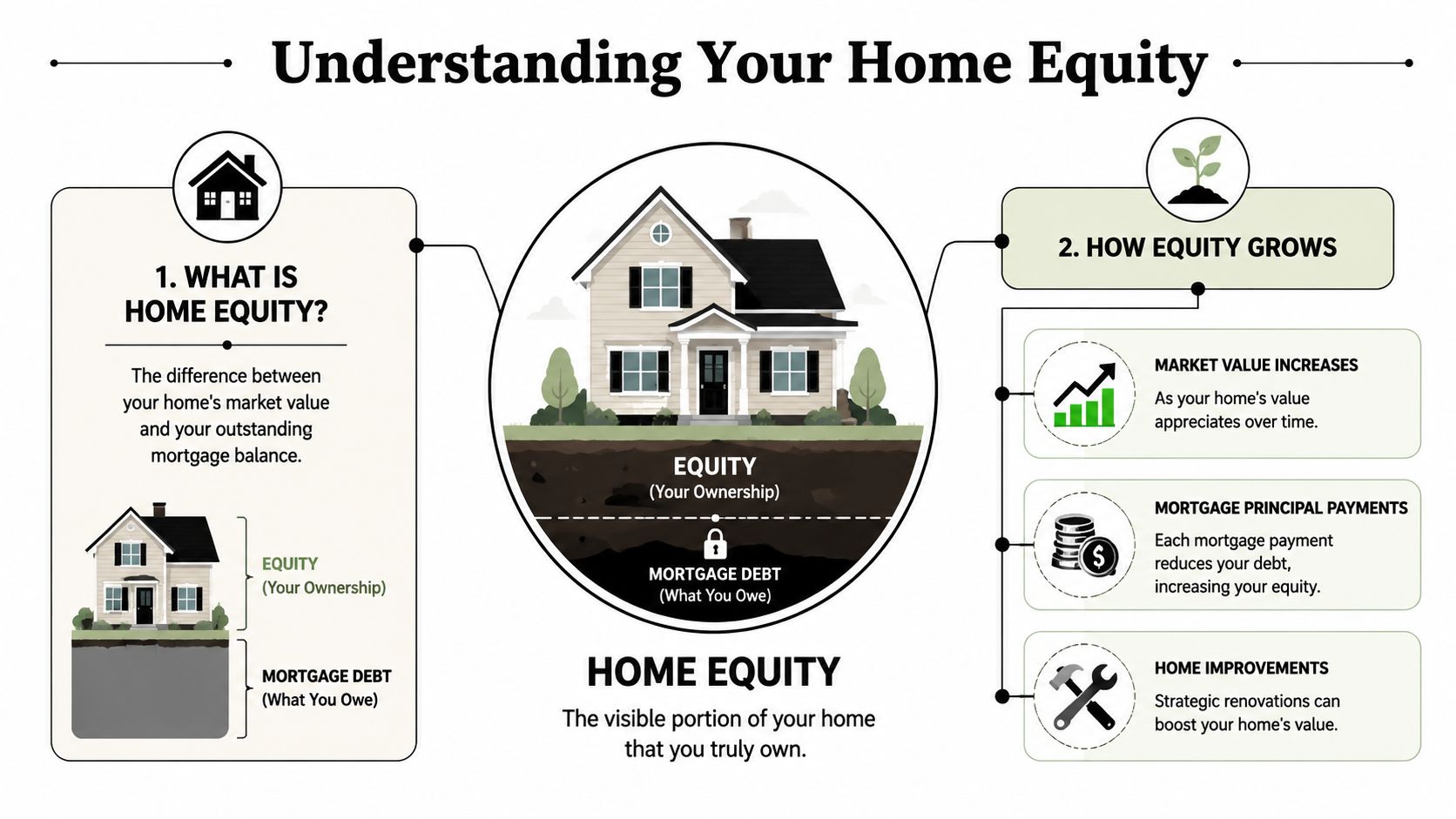
Home equity is the share of your home you own outright. It grows as your loan balance falls and as the property value rises. For renovation planning, equity works like stored borrowing capacity inside the property, but only part of that capacity is usually available for use.
What equity means in plain language
Start with a simple formula. Take the current value of the home and subtract what you still owe on the mortgage. The difference is your equity.
The part that often causes confusion is this. Equity and usable equity are not the same thing. Lenders usually keep a safety margin rather than lending against the full value of the home. In practice, renovation borrowing is often capped at around 80% to 85% of the property's value minus the existing mortgage, as explained in this home renovation financing guide.
A quick example makes it easier to see. If your home is worth $900,000 and your current mortgage is $500,000, the usable amount may be about $220,000 to $265,000, depending on the lender's policy and any costs rolled into the loan. That gap catches homeowners out all the time because the headline equity figure looks larger than the amount a bank is willing to approve.
Why this matters before you finalise the build
This is the point where your builder should come into the conversation, not after the drawings are complete.
If you are planning a major kitchen renovation, usable equity helps answer whether you can afford structural changes, new services, and higher-end selections, or whether the project needs to stay within a tighter footprint. If you are planning a full extension, equity gives an early sense of whether you are likely to suit a simple loan increase or a more managed funding structure tied to progress on site.
That early check can save months of wasted design work. A builder who understands realistic construction costs can help you test the scope against your likely funding range before you get too attached to a plan that the lender may not support. For a broader look at how project planning and finance fit together, our guide to funding a property development project explains the same principle from a build-first perspective.
Redraw and offset are different tools
These two get lumped together, but they do different jobs.
- Redraw gives you access to extra repayments you have already made into the home loan.
- Offset is a separate account whose balance reduces the interest charged on the loan.
For a smaller bathroom update or cosmetic kitchen refresh, either one may help with cash flow. For an extension, major reconfiguration, or renovation with engineering and approval costs, they may only cover part of the picture. They are useful tools, but they do not automatically solve the funding question.
When equity-based borrowing tends to fit
Equity-backed borrowing often suits larger renovation work because the home secures the debt, which usually makes it more practical than unsecured lending for structural projects.
It can suit a family in a few different situations. One is a well-defined kitchen rebuild where the scope is clear enough to cost properly. Another is a staged extension where the total project is manageable, but timing matters and you need finance that lines up with how the works will be delivered.
If you want a second plain-English explanation of how equity-backed borrowing works, the LendingXpress rental property loan guide covers the mechanics clearly, even though it is written for a different property scenario.
The figure that matters is not the value you have built up in the home. It is the portion a lender will let you use, while your repayments still remain comfortable for the household.
Exploring Major Renovation Financing Options
Not every project needs the same funding structure. The right choice depends on the type of work, how settled the design is, and whether costs are fixed or likely to move.
Home equity loan or equity release
This is one of the most common pathways for larger renovation work in Australia. You borrow against existing equity and use that funding for the renovation.
Best used for: a major kitchen renovation, bathroom rebuilds, reconfigurations, or medium-to-large upgrades where you already have a solid grasp of cost.
Why people choose it: repayments are usually more structured than a flexible line of credit, and it can suit projects where the contract value is known early.
Where it can be awkward: if your scope is still shifting, a lump-sum structure may be less flexible than you need.
Line of credit or HELOC-style facility
Some borrowers prefer a line-of-credit approach because it lets them draw funds as needed rather than taking everything at once.
Best used for: phased renovations, mixed works, or projects where the final scope may evolve after opening walls, reviewing engineering, or refining selections.
Strong point: flexibility. If your kitchen renovation may expand into adjacent living areas once design develops, this structure can be easier to work with.
Trade-off: flexibility can encourage loose budgeting if you're not disciplined. That's where early planning matters.
Cash-out refinance
With a cash-out refinance, you replace your current mortgage with a new loan and release some equity as part of the new arrangement.
This can work well when the renovation is part of a broader financial reset. For example, a family may want to consolidate existing debt, simplify repayments, and fund a large extension under one facility.
Best used for: major renovations where the existing mortgage is due for review anyway.
Potential downside: you're reworking the whole home loan, not just adding renovation funds. That can be sensible, but it's a bigger decision than topping up for construction.
For homeowners who want a broader explanation of equity release through refinancing, this guide to releasing equity gives a useful product-level comparison.
Construction loan
For substantial extensions and structural works, a construction-style loan can be the most practical option. Instead of releasing the entire amount upfront, the lender may release funds in stages tied to progress milestones.
That's often the cleanest fit when the project has a formal building contract, a schedule, and lender-required documentation. If your renovation looks more like a mini-build than a simple refurb, this structure often makes sense.
Best used for: rear extensions, second-storey additions, and major structural remodels.
Main advantage: staged drawdowns align better with the way builders bill for work.
Main challenge: lenders usually want stronger documentation, and the approval process can feel more involved.
If your project is part of a broader development or value-add strategy rather than a standard family renovation, this guide on how to finance property development is worth reading because the funding logic starts to shift once complexity increases.
Bridging finance
This is a niche tool, but it matters in some situations. Bridging finance can help when you're buying, selling, and renovating across overlapping timeframes.
Best used for: homeowners moving between properties while planning works, or temporary funding gaps during a transition.
It's less common for straightforward owner-occupier renovations and usually needs careful advice because timing risk matters.
Personal loan
A personal loan can suit smaller works where you don't want to tie the debt to the home. It's usually more relevant for contained projects than for extensions or structural change.
Best used for: limited-scope updates, modest cosmetic works, or items that don't justify a property-secured facility.
The catch: borrowing limits and pricing can make it unsuitable for larger projects.
If the renovation changes the structure, footprint, or core services of the home, start by examining property-secured options first. Personal lending usually fits the edges of renovation work, not the centre of it.
Comparing Your Financing Choices Side-by-Side
When clients compare renovation financing options, they often ask for “the cheapest one”. That's not always the right question. A better question is, which option fits the way this project will run?
Here's a practical comparison.
Renovation financing options at a glance
| Financing Option | Best For | Typical Interest Rate | Key Fees | Pros | Cons |
|---|---|---|---|---|---|
| Construction loan | Extensions, structural remodels, major staged projects | Varies by lender and borrower profile | Valuation, application, progress payment or loan establishment costs may apply | Matches staged construction payments, works well with formal contracts | More paperwork, stricter documentation, slower setup |
| Equity loan or line of credit | Major kitchens, larger upgrades, phased renovations | Varies by lender and borrower profile | Establishment, valuation, ongoing account or line fees may apply | Uses home equity, can provide flexible access to funds | Requires sufficient equity and serviceability |
| Cash-out refinance | Large renovations combined with broader mortgage restructuring | Varies by lender and borrower profile | Refinance, discharge, valuation, and setup costs may apply | Consolidates debt into one facility, can simplify repayments | Replaces the existing mortgage, not just the renovation portion |
| Personal loan | Smaller non-structural works | Often higher than property-secured options, depending on lender | Application or account fees may apply | Faster and simpler for contained projects | Lower borrowing capacity, less suitable for major renovations |
The real trade-offs
A construction loan usually suits a fixed, documented project. If you're adding a rear extension and already have plans, approvals underway, and a clear contract pathway, staged drawdowns tend to mirror the build process more neatly than an all-at-once release.
An equity loan or line of credit is often more comfortable for a substantial kitchen project where the footprint stays mostly the same but costs may shift with appliances, joinery, finishes, or hidden site conditions. You retain flexibility without restructuring the full mortgage.
Cash-out refinancing is often a strategic decision rather than a renovation-only decision. It can work well if your current home loan no longer suits you and the renovation is one piece of a larger reset. It's less attractive if you're otherwise happy with the existing loan structure.
Which option suits which scope
Use the build itself as the guide.
- Kitchen renovation with known scope often points to an equity loan.
- Kitchen plus living reconfiguration may suit a line of credit if design decisions are still moving.
- Full extension commonly fits a construction-style facility.
- Smaller cosmetic upgrade may be manageable with cash, redraw, or a personal loan if the scope is contained.
The more fixed your plans are, the more structured your finance can be. The more unknowns you still carry, the more flexibility you'll usually need.
How to Prepare Your Application and Choose a Lender
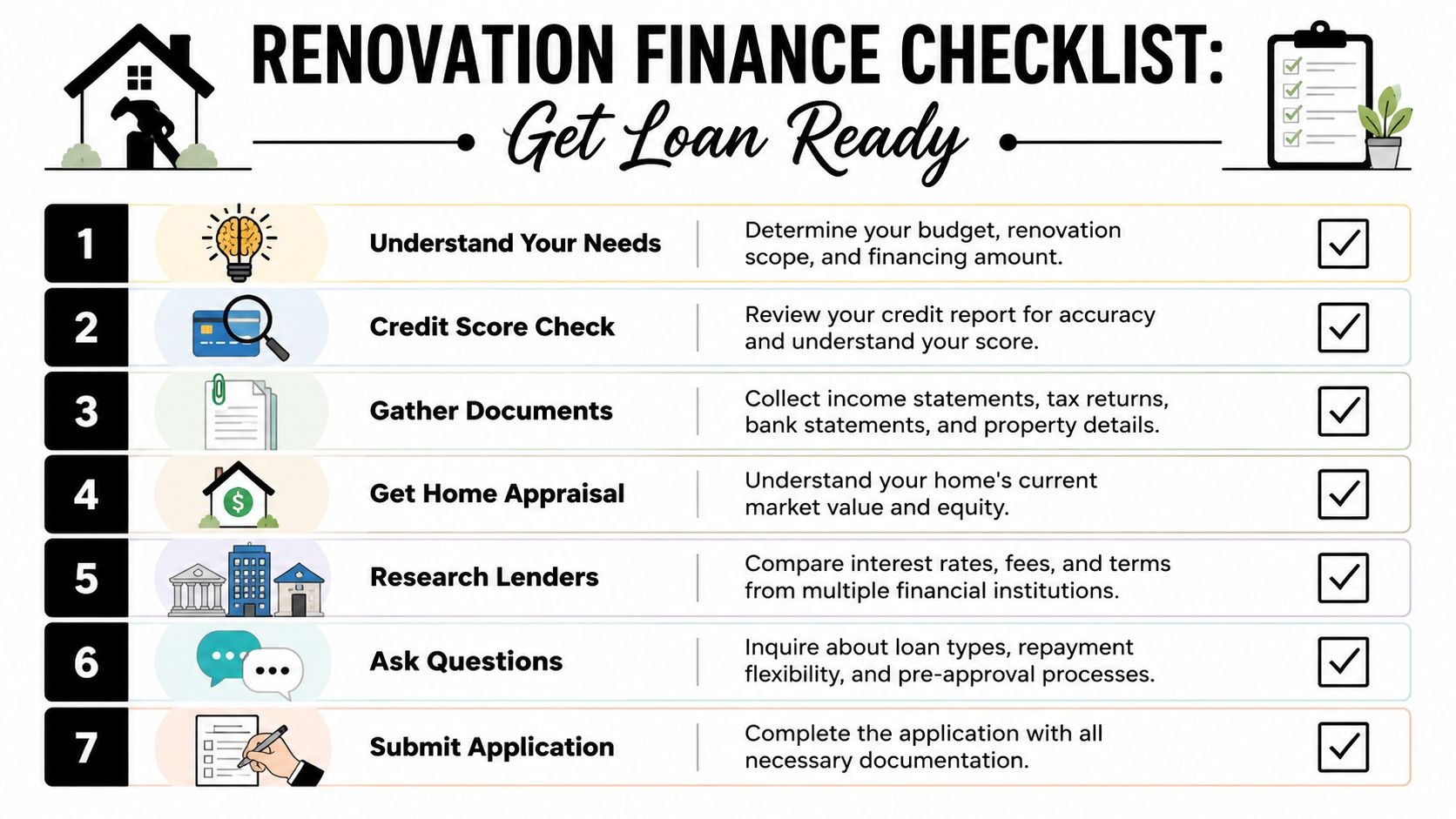
A good renovation finance application doesn't begin with the bank meeting. It begins with clear paperwork, realistic costing, and a scope that makes sense on paper as well as in your head.
That matters because renovation lending can be hard to secure. One Urban Institute analysis found a 43% denial rate for renovation loans, compared with 10.6% for purchase loans, and noted that many lenders require a loan-to-value ratio of 80% or less before renovation, as discussed in this Urban Institute analysis of renovation finance.
What to prepare before you apply
The cleaner your file, the easier it is for a lender to assess the project.
Clear renovation scope
Know whether you're doing a cosmetic upgrade, structural alteration, extension, or full remodel. A vague idea is hard to finance.Detailed costings
Lenders respond better to itemised budgets than rough estimates. Accurate project costing is one reason a practical renovation budgeting guide is worth reviewing early.Income and loan documents
Expect to provide the standard financial records a lender uses to assess serviceability.Plans and approvals where relevant
For larger projects, supporting drawings, engineering input, and approval status can all affect lender confidence.
Here's a helpful overview of the process:
Questions worth asking lenders
Not all lenders treat renovation projects the same way. Ask practical questions, not just pricing questions.
How do you assess staged renovations?
This matters if your extension or major kitchen will be built in phases.Do you require fixed-price contracts?
Some lenders are more comfortable when scope and contract sums are tightly documented.How do you value the project?
You want to know whether they're focused only on today's property position or looking carefully at the completed outcome.How are funds released?
This can affect builder payments, ordering timelines, and cash flow during construction.
Choosing the right lender, not just the fastest one
The fastest approval isn't always the best fit. A lender who understands construction staging, progress payments, and renovation documentation can make the process far less stressful than one who treats the project like a standard top-up.
Shortlist lenders based on:
- Their comfort with renovation and construction-style lending
- Their documentation requirements
- How flexible they are with staged drawdowns
- Whether their process suits your project timeline
A lender is not just funding the work. They're becoming part of the project machinery. If their process doesn't align with the way the renovation will run, problems tend to show up mid-build rather than at application stage.
Partnering with Your Builder for a Smooth Financial Journey
Finance and construction are strongly connected. They shouldn't be treated as two separate tracks.
A lender may approve the borrowing in principle, but the strength of the application often depends on the quality of the project information behind it. That includes the scope, documentation, schedule, and contract structure. In real terms, the builder's paperwork and planning discipline can shape how smooth the finance process feels.

Why builder input matters early
Homeowners often wait until finance is nearly sorted before involving the builder properly. For smaller works, that can be manageable. For extensions and major kitchen projects, it usually creates friction.
A builder can help clarify:
- Whether the proposed scope is realistic for the site and existing structure
- Whether the budget aligns with the design intent
- How the project is likely to be staged
- What documentation a lender may ask for during assessment
That early alignment reduces the chance of chasing finance for a project that later has to be redesigned.
What good builder coordination protects you from
A well-organised builder helps keep the financial side stable during construction, not just before it starts.
That can include:
- Accurate scope definition so the lender and homeowner are looking at the same project
- Clear contract pricing where appropriate
- Progress claim structure that works with staged funding
- Fewer avoidable variations caused by unclear selections or missing detail
A renovation budget rarely blows out because of one dramatic mistake. More often, it slips through unclear documents, late decisions, and funding that doesn't match the build process.
For families planning an extension or major kitchen reno, the best outcome usually comes from treating finance as part of project planning from day one. When the design team, builder, and lender are all working from a clear brief, the project is easier to fund and easier to deliver.
If you're planning a renovation, extension, or custom home in Adelaide, Templeton Built can help you align your design ideas with realistic construction costs before the build gets underway. That early clarity makes lender conversations easier and helps you choose a renovation scope that fits both your home and your finances.


Leave a Reply