

Smart Lighting Systems: A Guide for Your Custom Build
You're probably making lighting decisions at the same time you're choosing flooring, joinery finishes, appliances and tapware. That's usually when smart lighting gets pushed into the “we'll sort that later” basket. In a custom build or major renovation, that's the wrong time to leave it vague.
Lighting isn't just about whether a room is bright enough. It shapes how a home feels at breakfast, how a kitchen works during meal prep, how artwork reads at night, and whether a commercial space feels calm, sharp, welcoming or flat. A standard switch can only do one job. A properly planned smart lighting system can support architecture, daily routines, energy control and the overall finish quality of the project.
The key difference is this. DIY smart bulbs are a product. Integrated smart lighting systems are part of the building.
Beyond the Switch The Rise of Smart Lighting
Walk into a newly completed home with a premium kitchen, carefully selected stone and custom cabinetry, then turn on one harsh bank of downlights from a single switch, and the whole room feels less resolved. You can have excellent materials and still end up with blunt, inflexible lighting.
That's why smart lighting has moved well beyond the gadget category. In a well-designed project, it becomes part of how the house is zoned, how people move through it, and how each room changes through the day. The appeal isn't novelty. It's control, comfort and better design outcomes.
In Australia, this shift is already well established. As of 2021, 69% of Australian households owned at least one smart home device and households maintained an average of five devices, with smart lighting forming a core part of that ecosystem, according to the ACCC-linked TP-Link Australia submission. The same source notes that sustainability, safety, security and convenience are key drivers behind adoption.
Why clients now expect more from lighting
Clients rarely ask for “technology” in the abstract. They ask for outcomes.
- Less friction: They want lights to respond properly when they arrive home, wake early, entertain or lock up at night.
- Better atmosphere: They want one room to support cooking, dining and relaxing without feeling overlit.
- Lower waste: They don't want lights left on unnecessarily, especially in larger homes and mixed-use spaces.
- Cleaner walls: They want fewer banks of switches and a more considered interior finish.
Smart lighting works best when it disappears into the house and leaves only the result visible.
That's why integrated systems are now discussed alongside glazing, insulation, shading and appliance selection. They support efficiency, but they also support architecture. If you're building from scratch or opening up substantial parts of an existing home, it makes sense to plan lighting as a system instead of a collection of fittings.
Understanding the Core Components
The easiest way to think about smart lighting systems is as a lighting nervous system. One part gives instructions, one part senses what's happening, and one part does the work.
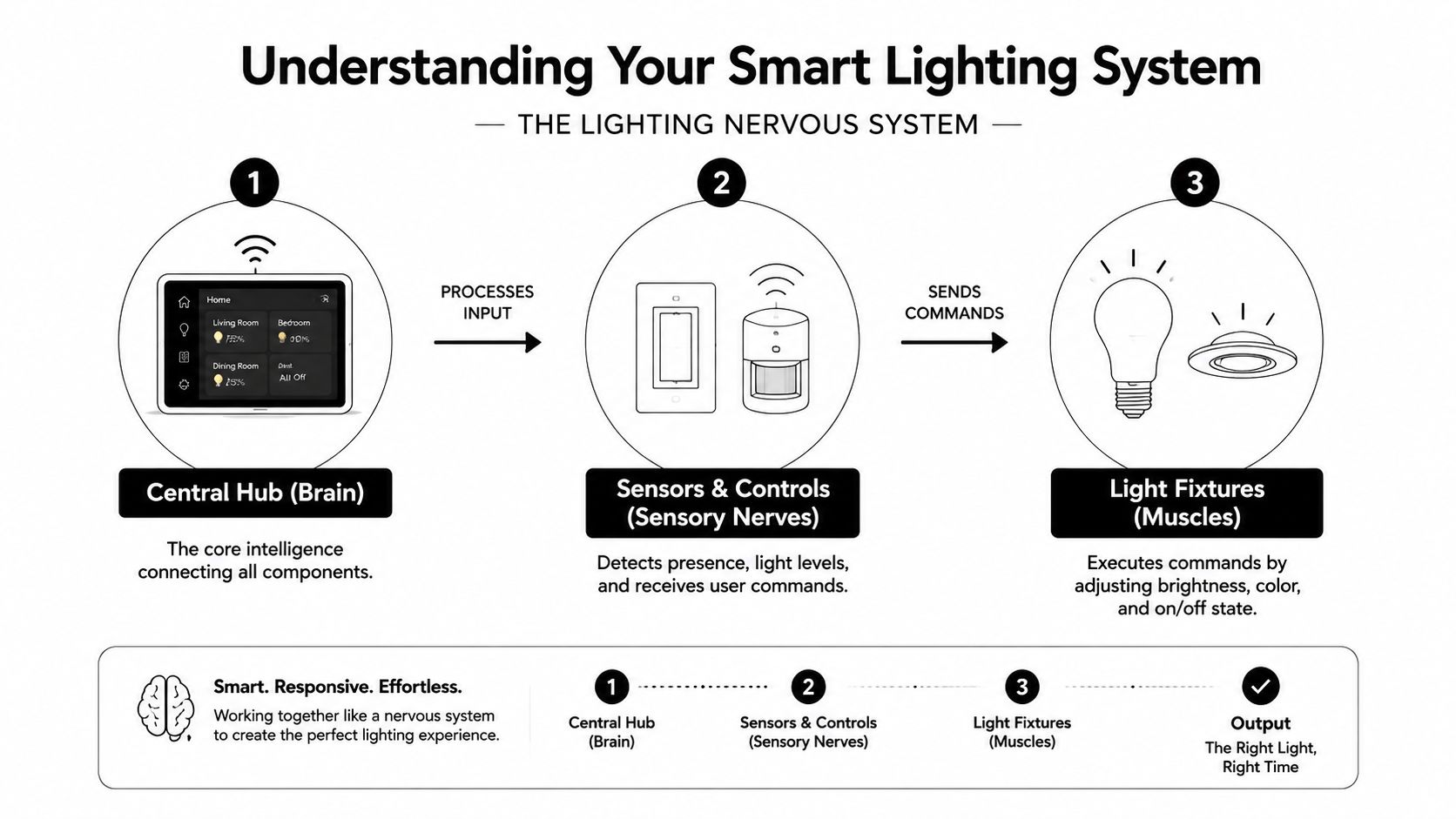
The lights do the visible work
This is the part that first catches the eye. It includes smart bulbs, LED strips, downlights, pendants and integrated architectural fixtures. But these options aren't interchangeable.
A single smart bulb suits a lamp or a simple retrofit in one room. It's useful when you want a quick upgrade without rewiring. In a larger custom project, though, relying on bulb-by-bulb solutions often becomes messy. You end up managing too many individual products, and the fittings may not deliver the beam spread, dimming quality or trim detail the architecture needs.
Integrated fixtures usually give better results in projects where lighting is meant to support the design language of the home. They allow more deliberate placement, cleaner ceiling layouts and better consistency across the whole property.
The controls shape how you use the space
Controls are where convenience becomes practical. These can include wall keypads, smart switches, dimmers, occupancy sensors, daylight sensors, apps and voice assistants.
A good control strategy doesn't ask you to pull out your phone every time you enter a room. It balances manual control with automation. In a kitchen, that might mean one keypad button for prep lighting, another for dining mode, and a low-level evening path at night. In a commercial fit-out, it might mean scheduled opening and closing scenes with local override where staff need it.
Here's where projects often go wrong:
| Approach | What works | What doesn't |
|---|---|---|
| App-only control | Useful for setup, remote access and adjustments | Annoying as the main way to operate everyday lighting |
| Too many switches | Familiar at first | Creates wall clutter and confusion |
| Thoughtful scene control | Simplifies daily use and reduces decision fatigue | Needs planning early to work well |
A short explainer can help if you want to see how these parts fit together in practice.
The brain keeps the system coherent
The “brain” is the hub, bridge or gateway that connects fixtures and controls into one system. Without it, many setups are just separate smart products that happen to live in the same house.
Practical rule: If you want whole-home reliability, scene control and room-to-room consistency, plan around a central system instead of collecting isolated devices.
That central layer matters most in larger homes, renovations with multiple zones, and commercial spaces where reliability matters more than novelty. It's what lets entry lighting trigger a hallway path, outdoor lighting respond to schedule changes, and key spaces behave consistently without constant manual adjustment.
How Your Smart Lights Communicate
Not all smart lighting systems speak the same language. That matters because communication problems are what usually make a setup feel flaky. Delayed response, fixtures dropping offline and inconsistent behaviour almost always come back to the way devices are connected, not the idea of smart lighting itself.
Wi-Fi and Bluetooth for simple setups
Wi-Fi is familiar. It is widely available, and many entry-level smart bulbs connect directly to it. For a small setup, that can be perfectly adequate. A few lamps, a hallway globe or a basic outdoor light can work well without extra hardware.
Bluetooth is even simpler for nearby control. It's useful where local operation matters more than whole-property integration.
The limitation with both is scale. Once a project moves beyond a few fittings, these approaches can become awkward to manage. They can also leave too much of the system dependent on a general household network that's already handling phones, tablets, televisions and other connected devices.
Zigbee and Z-Wave for integrated projects
For larger homes and serious renovations, builders and integrators often favour systems that run on a dedicated lighting network. Zigbee and Z-Wave are commonly used for that reason. They're designed for connected devices and are better suited to a coordinated, whole-home approach.
That doesn't mean every project needs the same protocol. It means the communication method should match the scope of the build. If you're planning layered lighting, multiple scenes, sensors and integration with entry points or security, reliability matters more than easy shelf purchase.
There's a close relationship here with broader energy planning. If you're also looking at battery storage, load shifting or coordinated automation, this guide for Australian solar battery owners gives useful context on how connected devices can work together rather than as stand-alone upgrades.
Choose for reliability, not novelty
The best system is usually the one nobody has to think about after handover. It responds quickly, keeps working after internet hiccups and doesn't require every family member or staff member to learn a new routine.
That's also why lighting should be considered alongside other building systems rather than in isolation. If you're coordinating lighting with doors, gates, alarms or entry permissions, the planning should happen together. Such coordination means broader building technology, including access control systems, starts to overlap with lighting decisions in a meaningful way.
Benefits for Modern Homes and Businesses
The strongest case for smart lighting isn't that it's clever. It's that it solves real day-to-day problems in both residential and commercial spaces.
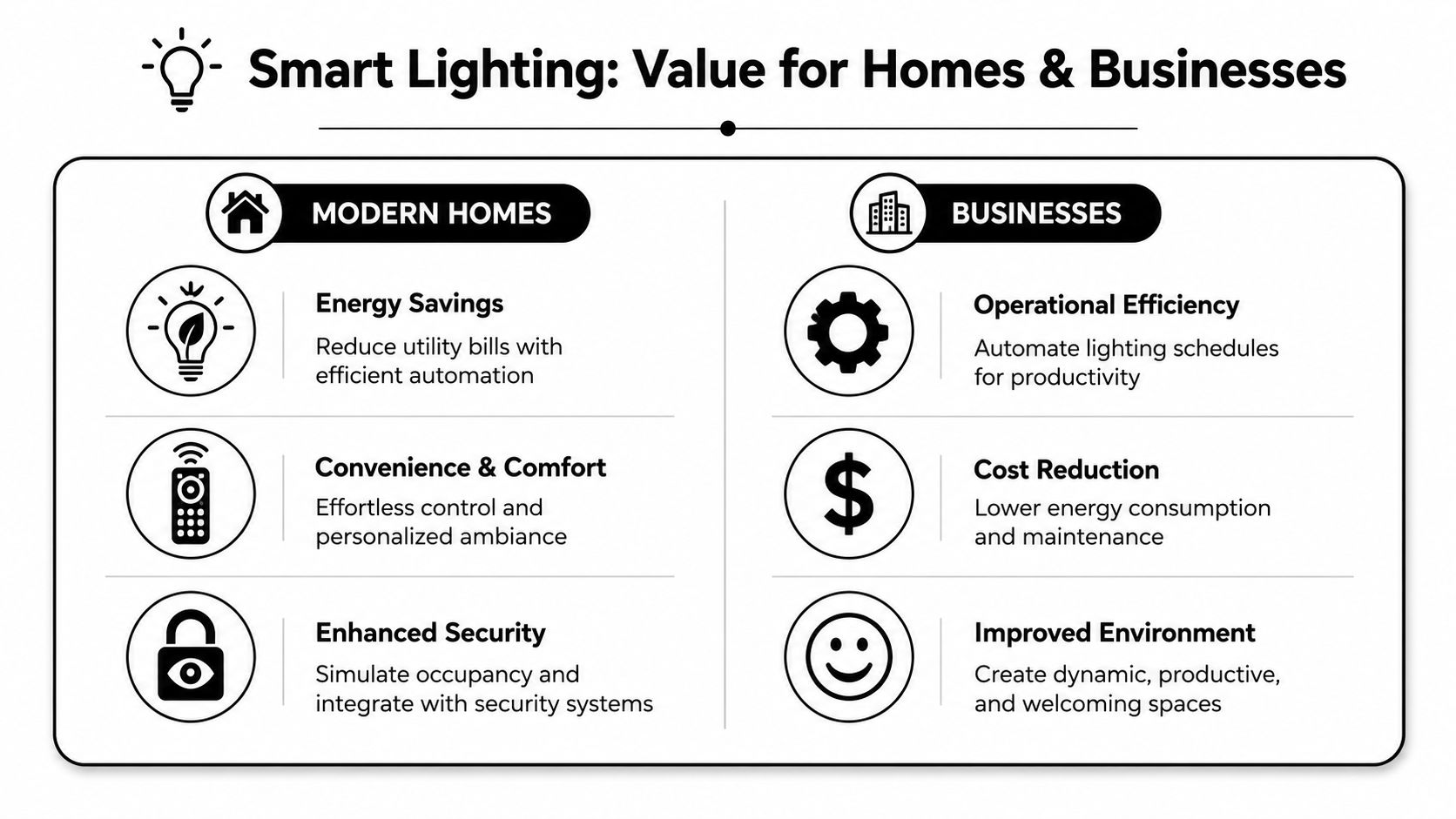
For homes, the value is lived every day
A good residential lighting plan changes the way the house behaves. You stop thinking in terms of “on” and “off” and start thinking in terms of mood, function and timing.
Lifestyle and comfort
Scenes are one of the most useful features in a custom home. A single command can set the kitchen island, dining pendant and living room lamps to the levels that suit dinner. Another can reduce the entire ground floor to soft evening light.
That sounds simple because it is. The point isn't to add complexity. It's to reduce the number of small decisions you make every day.
- Morning use: Gentle brightness in circulation areas helps the home wake up without flooding every room with full output.
- Evening wind-down: Lower, warmer light can make open-plan spaces feel settled rather than exposed.
- Entertaining: Different layers can be activated without walking room to room adjusting dimmers.
Security and peace of mind
Lighting is part of how a property presents when occupied and when empty. Timed scenes, external pathways and entry sequences make a home feel attended to. That's useful when travelling, but it's just as valuable on ordinary evenings when people arrive at different times.
A well-planned setup can also support safer circulation. Hallways, stairs and bathrooms don't need full brightness in the middle of the night. They need enough light in the right place at the right time.
For businesses, the value is operational
Commercial lighting decisions affect staff, customers and running costs. In a retail tenancy, poor lighting can flatten products and make the space feel tired. In an office, it can make focused work harder than it needs to be.
The commercial test is simple. If lighting needs constant manual correction, the system wasn't planned well enough.
Efficiency and consistency
Smart lighting helps businesses standardise routines. Opening, trading, cleaning and closing all have different requirements. The right system lets those changes happen predictably rather than relying on whoever is first in or last out.
Better environments for people
Light influences how a space feels to occupy. In customer-facing environments, that shapes perception. In staff environments, it affects comfort and usability. Smart control gives you more precision across reception areas, work zones, meeting rooms and display spaces.
For clients already pursuing broader performance upgrades, there's a natural overlap with energy-efficient home renovations, particularly where lighting, insulation, glazing and appliance choices are being considered together rather than one by one.
Design and Integration Strategies
The best time to design smart lighting systems is before plaster goes on, not after the paint is dry. That's true in homes and commercial spaces alike. Once the wiring, switching logic and fixture locations are locked in, your options narrow quickly.
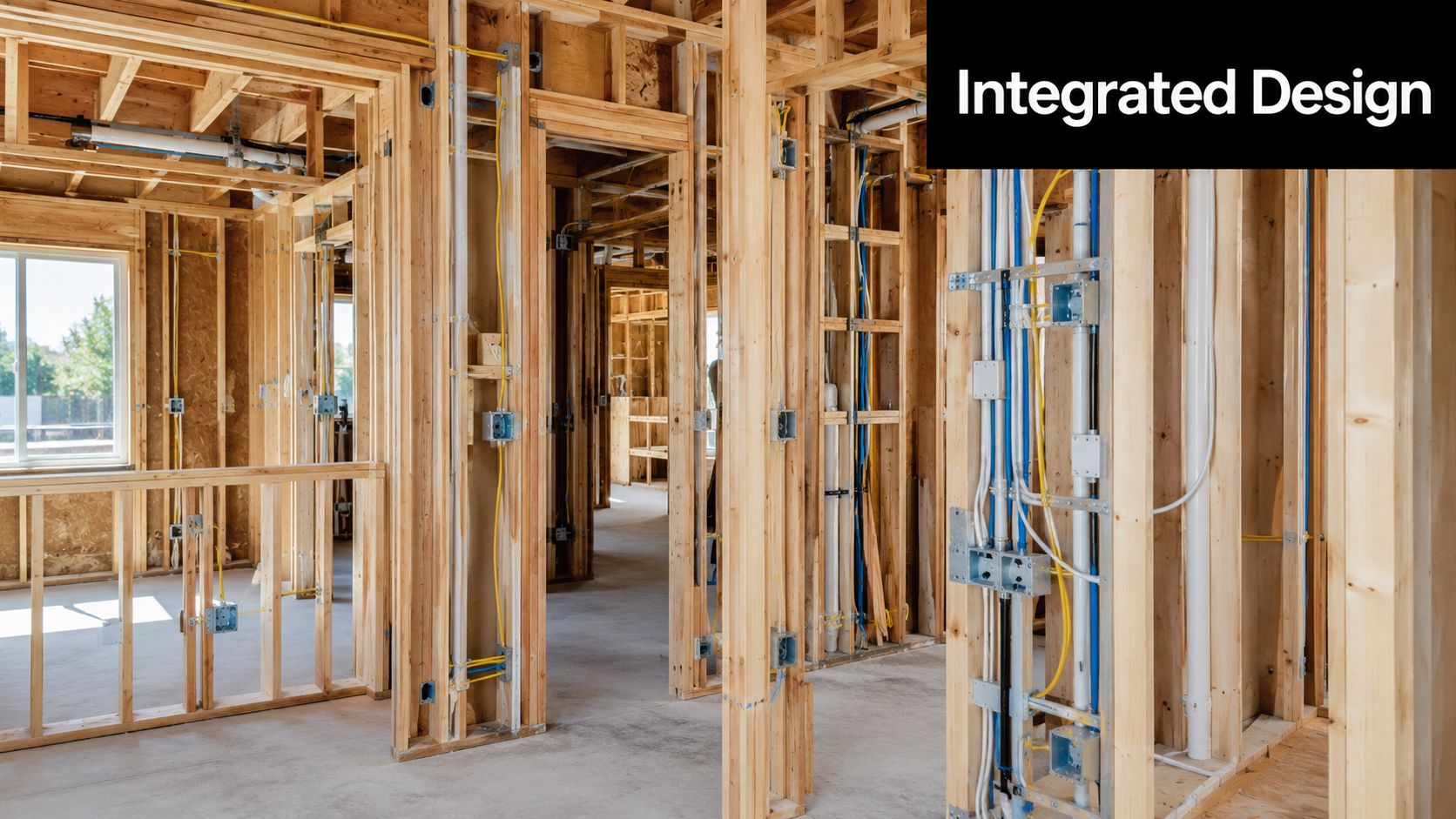
Build it into the architecture
Retrofitting can absolutely work, but it usually involves compromise. You might keep existing switch positions that don't suit the new room layout. You might accept fittings that are easy to replace rather than ideal for the ceiling design. You might also end up with visible control hardware where a cleaner solution would have been possible if the system had been planned earlier.
A new build or major renovation gives you the chance to coordinate:
- Ceiling layouts with downlight spacing, pendants and feature lighting
- Joinery design with strip lighting in robes, vanities and kitchen details
- Circulation paths with low-level lighting and sensor logic
- Outdoor zones with pathways, entries and site elements working as one scheme
Use layered lighting instead of one light per room
A well-resolved lighting design usually combines ambient, task and accent lighting.
Ambient lighting gives general illumination. Task lighting supports activities like chopping, reading or working. Accent lighting highlights texture, artwork, shelving or architectural form. Smart controls make those layers more useful because they let each one respond differently depending on the time of day and what the room is being used for.
That's where “scenes” earn their keep. A kitchen scene for cooking isn't the same as a kitchen scene for late-night cleanup. A living room setting for reading isn't the same as one for watching a film.
In good projects, the lighting plan isn't added after the architecture. It helps define how the architecture is experienced.
Prioritise light quality, not just connectivity
The smartest controls in the world can't rescue poor-quality light, an area where many installations underperform. Clients focus on app features and forget to ask how materials, skin tones, joinery finishes and stone surfaces will look under the fittings.
In Australian residential smart lighting installations, a Colour Rendering Index above 90 is now the expert benchmark for high-quality LED sources, while values above 80 are considered insufficient for accurate colour perception in living spaces, as outlined in this Australian smart home lighting guidance. That matters most in kitchens, workspaces and any area where colour accuracy affects comfort and finish quality.
Colour temperature matters too. Warmer light can soften bedrooms and living areas. Cooler, clearer light often works better in task-heavy spaces. The correct choice depends on the room, the palette and how the space is used.
This kind of coordination is why smart lighting often sits alongside broader home automation decisions. If you're comparing how integrated controls work across comfort systems as well, a piece on smart thermostat installation is a useful example of how early planning affects performance and usability. For projects where multiple systems need to work together, smart home installation becomes part of the same conversation.
Budgeting for Smart Lighting ROI and Future-Proofing
The budget question is fair. Smart lighting can be a modest upgrade in one part of a project or a substantial line item across an entire property. The right way to assess it isn't “How much do smart lights cost?” It's “What level of system suits the way this building will be used?”
Think in tiers, not one price
At one end, there are room-by-room solutions using a few connected fittings and basic app control. At the other end, there are fully integrated systems with central control, sensors, scenes and coordination across interior and exterior zones.
Those aren't competing answers. They suit different briefs.
A practical way to frame the decision is:
| Project level | Typical fit | Main trade-off |
|---|---|---|
| Targeted upgrade | Selected rooms, simple routines, basic remote control | Lower integration and less architectural cohesion |
| Mid-level system | Key living areas, better switching logic, selected scenes | Requires more upfront planning |
| Whole-property integration | Coordinated lighting strategy across the building | Higher upfront investment, stronger long-term usability |
Where the return actually comes from
Energy use is the most obvious part of return, and it's one of the few areas where hard numbers are available. Switching to smart lighting systems in Australian homes can reduce energy bills by up to 75%, depending on usage habits and system efficiency, according to Enersol Electrical's review of smart lighting and home energy efficiency. That source also states that the Australian lighting market is valued at AUD 13.51 billion in 2025, with projected growth at a CAGR of 8.50% from 2026 to 2035 and a forecast value of AUD 30.55 billion by 2035.
Those figures matter for two reasons. First, they show why owners are paying more attention to controllable, efficient lighting. Second, they indicate that smart lighting is moving deeper into mainstream building practice rather than remaining a niche feature.
Beyond direct bill savings, return also comes from less visible gains:
- Better day-to-day use: A system that suits the building properly gets used as intended.
- Stronger presentation: Good lighting improves how the home or business is experienced.
- Reduced rework later: Early planning avoids piecemeal upgrades after completion.
Future-proof the investment
Future-proofing doesn't mean chasing every new feature. It means choosing systems that can adapt, integrate and remain serviceable.
Look for:
- Ecosystem compatibility: The system should work with major platforms such as Google Home, Apple HomeKit and Amazon Alexa where that suits your brief.
- Expandability: You may not automate every zone on day one, but you should be able to add to the system later.
- Professional support: If a system is difficult to maintain, update or hand over, it becomes a burden rather than an asset.
A future-proof smart lighting plan is rarely the cheapest one on paper. It's the one that still makes sense years after the handover.
Your Smart Lighting Project Checklist
Most lighting problems don't come from poor products. They come from unclear briefing. If you can answer the right questions early, the system becomes far easier to design well.
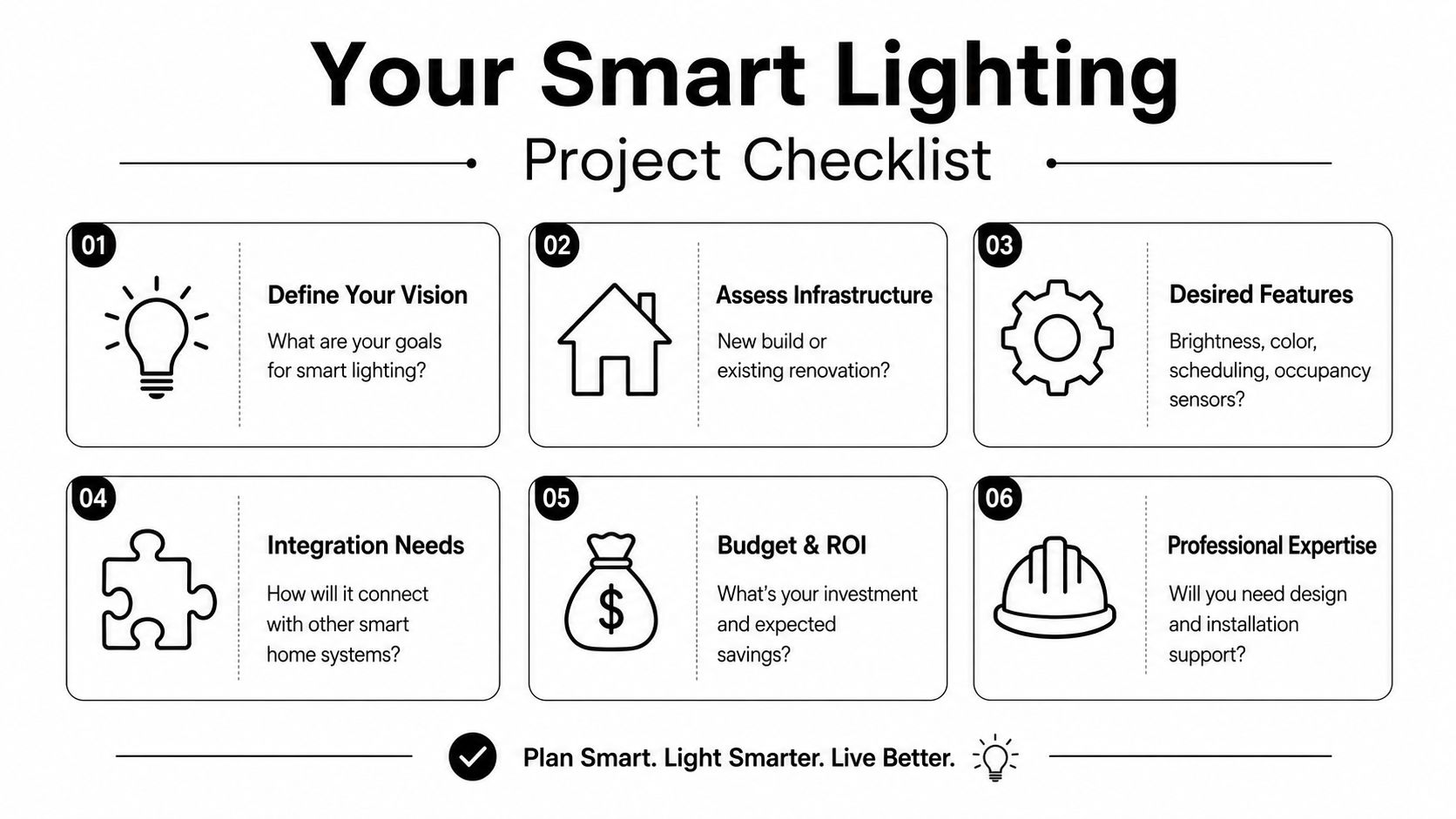
Questions worth asking before design is finalised
- How do you use each room? A kitchen used for fast family dinners needs a different control strategy from one designed for long entertaining. The same goes for a retail tenancy versus a private office.
- Which features of the architecture should the lighting support? Think about joinery, artwork, textured walls, stair forms, voids and outdoor features.
- What should happen automatically? Some clients want strong manual control. Others want arrival scenes, occupancy-based switching and time-based routines doing more of the work.
- Which control method feels natural to you? Wall keypads, app access, sensors and voice control all have a place, but one of them shouldn't become a substitute for good planning.
- What level of flexibility do you want later? If spaces may change use, the system should be able to adapt.
- How important is light quality? Ask about beam angle, dimming performance, glare control, trim detail and colour rendering, not just whether the fitting is “smart”.
A practical briefing framework
Bring these decisions into one conversation with your builder, designer and electrician:
Room function first
Define what happens in each zone at different times of day.Fixture selection second
Match fittings to ceilings, materials and visual priorities.Controls third
Decide what should be manual, scheduled or sensor-driven.Integration fourth
Confirm whether lighting needs to interact with security, shading, climate or audio systems.
Good lighting plans read like a set of lived routines, not a shopping list of devices.
Don't leave the decisions too late
Once finishes are selected, cabinetry is detailed and electrical rough-in is underway, late lighting changes become more expensive and less elegant. Early coordination gives you cleaner switch locations, better fixture placement and more convincing scenes.
If you're preparing for a custom build, extension, renovation or commercial fit-out, smart lighting deserves the same level of attention as joinery, stone and appliances. It affects how every completed space will feel when the project is handed over.
If you're planning a custom home, major renovation or commercial fit-out in Adelaide, Templeton Built can help you incorporate smart lighting into the project from the design stage, so the finished result feels cohesive, practical and architecturally resolved.


Leave a Reply