

Mastering Subcontractor Management: A Builder’s Guide
You're usually not thinking about subcontractor management when the plans first look great and the selections are exciting. You're thinking about the stone benchtop, the skylight over the stair, the timber joinery detail that will make the whole home feel right.
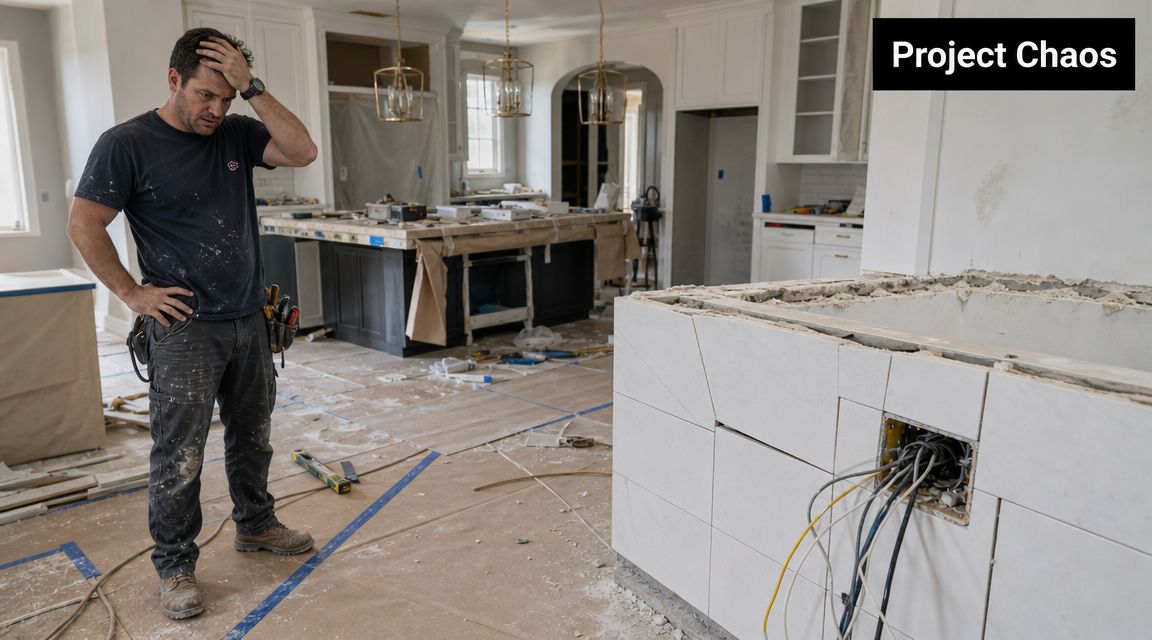
Then the job starts. One trade arrives late. Another says the drawings weren't clear. A third leaves work that's technically installed but nowhere near the finish standard the project needs. Suddenly the issue isn't design. It's coordination, accountability, and whether the site is being run properly.
That's where good builders separate themselves. On high-end renovations, custom homes, and extensions, subcontractor management isn't paperwork for its own sake. It's the system that protects workmanship, programme, safety, and the client relationship when pressure builds.
Why Strong Subcontractor Management is Non-Negotiable
A premium residential job can come unstuck fast. The cabinetmaker is waiting on set-out confirmation. The electrician has roughed in to an old revision. The tiler wants access before waterproofing sign-off. The painter is booked, but the plastering still isn't right. By the time the client sees the issue, the underlying problem has usually been sitting there for days.
That's why formal systems matter. In construction, subcontractors carry a huge amount of delivery responsibility. An industry reference cited by Deltek notes that commercial and high-rise projects can involve 40% or more of the contract value being delivered by subcontractors, which shows why clear scope, coordination, and performance controls are central to outcomes in practice (Deltek on subcontractor management). On residential work, the same lesson applies even more sharply because renovation and custom-home projects rely on tight sequencing across many specialist trades.
What goes wrong when the process is loose
On a live renovation site, poor subcontractor management usually shows up in familiar ways:
- Scope drift: A trade prices one thing, assumes another, and installs something else.
- Timing gaps: The right trade is booked, but not booked for the right stage.
- Finish quality issues: Work may be compliant enough to pass through a stage, but not good enough for the final standard.
- Blame shifting: When no one owns interfaces, every issue becomes someone else's problem.
A lot of people still treat this as admin. It isn't. It's project control. If you want a plain-English explanation of how that broader discipline works, this guide on project management in construction is worth reading.
Practical rule: If a builder can't show you how they vet, brief, schedule, and review their trades, they're relying on luck.
What actually works
The jobs that stay under control usually have the same backbone:
| Area | What works | What fails |
|---|---|---|
| Trade selection | Prequalified subcontractors with known capability | Last-minute booking off price alone |
| Scope control | Clear inclusions, exclusions, and hold points | Verbal assumptions |
| Site oversight | Regular milestone checks | End-of-job surprise inspections |
| Communication | One current set of instructions | Mixed messages across calls, texts, and old plans |
Digital coordination helps here, especially once you're running multiple trades across changing site conditions. A practical overview of SaberTask field service management is useful if you want to understand how scheduling, dispatch, and field documentation can support stronger trade control.
The main point is simple. On a high-end home, clients don't see subcontractor management as a line item. They feel it in the smoothness of the build, the cleanliness of the handovers between trades, and the absence of chaos.
Finding and Vetting the Right Trade Partners
A good subcontractor rarely looks good only on quote day. They look good before that, during due diligence, and after that, once you test whether they can operate well on a live site with pressure, detail, and accountability.
The mistake is choosing a trade because they're available, cheap, or known socially. That approach creates problems that surface later as defects, missed dates, insurance gaps, or payment disputes. The better approach is prequalification against objective controls.
Start with the non-negotiables
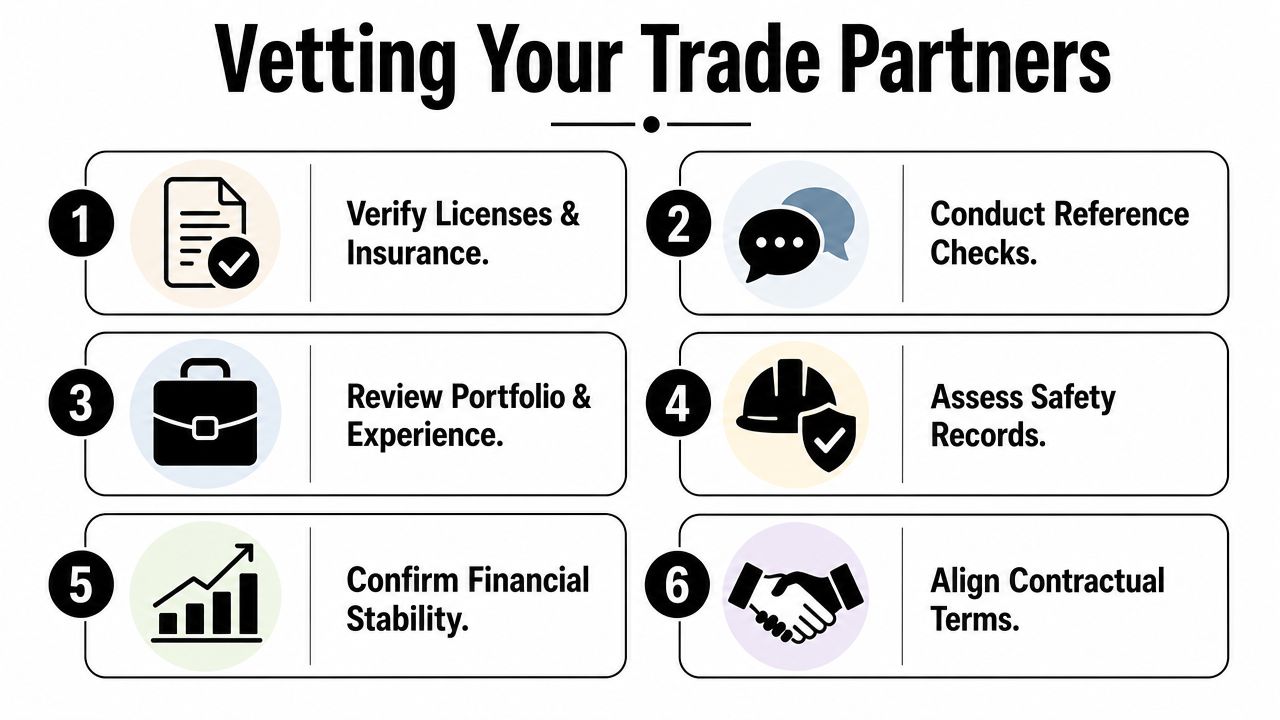
For Australian builders, practical subcontractor management starts by verifying licences, checking insurances, confirming WHS systems, and testing financial capacity before awarding work. In South Australia, that includes checking licence status through Consumer and Business Services, then making sure the subcontract arrangement lines up with the principal contractor's WHS obligations. The source also notes that poor due diligence is a common driver of downstream defects, safety incidents, and payment disputes, which is why scored prequalification, recent referees, and evidence of current insurance and incident history matter before site access is granted (legal guide to managing subcontractor risks).
That sounds formal because it is. It should be.
A practical vetting sequence
I'd break the review into a clean sequence rather than one big pile of paperwork.
Licence check first
If the trade needs to be licensed, confirm it before anything else. Don't assume a logo on a ute means the paperwork is current.Insurance review second
Ask for current certificates. Public liability is standard. Workers compensation matters where relevant. Professional indemnity may matter for design-linked scopes.WHS capability check
You're not looking for pretty templates. You're looking for whether they can follow site rules, produce SWMS where required, brief their crew, and respond properly when an issue is raised.
Read the quote like a risk document
A tender response tells you a lot if you know what to look for.
- Thin wording: If the quote is vague, the trade may be vague on site.
- Heavy exclusions: Sometimes legitimate. Sometimes a sign they're protecting a low number that will expand later.
- No lead times: That's a warning on programme reliability.
- No mention of access assumptions: They may not understand renovation complexity.
A strong subcontractor doesn't just price the work. They show they understand sequence, risk, and finish expectations.
Check the person, not just the business
The company name on the quote may not be the person who turns up. On high-end residential work, that matters. The supervisor, leading hand, or installer can make or break the result.
A quick comparison helps.
| Vetting item | Weak answer | Strong answer |
|---|---|---|
| Referees | Old or vague | Recent and relevant |
| Portfolio | Generic job photos | Comparable renovation or custom-home work |
| Crew plan | “We'll sort it out” | Named people and likely supervision |
| Incident history | Avoided | Disclosed and discussed clearly |
If you're trying to understand how contractor classification issues can become messy in cross-jurisdiction discussions, IRS and CT laws for contractors is a useful legal explainer. It's not an Australian compliance guide, but it does show why builder-contractor relationships need clear definitions and proper structure.
The red flags worth acting on
Some signs aren't minor. They're reasons to pause.
- Expired or missing documents
- Reluctance to provide recent referees
- Defensive answers about defects or safety incidents
- A strong price paired with weak documentation
- No clear understanding of renovation conditions such as access, protection, staging, or occupied areas
On an extension or renovation, one poor trade choice doesn't stay isolated. It affects every trade after them.
Structuring Watertight Contracts and Insurances
Once you've chosen the right trade, the next job is clarity. Not suspicion. Clarity.
The best subcontract agreements don't try to “catch people out”. They set expectations in a way that leaves less room for argument when the site gets busy. That matters on residential work because fine-detail projects create more interface issues than straightforward volume work. Joinery meets plaster. Stone meets cabinetry. Waterproofing meets screed heights. If the contract language is loose, site arguments fill the gap.
Scope needs to be painfully clear
A proper subcontract scope should spell out:
- What is included
- What is excluded
- What the trade must allow for
- What information they are working from
- What must be checked before proceeding
The phrase “as necessary” causes more grief than people realise. Necessary to whom? Based on what detail? At whose cost? Better to define the exact task, reference the current drawings and specification, and identify any assumptions in writing.
For homeowners trying to understand why contract detail matters so much, this guide on what to look for in a building contract gives useful context from the client side.
Payment terms should follow verified progress
A solid payment structure doesn't reward promises. It rewards completed, checked work.
On a residential extension, that might mean a rough-in claim only gets processed once rough-in is complete, compliant, and ready for the next stage. On finishes, it may mean hold points before final fixing or completion of defects. That protects the builder's cash flow, but it also protects the subcontractor because the approval path is clear.
On-site advice: If the scope is vague and the claim stages are vague, the dispute has already started. It just hasn't happened yet.
Insurance is part of the commercial setup
Insurance requirements shouldn't sit at the back of the file as a token attachment. They should be named in the subcontract, checked before mobilisation, and monitored if the job runs long enough for renewal dates to matter.
A practical arrangement usually covers:
| Contract item | Why it matters |
|---|---|
| Required policies | Confirms the minimum cover expected |
| Currency of certificates | Shows the cover is current, not historic |
| Renewal obligations | Prevents cover lapsing mid-project |
| Notification duties | Requires the trade to report changes or cancellations |
On better-run projects, insurance review is tied to subcontractor onboarding, not treated as a separate office task that someone might forget.
Good contracts reduce friction
A fair subcontract also needs practical mechanisms for variations, delays, defects, and access constraints. If there's no agreed process, every issue turns personal. That's when people stop talking commercially and start arguing emotionally.
The strongest contracts do the opposite. They make the relationship more workable because both sides know the rules before pressure arrives.
Streamlining Onboarding and Site Coordination
A subcontractor's first day on a complex residential site tells you a lot about how the rest of the job will run.
They pull up outside a tight suburban block. Access is narrow. Neighbours are close. There's demolition protection in place through part of the existing house. The client may still be living in one section, or visiting regularly. Deliveries can't just land anywhere. Waste can't just be stacked where convenient. If the trade walks on site and gets nothing more than “you'll work it out”, trouble starts immediately.
The first-day standard
A proper onboarding process is practical, not ceremonial. The trade needs to know where they report, what areas are live, what areas are protected, where materials go, which drawings are current, and who gives direction.
That first briefing should cover:
- Site access and parking rules
- Hours, noise limits, and neighbour constraints
- Amenities, storage, waste, and security
- Emergency procedures and contacts
- Who can authorise changes
A rushed induction is one of the easiest ways to create avoidable confusion. People fill information gaps with assumptions, and assumptions are expensive.
Pre-start meetings prevent rework
Before each major trade package starts, a short pre-start meeting pays for itself. Not because it sounds organised, but because it lets the builder check the handover from one trade to the next.
For example, before cabinetry starts, the builder should already know:
| Question | Why it matters |
|---|---|
| Are walls straight and ready | Joinery tolerances are unforgiving |
| Are services where they should be | Rework after install is messy and costly |
| Are finishes and reveals confirmed | Small discrepancies become visible fast |
| Has the latest detail been issued | Old revisions cause immediate waste |
Those meetings also expose whether the subcontractor has reviewed the information. A trade that hasn't looked at the details before arrival often creates site pressure by demanding immediate answers to preventable questions.
Communication rhythm beats constant interruption
The best-run sites don't rely on random phone calls all day. They set a rhythm.
That usually means one point of contact, one current programme, one method for RFIs, and one approval path for variations. Text messages can still happen, but they shouldn't become the project record. When changes affect scope, cost, or sequence, they need to be captured properly.
Trades don't need endless meetings. They need clear direction, timely decisions, and a site that's ready for them when they arrive.
Coordination is more important on bespoke homes
On a standard build, some sequencing issues are recoverable. On a custom home or detailed renovation, they often aren't. Specialty finishes, long-lead items, custom fabrication, and heritage conditions leave less room to improvise.
That's why good onboarding isn't just a safety form and a gate code. It's the builder's first real test of whether the subcontractor can slot into the job without creating drag for everyone else.
Upholding Quality, Safety, and Compliance On-Site
Once trades are on site, subcontractor management becomes daily work. Through this daily engagement, builders either maintain control or start reacting to problems after the fact.

High-end residential jobs need close oversight because the standard isn't just “installed”. The standard is straight, level, aligned, consistent, protected, and ready for the next trade. That takes inspections at the right points, not a frustrated walk-through at the end.
Inspect without smothering the trade
Micromanagement slows a site down. Zero oversight is worse. The balance is milestone inspection.
A builder should check work when it still can be corrected with minimal pain. Framing before lining. Waterproofing before covering. Services before closing walls. Joinery set-out before benchtops. Painting samples before full application.
A practical quality routine often includes:
- Hold points for concealed work
- Marked-up defect lists with dates
- Photo records tied to location
- Clear responsibility for rectification
- Reinspection before the next trade proceeds
For a broader view of how builders maintain standards across a job, this resource on quality control in construction projects is useful.
Compliance needs to match modern site reality
Traditional subcontractor management often stops at licences, insurance, and a site meeting. That isn't enough anymore. An industry commentary from IRMI highlights the gap clearly. Builders now need systems that verify competencies, track site-specific inductions, capture digital evidence, and flag repeat non-compliance before it turns into an incident or claim. The same piece notes that this matters in Australia because construction remains one of the highest-risk industries for serious worker injury claims, and current WHS attention includes psychosocial hazards, multi-employer coordination, and evidence-based systems (effective subcontractor management and quality oversight).
That matters on smaller residential sites as much as larger projects. Sometimes more. You may have labour-hire workers, specialist installers, delivery crews, and short-duration subcontractors moving through a tight footprint in quick succession.
What a modern compliance system should track
Paper folders don't keep up well once people are moving across sites. Builders need live records.
| Compliance item | What to track on site |
|---|---|
| Competency evidence | Tickets, licences, and role suitability |
| Site induction status | Who has been inducted for this specific site |
| Safety observations | What was seen, raised, and closed out |
| Repeat issues | Which subcontractors keep missing the same requirement |
| Digital proof | Photos, sign-offs, and time-stamped records |
A short video can also help reinforce what practical site oversight looks like in the field.
Safety and quality are linked
Builders sometimes separate safety and quality into different conversations. On site, they overlap all the time. A rushed crew leaves poor work. Poorly sequenced work creates unsafe access. An unclear handover between trades leads to both defects and hazards.
Good subcontractor management means spotting patterns early. The same trade that ignores one site rule may also ignore a set-out check or a protection requirement.
That's why documentation matters. Not because the file looks tidy, but because it gives the builder proof of what was checked, what was raised, and what was done about it.
Navigating Payments and Resolving Disputes
Payment problems rarely start in accounts. They usually start on site.
A claim comes in before the work is fully complete. A variation is discussed but never documented. A trade says an item was outside scope. The builder says it was included. Then money gets held up, tempers rise, and the actual issue becomes harder to solve because nobody trusts the process.
Tie payment to clear milestones
The cleanest system is simple. The subcontractor submits a claim against agreed stages. The builder checks whether that stage is complete, whether the work meets the required standard, and whether any supporting documents are still outstanding. Then payment is approved, adjusted, or queried with reasons.
That sounds basic because it should be. Complexity causes friction.
A practical workflow looks like this:
- Invoice received against a defined stage or approved variation.
- Site verification confirms the claimed work is complete.
- Commercial review checks the claim against subcontract terms.
- Remittance advice issued so the trade knows what is being paid and why.
- Record updated for retention, defects, or outstanding items where relevant.
For builders tightening up the financial side of this process, Jumpstart Partners' finance guide is a worthwhile read because it addresses the bookkeeping discipline construction businesses need behind the scenes.
Fast communication prevents slow disputes
Subcontractors don't expect every answer instantly. They do expect clear answers. If a claim is wrong, say why. If a variation needs more detail, say what's missing. Silence is what poisons the relationship.
Good builders also avoid letting site frustrations spill into payment administration. A trade can be difficult to manage and still be entitled to payment for properly completed work. Keep those issues separate.
Use a tiered dispute process
Most disagreements don't need to become formal disputes if they're handled early and documented properly.
| Level | Best use |
|---|---|
| On-site conversation | Minor misunderstandings or sequencing issues |
| Written clarification | Scope, programme, or claim disagreements |
| Meeting with records | Repeated or higher-value issues |
| Formal escalation | Where the contract requires a defined next step |
The key is timing. If you let resentment build for weeks, even a small issue becomes harder to settle.
The aim isn't to “win” every disagreement. The aim is to keep the project moving while dealing with the issue fairly.
Prevention is commercial management
Most payment disputes are preventable when scope is clear, variations are captured early, and claims are linked to inspected progress. Builders who do this well usually have better trade relationships because subcontractors know where they stand.
That stability matters. Reliable payment systems attract reliable trades, and reliable trades make future projects easier to deliver.
Using KPIs to Build Your A-Team of Trades
The smartest subcontractor management doesn't end when the job reaches practical completion. That's when the data becomes useful.
Every project tells you which trades communicated well, who held programme, who needed chasing, who protected finished work, and who made life harder than it needed to be. If you don't record that properly, the lesson disappears and the next project starts from scratch.

Measure the things that matter
Industry guidance described in an Australian construction source recommends a practical subcontractor scorecard with 5 to 7 KPIs covering safety, schedule, quality, commercial performance, cooperation, and documentation. It also states that results should be captured monthly at project level and rolled into a company-wide scorecard targeting 80+. The same guidance recommends a preferred subcontractor list updated quarterly, with risk ratings such as green for EMR below 0.8 and backlog under 6 months, and red where defaults exceed 1 (subcontractor management, strategic risk and competitive advantage).
Even if a small residential builder keeps the format simple, the principle is sound. Trade performance should be tracked, not remembered vaguely.
A residential scorecard that's actually usable
For renovations and custom homes, I'd keep the scorecard practical.
Programme reliability
Did they arrive when booked, finish when promised, and coordinate well with adjacent trades?Quality at inspection
Did the work pass cleanly, or did it create avoidable defects and call-backs?Documentation discipline
Did they submit what was needed, respond properly to RFIs, and keep variations clear?
Use the data to make future selections easier
A scorecard becomes powerful when it changes who gets invited back.
| Trade result | Action |
|---|---|
| Consistently strong | Preferred list and early booking |
| Good but inconsistent | Use with tighter supervision |
| Commercially difficult | Limited use or smaller scopes only |
| Repeatedly poor | Remove from active tender list |
Builders build an actual A-team, not by saying a trade is “good to work with”, but by proving it over multiple jobs.
Quarterly review beats gut feel
The source guidance points to monthly capture and quarterly list updates. That cadence makes sense because it stops one recent good job or one bad week from distorting the whole picture. You end up judging performance over time, not just by whoever was easiest to deal with last month.
A preferred subcontractor list should be earned. If it isn't tied to measured performance, it's just a favourites list.
Builders who do this well become easier to trust. They book trades earlier, coordinate jobs more smoothly, and protect finish quality because the team around them is proven, not improvised.
That's the long game in subcontractor management. Better records lead to better trade choices. Better trade choices lead to calmer sites, stronger workmanship, and fewer nasty surprises for clients.
If you're planning a renovation, extension, or custom home in Adelaide and want a builder with a disciplined, practical approach to managing trades from prequalification through to final handover, Templeton Built is worth a closer look. Their work is grounded in detailed planning, transparent communication, and the kind of site control that protects quality, programme, and the client experience.


Leave a Reply