

Adelaide Gardens: Sustainable Landscaping Practices
You're probably looking at a block of bare earth, a tired lawn, or a set of house plans and thinking the same thing most Adelaide homeowners do. You want an outdoor area that looks sharp, works for family life, and doesn't become a constant fight against heat, dust, water bills, and summer restrictions.
That old idea of the perfect garden, big lawn, thirsty borders, clipped hedges, and sprinklers running through warm evenings, doesn't suit South Australian conditions very well. It can still look good for a while, but it asks for ongoing inputs: more water, more fertiliser, more maintenance, and more replacement when plants fail.
Good sustainable landscaping practices take a different approach. They start with climate, soil, water, and how people use the space. In Adelaide, that isn't a niche design style. It's a practical way to build a garden that lasts, performs, and feels connected to the place it sits in.
The Adelaide Dream Garden Reimagined
A lot of clients still begin with a familiar picture. They want lawn for the kids, screening along the fence, a paved entertaining area, and something green to soften the build. There's nothing wrong with that brief. The problem starts when the garden is based on a cool-climate template instead of an Adelaide block.
The traditional suburban model often treats the garden like a decorative extra. Turf goes wall to wall, exotic planting fills every edge, and irrigation gets added later to keep the whole thing alive. In a hot, dry summer, that setup becomes a maintenance contract with the weather. The garden can look fine in spring and then struggle hard once the heat arrives.
What works better here is an outdoor area that's designed to handle stress without looking stripped back or severe. Sustainable approaches to site management in Adelaide are less about sacrifice and more about being smarter with every square metre. That means keeping planting where it gives shade, privacy, habitat, and cooling value. It means limiting lawn to the places where people will use it. It means building soil, controlling runoff, and choosing materials that won't need replacing after a few hard seasons.
What homeowners usually gain
- Lower ongoing water demand: The layout and plant selection do the heavy lifting, rather than relying on constant irrigation.
- Less routine upkeep: Fewer high-input areas means less mowing, feeding, spraying, and replanting.
- A more settled look over time: Climate-suited gardens tend to improve as they establish, rather than decline.
- Better connection to place: The garden feels like it belongs in South Australia instead of fighting against it.
For many homeowners, the turning point comes when they stop asking, “How do I keep this garden alive?” and start asking, “How do I make this garden work with the site?”
A useful reference if you're still shaping your brief is this guide to sustainable yard design from R.E. and Sons. It's a good reminder that a sustainable garden isn't one single look. It's a set of decisions about layout, water use, materials, and long-term maintenance.
A successful Adelaide garden doesn't try to copy an English one. It responds to heat, wind, and water limits from day one.
Starting Strong with a Site and Soil Assessment
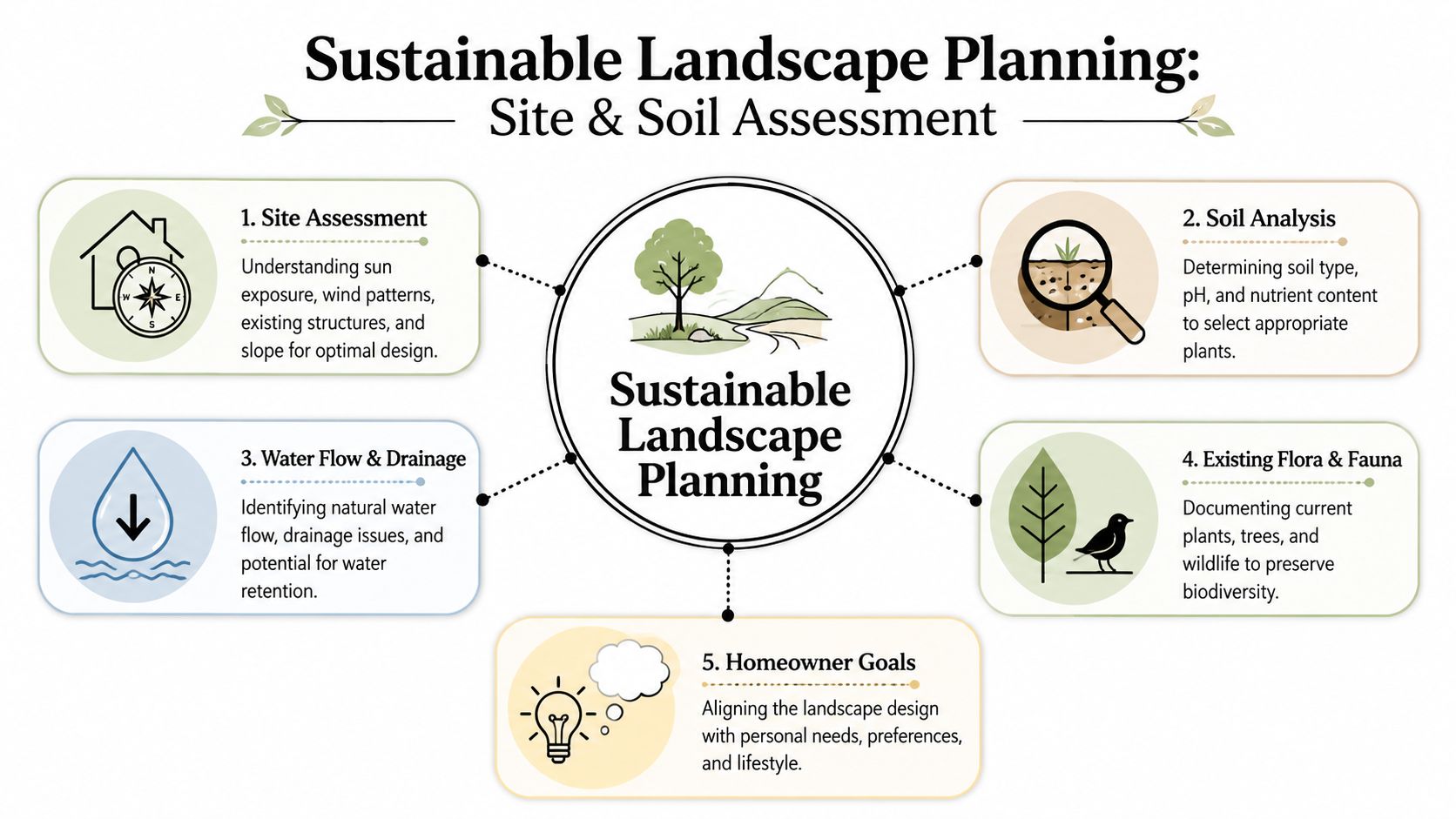
The best outdoor design decisions are made before you choose a single plant. If the site hasn't been read properly, even a good-looking plan can underperform. That's why a site and soil assessment matters so much. It's the outdoor design equivalent of checking footings before pouring concrete.
Read the block before designing the garden
Start by looking at how the site behaves across the day and across the seasons. Morning sun, harsh western exposure, prevailing wind, existing shade, low points where water sits, and hard surfaces that throw heat back into planting zones all affect what will survive and what will struggle.
If you're building or renovating, this is also the stage where site information should line up with the house design. A proper site survey for your build gives you the base information needed to position paths, drainage, retaining, tanks, and planting zones sensibly.
A practical site check usually includes:
- Sun and shade mapping: Not just where the sun lands, but where reflected heat becomes a problem.
- Drainage observation: Where stormwater naturally moves and where it pools after rain.
- Wind exposure: Especially on open suburban blocks and corner sites.
- Existing vegetation review: Mature trees, root zones, and what's worth preserving.
- Use patterns: Entertaining, play space, access, bin storage, clotheslines, and service areas.
Soil decides more than plant choice
Adelaide soils vary a lot, but sandy profiles are common enough to deserve special attention. In Adelaide's semi-arid climate, technical data indicates that sandy soils hold less than 10% of their water volume for plant uptake, which is why incorporating 20 to 30% organic matter can improve water retention by up to 45%. That's one of the clearest examples of why soil prep isn't optional in a sustainable garden plan.
If the soil drains too quickly, water runs through before roots can make use of it. If the soil drains poorly, roots sit wet and decline. Both problems are fixable, but only if they're identified early.
Practical rule: Don't spend heavily on plants until the soil profile is doing its job. Good soil makes average plants perform better. Bad soil makes premium plants fail.
Improve what you have, don't guess
The most reliable approach is to test and amend based on actual conditions. Compost, composted bark, leaf mulch, and other organic inputs can improve structure, moisture retention, and root health. For homeowners who want a plain-English primer on building better soil, this article on natural soil solutions for North Georgia is useful because the soil-first logic carries across well, even if the region is different.
A simple decision table helps at this stage:
| Site condition | Common result | Better response |
|---|---|---|
| Fast-draining sandy soil | Frequent watering and stressed plants | Add organic matter and use mulch |
| Poor drainage | Root decline and patchy growth | Raise beds or reshape drainage |
| Harsh western sun | Burnt foliage and heat stress | Use tougher species and layered shade |
| Windy exposure | Dry soil and damaged new growth | Plant shelter layers and reduce exposed turf |
This is the stage that saves money later. A sustainable outdoor space doesn't begin with the plant list. It begins with understanding what the ground can support.
Designing with Nature Through Plant Selection and Biodiversity
Plant selection is where a lot of gardens go wrong. People chase what looks good in a display garden or on a mood board, then try to force those plants into conditions they don't suit. The result is familiar: high irrigation demand, patchy performance, and a garden that never quite settles.
The better philosophy is right plant, right place. That sounds simple, but it changes everything. Instead of asking whether a plant is fashionable, ask whether it can handle the site's sun, wind, soil, and watering pattern. That's how sustainable landscaping practices start to feel effortless rather than constantly managed.
Native doesn't mean sparse
In South Australia, a critical benchmark for new outdoor spaces is the Native Plant Mandate, requiring at least 30% of non-turf plant material to be native species adapted to local microclimates, which helps minimise reliance on supplemental watering. That benchmark reflects a practical truth. Plants adapted to local conditions generally ask for less intervention once established.
That doesn't mean every garden has to become a bush block. It means using South Australian natives and other site-adapted species where they do the most work. Screening plants along a boundary. Low shrubs in hot reflected-heat zones. Grasses and strappy plants where roots need to cope with leaner soils. Flowering species where you want birds, pollinators, and seasonal movement.
Group plants by how they actually use water
One of the most useful design habits is hydrozoning. Put plants with similar water needs together. Keep thirstier plants near the house or entertaining spaces where they'll be seen and maintained. Move tougher species to outer zones, nature strips, boundaries, and difficult corners.
That avoids one of the most common waste patterns in suburban gardens. A single irrigation zone trying to satisfy lawn, shrubs, feature trees, and narrow side beds at the same time.
A practical planting layout often looks like this:
- Functional zone near living areas: More refined planting, feature pots, and small pockets of lawn if they're needed.
- Transitional zone: Mixed planting with moderate water needs and strong structure.
- Outer zone: Tough, lower-input species that can handle heat and occasional dry spells.
Dense planting can still be sustainable. It just has to be organised around water need, mature size, and long-term maintenance.
Build layers, not plant collections
The best gardens don't read like a shopping list of individual species. They read as layers. Groundcovers to protect soil. Mid-height shrubs to hold form. Taller screening or canopy planting for shade and privacy. Seasonal flowering threaded through that structure rather than competing with it.
That layered approach does more than improve the look. It supports habitat, moderates soil temperature, and helps the garden area feel established sooner. Birds and beneficial insects respond well to gardens that offer shelter, food, and varied structure. You don't need a wild or messy garden to create biodiversity. You need a garden with purpose.
What doesn't work as well is overreliance on a few fast-growing screening plants planted too tightly. They might solve privacy quickly, but they often create future pruning issues, water competition, and dead material trapped inside the planting mass.
A stronger plant palette usually balances:
- Structure: Plants that hold shape through the year
- Seasonal interest: Flowering or textural change without constant replacement
- Habitat value: Nectar, seed, cover, and perching opportunities
- Durability: Species that cope with heatwaves and site stress
If the planting plan only looks good in the first eighteen months, it isn't sustainable. A key test is whether it still looks composed after several Adelaide summers.
Implementing Smart Water Solutions and Rainwater Harvesting
Water strategy separates a decent garden from one that performs properly. In Adelaide, irrigation isn't something to bolt on at the end. It needs to be designed with the planting, hardscape, and drainage from the start.
Traditional spray systems often waste water in exactly the conditions when gardens need help most. In hot, dry climates, evaporation losses can account for up to 30% of total water use, which is one reason drip irrigation and micro-irrigation are favoured for sustainable green spaces. South Australian guidance also points to water-wise irrigation protocols that can reduce consumption by 50 to 90% compared to conventional turf systems when properly designed and applied.
Why drip usually beats spray
Drip irrigation delivers water to the root zone instead of throwing it into hot air or onto paving. That matters on Adelaide blocks where wind, reflected heat, and narrow side setbacks can make overhead watering especially inefficient.
Good systems also separate planting zones properly. Turf should not share a line with shrubs or perennial beds. Narrow planting beds are better handled with micro-irrigation to reduce overspray and runoff. When every part of the garden gets the same water, someone always gets too much and someone else gets too little.
For homeowners planning a build or upgrade, it helps to think about irrigation as part of a wider water efficiency strategy for the home, not just as a garden add-on.
Mulch is part of the irrigation system
Mulch isn't decoration. It's a moisture-management tool. South Australian guidance supports mulching layers of 5 to 10 cm, which help suppress weeds naturally, reduce erosion, and hold moisture in the soil. Organic mulch also supports soil life as it breaks down.
That said, not every mulch suits every location. Near planting beds away from the house, an organic mulch can work well. In higher-risk fire areas close to the building, the choice needs more care, which matters for the bushfire discussion later.
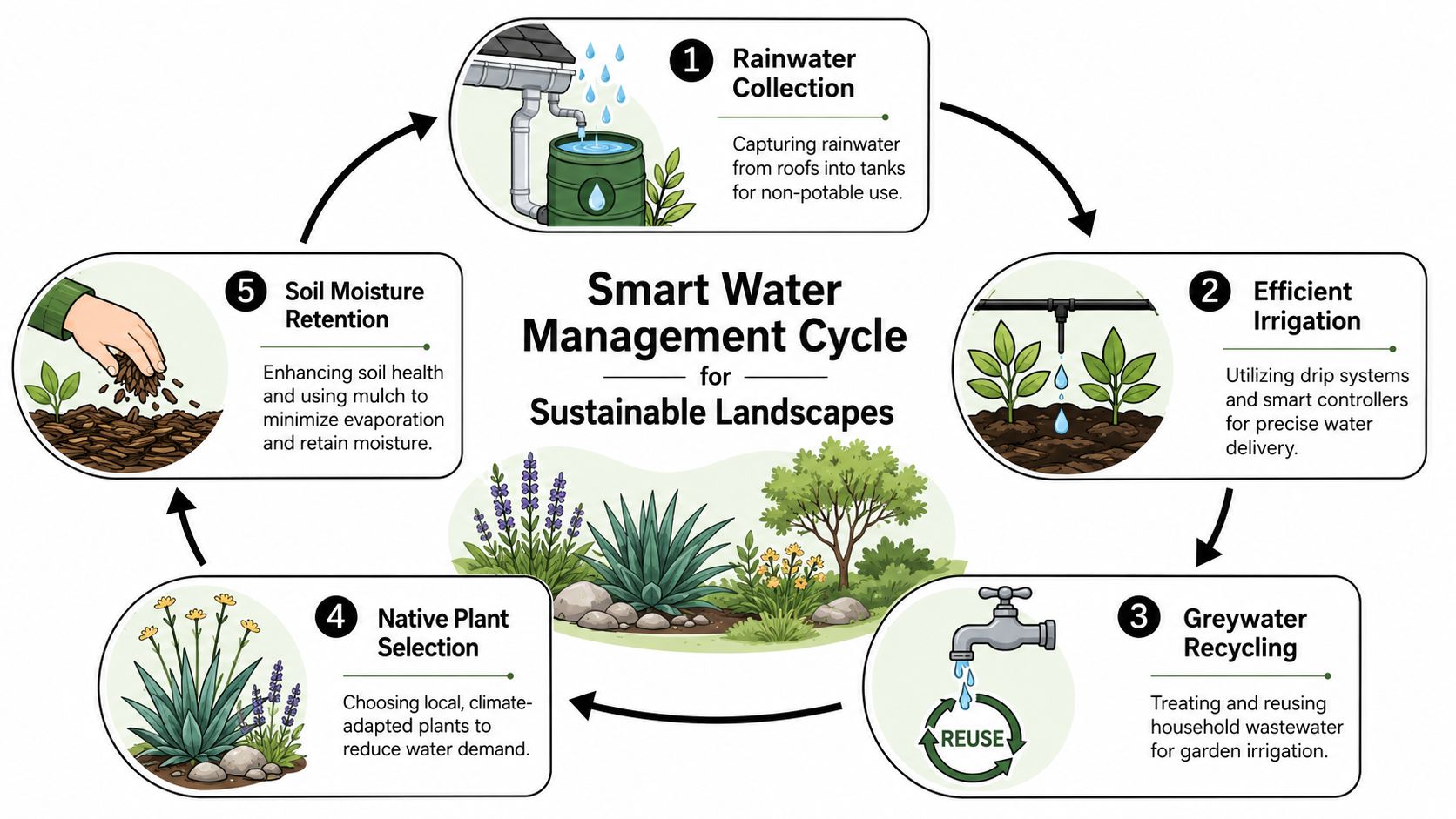
A strong water-smart setup usually includes:
- Drip lines in planting beds: Water delivered low and slowly
- Separate irrigation zones: Turf, trees, and shrubs managed independently
- Mulched soil surfaces: Moisture held where roots can use it
- Rain shut-off or smart control: Watering based on conditions, not habit
Here's a practical visual summary of the cycle:
Rainwater harvesting changes the economics
If you're already doing a new build or major renovation, rainwater harvesting is one of the easiest systems to integrate early and one of the hardest to retrofit neatly later. Tank placement, pump location, overflow direction, and pipe runs all work better when they're planned with the house and grounds together.
Rainwater won't remove the need for careful irrigation design, but it gives the garden a more resilient supply. That matters during restrictions and during long dry spells when mains water becomes an expensive way to keep ornamental planting alive.
There's also a site-management benefit. Features such as bio-swales and rain gardens can reduce stormwater runoff by 40 to 60% when integrated properly, helping slow and filter water before it leaves the block. For some homes, that's a far better response than treating every downpipe as a disposal problem.
Building the Bones with Permeable Surfaces and Low-Carbon Materials
Plants usually get the attention, but hardscape choices have just as much impact on how sustainable a garden really is. Paths, patios, edging, retaining, decks, and driveways decide how water moves, how heat builds up, and how much replacement work the garden will need later.
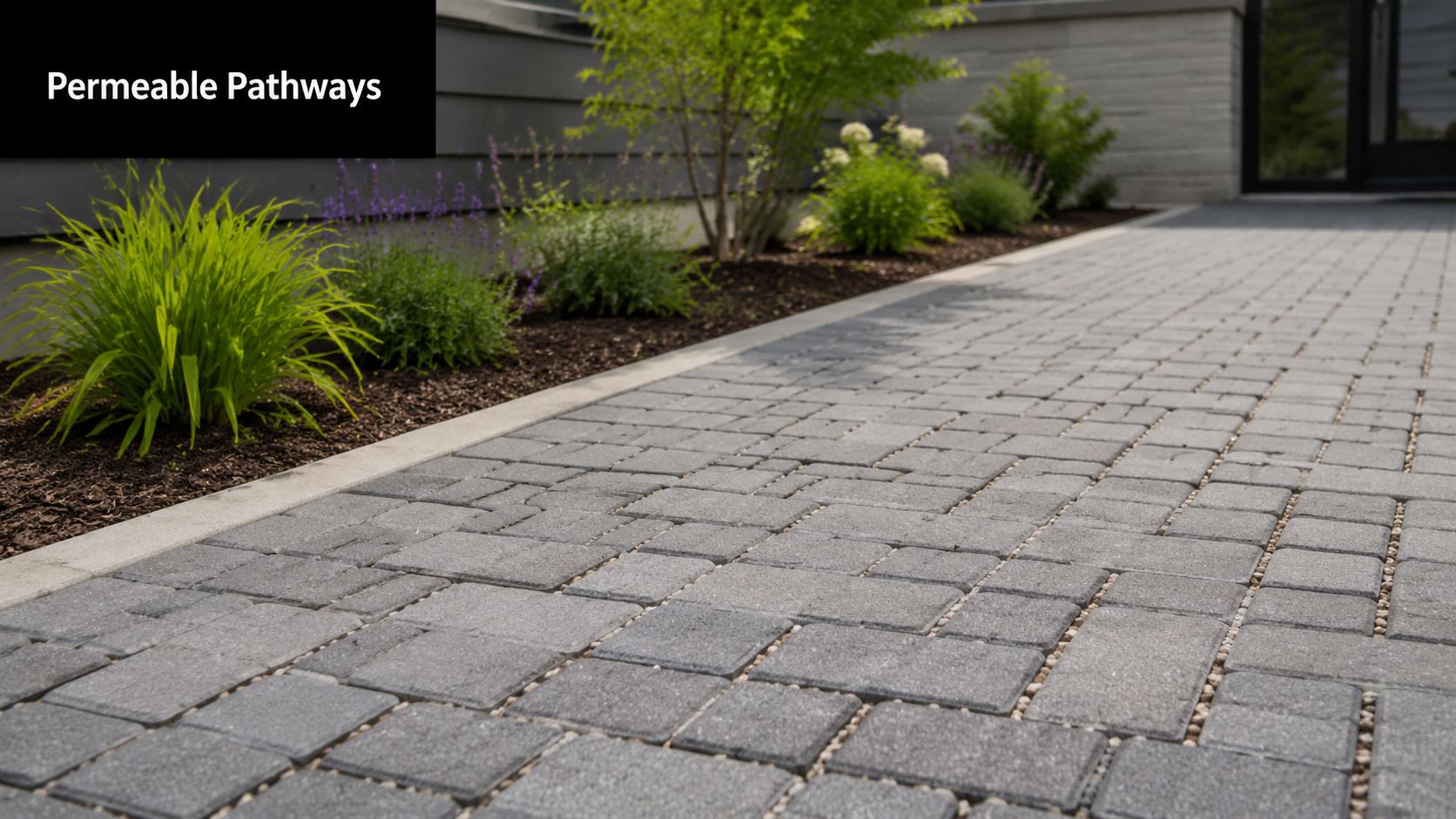
A hard surface that looks clean on day one can still be a poor long-term choice if it sheds every drop of rain, overheats the surrounding area, or needs major repair after a few seasons of movement and weather. Sustainable landscaping practices have to account for those built elements, not just the planting plan.
Permeability matters more than people think
When rain can soak into the ground, the outdoor space performs more naturally. Soil gets a chance to recharge. Planting beds stay more stable. Less water is pushed quickly into drainage points. That's why permeable paving, gravel, open-jointed pavers, and thoughtfully detailed decking can make a real difference.
The aim isn't to eliminate hard surfaces. It's to use them more intelligently.
A simple comparison helps:
| Hardscape choice | Common issue | Better-performing option |
|---|---|---|
| Fully sealed paving | Fast runoff and more reflected heat | Permeable or open-jointed paving |
| Large dark paved areas | Heat build-up near planting and glazing | Mixed finishes with planted breaks |
| Cheap edging materials | Early failure and replacement | Durable, repairable detailing |
| Fashion-led products | Short trend cycle and rework | Timeless materials suited to the house |
If you're weighing finishes, a guide that helps homeowners compare Melbourne outdoor paver options can still be useful for thinking through texture, slip resistance, finish, and intended use, even though the project context is different.
The hidden cost is replacement
The lifecycle carbon cost of landscaping is often overlooked. Choosing designs that survive heatwaves and local soil constraints with minimal rework is the biggest sustainability win, as noted in this discussion of sustainable landscaping practices and whole-of-life thinking. In practical terms, the greenest material isn't always the one with the best marketing. It's often the one that lasts, suits the site, and doesn't need to be ripped out.
That's why low-carbon thinking in landscaping should include:
- Locally appropriate materials: Fewer transport impacts and better fit for local conditions
- Reclaimed or recycled elements: Salvaged brick, reused stone, recycled aggregate where suitable
- Repairability: Surfaces and details that can be maintained without full replacement
- Thermal performance: Materials that won't create unnecessary heat stress around the home
Don't choose a surface only by how it looks wet in a showroom. Choose it by how it will age in summer, how it drains, and how easy it is to repair.
For homeowners looking at broader material choices across the whole project, this guide to eco-friendly building materials for homes is a useful complement to the landscaping discussion.
The strongest outdoor spaces feel coherent because the hard and soft elements were chosen together. The paving, garden beds, walls, and planting should support one another, not compete.
Creating a Bushfire-Ready Sustainable Garden
Generic advice often falls apart for Adelaide homes. A lot of water-wise guidance pushes dense planting, deep mulch, and layered vegetation without properly addressing fire behaviour. That's a problem, because some measures that help with moisture retention can work against bushfire safety if they're applied carelessly.
Recent guidance increasingly treats landscaping as part of property resilience, linking Water Sensitive Urban Design with Bushfire Attack Level-aware planning, rather than treating sustainability and fire safety as separate issues. That's the right way to look at it in South Australia.
The common conflict near the house
Near the home, people often want cooling, privacy, and a soft green outlook. Sustainability advice might suggest heavy mulch, screening shrubs, and dense garden beds right up to the walls. In a bushfire-prone setting, that can create ember traps, fuel load, and a more dangerous edge condition around the building.
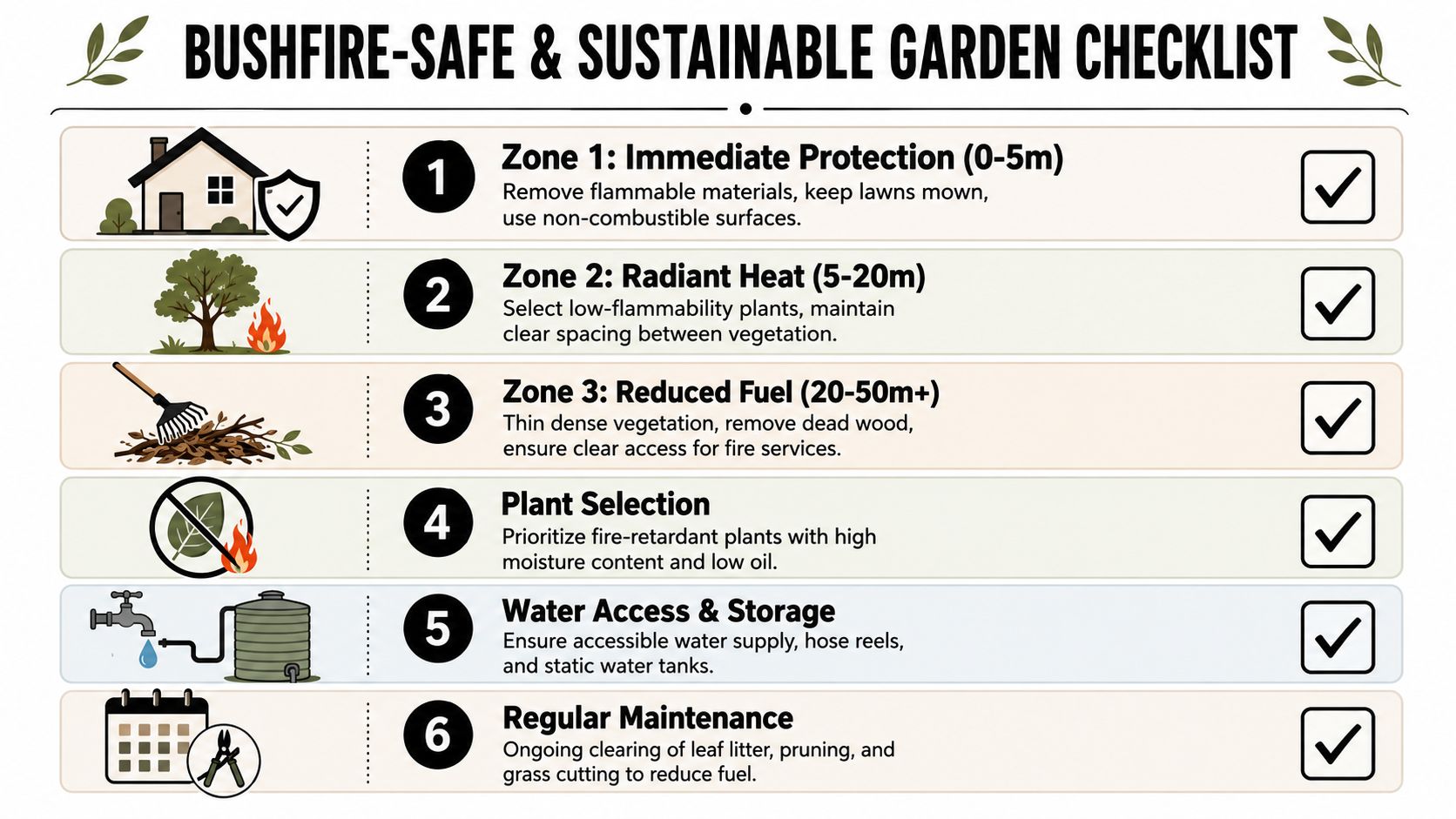
The answer isn't to strip the garden bare. It's to manage zones properly.
Close to the house, non-combustible surfaces and carefully selected, well-spaced planting usually make more sense than lush, continuous planting mass. Gravel, stone, and well-detailed paving can still work beautifully if they're designed as part of the outdoor environment rather than dropped in as a last-minute fire measure.
What a balanced approach looks like
A bushfire-ready sustainable garden typically works on separation and maintenance.
- Immediate areas around the home: Keep them clean, low-fuel, and easy to maintain.
- Middle garden zones: Use lower-flammability planting with clear spacing between forms.
- Outer areas: Reduce accumulated fuel, manage dead material, and avoid neglected thickets.
Plant choice matters, but so does shape and upkeep. A “fire-retardant” plant that's full of dead interior growth or planted under eaves is still a risk. Likewise, an organic mulch that helps retain moisture in one part of the garden may be the wrong choice right against the house.
Bushfire resilience isn't just about what species you plant. It's about where you plant them, how closely you group them, and how well you maintain them.
Sustainability still applies in fire-aware design
The trade-off between water-saving landscaping and bushfire risk is real, and it's often underexplained in mainstream garden advice. The best response is a selective one.
Use water-wise planting where it supports the broader site. Use moisture-retentive mulches where they're appropriate. Then adjust those decisions based on proximity to the dwelling, ember exposure, access, and defensible-space requirements.
A practical fire-aware checklist includes:
- Keep access clear: Paths and maintenance edges need to stay usable year-round.
- Avoid continuous fuel lines: Don't let garden beds create an unbroken path of combustible material.
- Choose mulch by location: Organic mulch may suit some zones. Mineral mulch may be better near the house.
- Maintain relentlessly: Leaf litter, dead branches, and overgrown understorey undo good design fast.
- Coordinate with the building: Screens, fences, decks, and planting should be considered together.
This is one of the clearest examples of why sustainable landscaping practices must be site-specific. A garden can be water-wise and still unsafe. It can also be bushfire-conscious and still look refined, layered, and attractive. The best results come from designing for both outcomes at once.
Integrating Landscaping into Your Renovation or New Build
The biggest mistake homeowners make is treating the grounds as the final line item. By that point, the house is finished, levels are fixed, services are awkward, and the garden has to solve problems it didn't create. That's when compromises start showing up in drainage, planting depth, tank placement, privacy, and usability.
The better approach is to design the grounds at the same time as the build or renovation. In Adelaide and similar Australian cities, sustainable grounds design is best understood as a water-security strategy, with the broader shift moving from water-heavy suburban lawns toward climate-responsive design defined by reduced irrigation, lower chemical use, and improved stormwater infiltration, as outlined in this overview of sustainable landscaping principles. That thinking works best when it's baked into the project from the start.
Why early coordination pays off
When the house and grounds are planned together, practical decisions get easier:
- Finished floor levels and site grading can direct water where it should go.
- Tank and irrigation infrastructure can be located neatly instead of squeezed into leftover space.
- Paving and planting zones can support indoor-outdoor flow rather than interrupt it.
- Bushfire, privacy, and shading responses can be handled as one integrated design problem.
This is also where budget gets used more effectively. Spending wisely on soil preparation, drainage, irrigation zoning, and durable hardscape nearly always delivers better long-term value than overspending on decorative planting at the end.
A landscape should support the way the home lives
The strongest outdoor spaces don't sit beside the house. They extend it. Entertaining zones need shade and durable surfaces. Family gardens need circulation, visibility, and manageable lawn only where it serves a purpose. Side setbacks need drainage and practical planting, not leftover species pushed into difficult conditions.
That integrated approach is what makes sustainable landscaping practices feel less like a checklist and more like part of the architecture. The garden cools, shelters, filters, frames, and softens the build while asking less of the owner over time.
A good Adelaide garden isn't one that looks finished on handover day. It's one that still works after hard summers, water pressure, and real family use.
If you're planning a renovation, extension, or custom home and want the outdoor space considered properly from the beginning, Templeton Built can help shape a home and outdoor environment that work together. Early coordination means better site use, smarter water planning, and a result that feels resolved rather than added on later.


Leave a Reply