

Water Efficiency Measures: Adelaide Renovations & New Builds
You're probably making decisions right now that feel bigger than taps, toilets or garden irrigation. Layouts, finishes, approvals, structural changes, joinery, glazing. Water usually gets pushed down the list until plumbing selections are due.
That's a mistake in Adelaide.
In South Australia, water efficiency measures aren't an optional sustainability extra. They affect how a home performs every day, how a site's exterior is configured, how an extension or new dwelling is assessed, and how much maintenance the owner signs up for after handover. Good water planning gives you a more resilient property. Poor water planning locks in waste, avoidable running costs and awkward retrofits later.
Why Water Efficiency Is a Cornerstone of Smart Building
If you're planning a renovation or custom build in Adelaide, the right time to think about water is before fixtures are ordered and before the landscaping plan is fixed. Once pipes, slab penetrations, roof drainage and external levels are set, your options narrow fast.
That matters because Australia hasn't treated water efficiency as a niche green idea for a long time. Water efficiency became a mainstream planning tool after the Millennium Drought, and the mandatory Water Efficiency Labelling and Standards scheme helped push efficient toilets, showerheads, taps and washing machines into normal residential specification across the country, especially in water-stressed regions such as South Australia, as outlined in this UN-Water analytical brief on water use efficiency.
It affects more than your water bill
Efficient design changes how a home functions.
A bathroom with sensible fixture selection, pipe layout and pressure planning is easier to use and cheaper to run. A laundry designed around efficient appliances and proper drainage performs better over the long term. A site planned for low-water planting avoids the cycle of replacing dead plants and overworking irrigation every summer.
For larger projects, it also shapes feasibility. Extensions, dual occupancies and custom homes on tighter sites need a sharper approach to demand, external water use and servicing. Water-sensitive decisions made early are usually simpler and cheaper than trying to add them during construction.
Practical rule: If a water-saving idea requires cutting concrete, moving drainage or redesigning the landscape after approvals, you're looking at it too late.
Smart building in Adelaide means integrated building
In practice, the best-performing projects don't rely on one hero product. They combine fixture selection, plumbing logic, external design and realistic owner behaviour. That's the difference between a house that looks efficient on paper and one that uses less water once people move in.
The same thinking applies to energy use. Homes that are planned as systems perform better than homes designed as a collection of disconnected upgrades. That's also why broader energy-efficient building strategies often sit naturally beside strong water planning in Adelaide projects.
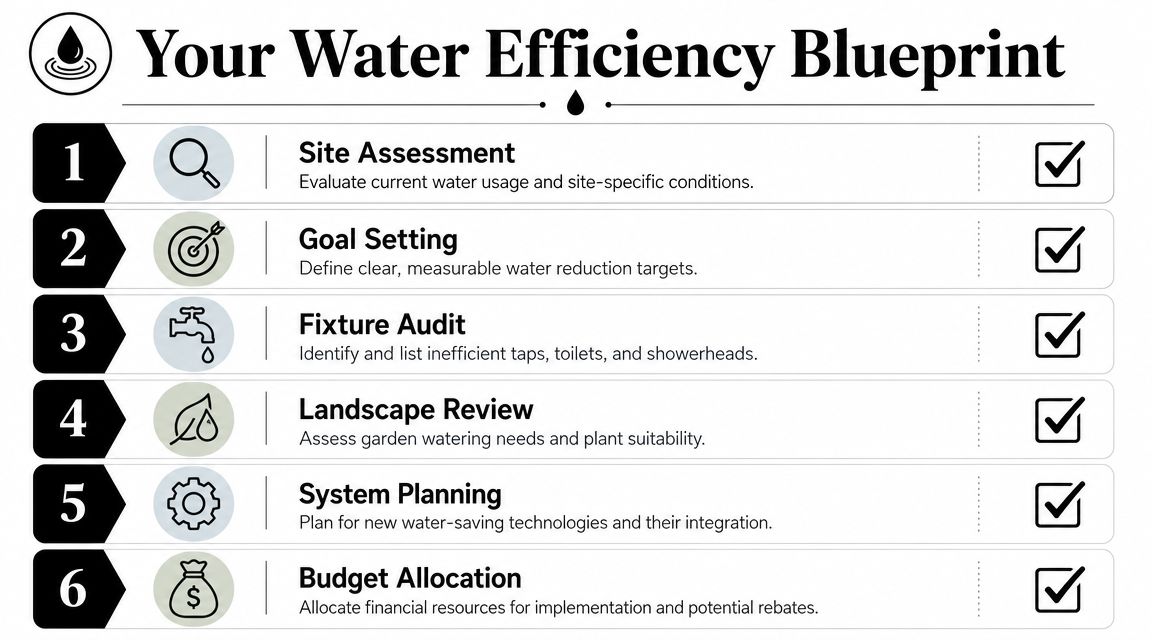
Creating Your Water Efficiency Blueprint
The first useful question isn't which tapware brand to buy. It's where water is being used, where it's being wasted, and what level of intervention makes sense for the property.
For a renovation, that starts with an audit of the existing home. For a new build or development, it starts with design intent.
For renovations, inspect before you specify
Walk the house and look for the obvious first. Many older Adelaide homes lose efficiency through a handful of repeat issues.
- Leaking outlets: Check taps, showerheads, stop valves and visible connections under vanities and sinks.
- Ageing toilets: Older suites often stay in place because they still function, not because they perform well.
- High-use bathrooms: The ensuite used every day matters more than the rarely used powder room.
- Laundry habits: Washing machine age, hose condition and household washing frequency all influence priorities.
- Outdoor draw: Existing spray irrigation, thirsty planting and poor zoning often create more waste than owners expect.
Then map usage, not just defects. A family home with two teenagers may put most of its demand through bathrooms and laundry. A downsizer's property may use far more water outside than inside. The blueprint should reflect actual use patterns, not generic advice.
For new builds, design water use by zone
A new home gives you better control because the system can be planned from scratch. The most effective approach is to divide the home and site into water-use zones and make decisions for each one early.
Internal wet areas need coordinated selections. Toilet location, shower arrangement, vanity layout and fixture pressure need to work together. A premium finish doesn't help if the fittings are mismatched or difficult to maintain.
Service areas such as laundries need practical allowances for appliance choice, drainage, storage and future access.
External zones deserve just as much attention. Front gardens, rear entertaining spaces, side setbacks and productive gardens all have different water demands. Treating the whole site as one irrigation zone is one of the most common planning errors.
New development can offset demand through efficiency measures, metering and landscape design, according to guidance on water-neutral growth from the Alliance for Water Efficiency. That's particularly relevant when you're adding dwellings or increasing site intensity.
A practical planning checklist
Before selections are finalised, answer these questions:
What's the main goal
Is the project trying to reduce household water use, improve drought resilience, support an approval pathway, or all three?Where is the highest daily demand
In many homes it's bathrooms and laundry. On some sites, irrigation dominates.What can be fixed now
Pipe runs, tank allowance, drainage coordination and grounds zoning are cheaper to solve on drawings than on site.What will the owners maintain
The smartest system on paper can become dead weight if filters, pumps or irrigation components are neglected.Does the outdoor area suit the block
A broad lawn concept on a dry, exposed Adelaide site usually creates an ongoing water and maintenance burden.
A good blueprint is simple. It tells the builder, plumber, exterior contractor and owner what the project is trying to achieve and how each part of the property contributes.
High-Impact Upgrades for Fixtures and Fittings
If you want the fastest gains from water efficiency measures, start with the fittings people use every day. That means toilets, showerheads, taps and clothes washers. These are the workhorses of household demand.
This is also where many projects go wrong. Owners often chase style first and performance second. In practice, you need both.
What the retrofit evidence tells us
A peer-reviewed study on residential fixture retrofits reported average household water reductions of about 10.9% from showerheads, 13.3% from toilets, and 14.5% from clothes washers, with an overall 6% to 14% drop in household water demand in the first two years after adoption when multiple measures were used together, as noted in this study on residential water demand management.
The takeaway is practical. One fixture swap helps. A coordinated package works better.
Read WELS for performance, not marketing
WELS matters because it gives buyers a common way to compare products. But star ratings alone don't make the decision for you. The right fixture still has to suit the users, the plumbing setup and the room.
A family bathroom needs a toilet that clears properly and a shower that feels comfortable at the available pressure. A guest powder room has different demands. A laundry appliance in a high-use household deserves more scrutiny than a tap in a secondary basin.
WELS rating quick comparison guide
| Fixture | WELS Rating | Typical Consumption | Notes |
|---|---|---|---|
| Toilet suite | Higher-star WELS models | Lower water use per flush than older suites | Good for daily savings, but bowl design and flushing performance still matter |
| Showerhead | Higher-star WELS models | Lower flow than older fittings | Comfort depends on pressure, spray pattern and plumbing quality |
| Basin mixer or tap | Higher-star WELS models | Lower flow at point of use | Best in bathrooms and powder rooms where flow control doesn't affect usability |
| Kitchen mixer | Mid to higher-star WELS models | Reduced flow compared with older taps | Balance efficiency with food prep, rinsing and sink size |
| Clothes washer | Higher-star WELS models | Lower water use per cycle than less efficient units | Worth prioritising in busy households |
What works and what doesn't
Some upgrades consistently deliver. Others look good in a brochure and disappoint in use.
Works well
- Toilet replacement in older homes: This is one of the clearest performance upgrades in a renovation.
- Showerhead upgrades with pressure checked first: Good products feel far better when paired with sensible plumbing.
- Efficient clothes washers in family homes: High-use laundries benefit quickly from better appliance selection.
Often disappointing
- Cheap tapware chosen only on appearance: Parts wear, cartridges fail and maintenance becomes frustrating.
- Ultra-restrictive fittings in the wrong location: If performance feels poor, owners often work around the product and lose the intended benefit.
- Single-fixture thinking: Replacing one tap while leaving the rest of the wet areas untouched rarely changes total household use in a meaningful way.
For commercial amenities or office fit-outs, sensor products can also be part of the conversation. If you're comparing touch-free options, this guide to automatic taps for Melbourne workplaces is a useful reference for how those systems are typically applied in higher-traffic settings.
Efficient fixtures only work when the user doesn't feel punished for using them. Comfort and reliability matter as much as the rating label.
Beyond the Tap with Rainwater and Greywater Systems
Once internal fixtures are sorted, the next question is whether the property should reuse water on site. For Adelaide homes, that usually comes down to rainwater systems, greywater systems, or a combination with carefully limited scope.
The right answer depends on roof area, block size, intended use, maintenance appetite and how much external water demand the property has.
Rainwater works best when the plumbing plan supports it
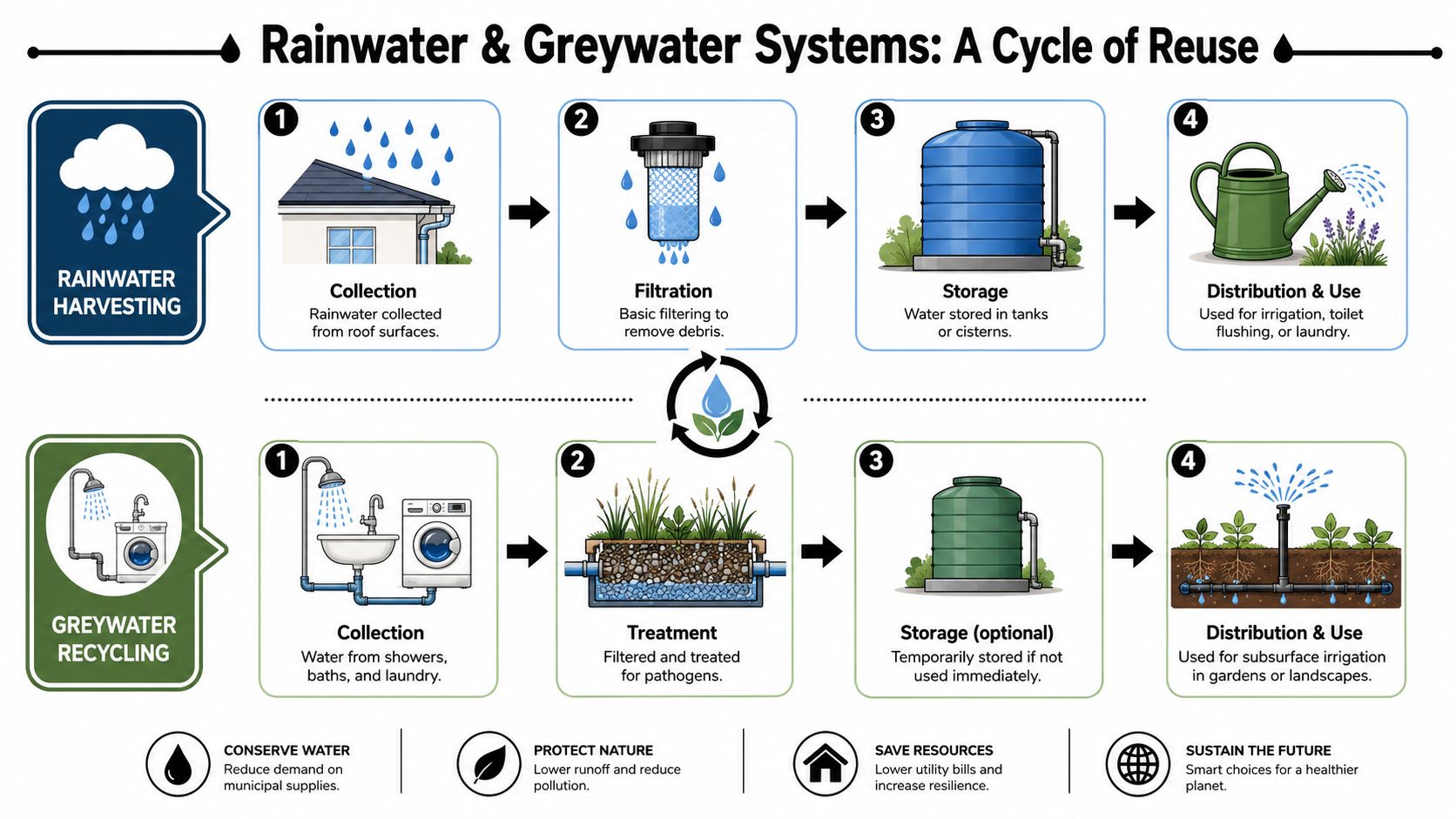
A rainwater setup is straightforward in principle. Water is collected from the roof, filtered, stored in a tank, then distributed where the design allows. The value comes from matching tank placement and plumbing connections to the building layout from the start.
On many Adelaide projects, rainwater is most practical when it serves outdoor taps, garden use, toilets or laundry. It becomes harder and more expensive when there's no good place for the tank, no allowance for pumps, or no clean route for pipework.
A compact urban block can still support rainwater harvesting, but the system has to earn its place. If a site has limited roof catchment and minimal garden demand, a large and complex setup may not make sense.
A short visual guide helps show the difference between the two main approaches:
Greywater suits some homes very well, and others not at all
Greywater systems reuse water from showers, baths and laundry for irrigation of planted areas, depending on the design and applicable requirements. That can be useful on sites with consistent planting demand and owners who are prepared to manage the system properly.
The weak point is usually not the idea. It's the ongoing discipline. Greywater needs the right detergents, the right distribution method and a realistic maintenance plan. If owners aren't going to pay attention to what goes down the drain or whether components are working properly, the system can become more trouble than it's worth.
Which one should you choose
Use this simple decision framework.
Choose rainwater first when
- The roof catchment is decent: More collection area makes the system more worthwhile.
- You want predictable use points: Toilets, laundries and outdoor taps are easier to plan for.
- You're building new or doing major works: Integration is cleaner before walls and slabs are locked in.
Choose greywater first when
- The site has meaningful garden demand: Especially where subsurface irrigation can be set up properly.
- The household creates steady internal water flow: Consistency improves usefulness.
- The owners are maintenance-aware: Product choice and upkeep matter.
Avoid overcomplication when
- The block is small and hardscaped: Limited planting often means limited reuse benefit.
- Access for tanks or servicing is poor: Installation and long-term upkeep become awkward.
- The budget is already stretched: Basic fixture and outdoor area improvements often deliver cleaner value first.
If you're still working through bathroom planning at the same time, it helps to compare layouts and fixture types early. This guide to find bathroom toilet suites is useful when you're matching internal selections to a broader water-saving strategy.
Designing a Water-Wise Adelaide Garden
A water-wise garden in Adelaide shouldn't feel sparse or lifeless. The best ones are comfortable, shaded, attractive and far easier to maintain through dry conditions than a conventional lawn-heavy layout.
The key is to treat the garden as a system. Soil, mulch, plant choice and irrigation all depend on each other. If one part is wrong, the rest won't perform well.
Start below ground
Most outdoor water problems begin in the soil. If the ground is compacted, hydrophobic or low in organic matter, irrigation becomes inefficient fast. Water either runs off, evaporates quickly or never reaches the root zone properly.
Improve the soil before planting. Compost and organic matter help with structure and moisture retention. That gives roots a better environment and reduces the need for frequent watering.
Then add mulch. Mulch isn't cosmetic. It slows evaporation, buffers soil temperature and helps suppress weed growth that competes for available moisture.
A garden that needs constant rescue watering usually has a design problem, not just an irrigation problem.
Choose plants for Adelaide conditions
The safest planting palettes are the ones that suit local heat, wind exposure and seasonal dryness. That doesn't mean filling the yard with gravel and a few token succulents. It means using plants that can hold form and colour without demanding excessive irrigation.
A practical mix often includes:
- Hardy natives: Good for resilience and habitat value when matched to the site.
- Mediterranean species: Often well suited to Adelaide's dry summers.
- Shaded understory planting: Useful where built form creates cooler microclimates.
- Targeted lawn, not blanket lawn: Keep turf where it adds function, not out of habit.
Group plants by similar water needs. Don't mix thirsty soft planting with low-demand species on the same irrigation line and expect efficient results.
Irrigate with precision
Drip irrigation usually makes more sense than broad spray for planted beds because it puts water closer to the root zone. Good zoning matters just as much as hardware. Sunny edges, covered patios, lawn areas and dense planting beds all need different schedules.
For clients trying to visualise alternatives before committing to an outdoor design package, tools such as landscape design ai can be useful for testing low-water layout ideas and planting concepts early.
A strong outdoor plan also needs to fit how the home will be used. Entertaining areas, paths, shade structures and planting beds should work together, not compete for the same space. That's where broader Adelaide outdoor living design considerations become part of the water conversation as well.
Navigating Costs Compliance and Long-Term Maintenance
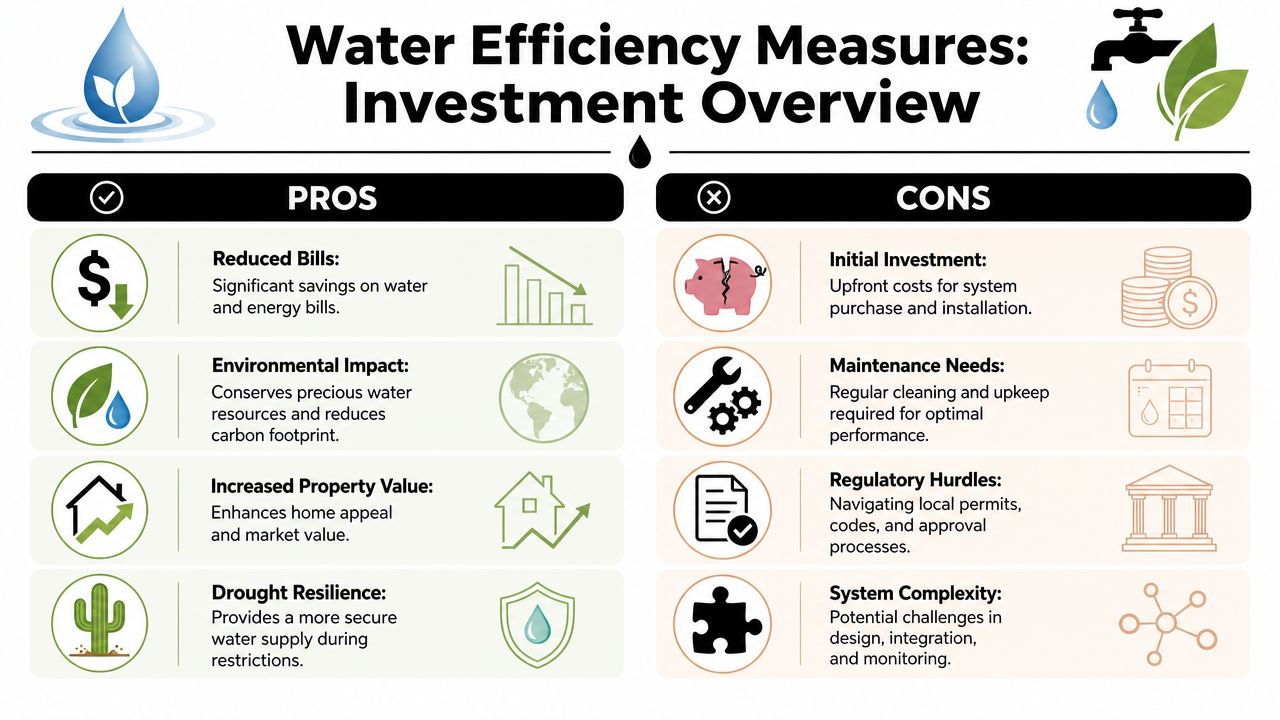
Most water efficiency measures are easy to support in principle. The harder question is whether they still make sense once you factor in installation complexity, maintenance and compliance.
That's where a builder's view matters. Two systems can both save water, but one may integrate cleanly and stay reliable while the other creates ongoing service issues.
Look at lifecycle cost, not just purchase cost
The most overlooked mistake is treating water efficiency as a simple product swap with a simple payback. That works for some fixture upgrades, but not for every measure.
The Pacific Institute notes an important trade-off in its white paper on the costs of water management and efficiency. Saving potable water can also create higher demand for energy or maintenance, which means renovation decisions should be judged through a lifecycle lens rather than by upfront savings alone.
That shows up on real projects in a few familiar ways:
- Pumps add energy use: A rainwater system may reduce mains demand but still require power and servicing.
- Filters need maintenance: Greywater and rainwater components don't stay effective if owners ignore them.
- Complex systems need owner buy-in: If the household won't maintain it, simplicity often wins.
Compliance in Adelaide needs early checking
South Australian projects don't all face the same approval pathway. The requirements depend on the scope of work, the system being installed and how it connects to the property.
For homeowners, the safest approach is to check approvals before work starts, not after materials are ordered. For developers, this is even more important because servicing, site design and external works can all affect timing and compliance risk.
As a rule, review three things early:
Building scope
Does the renovation, extension or new build trigger broader approval requirements?Water servicing
Will the proposed system affect how the property connects, drains or is supplied?Site works
Do tanks, plumbing changes or external alterations affect setbacks, access or documented plans?
If you're unsure where the formal approval line sits, this overview of building permit requirements in Adelaide is a useful starting point before getting into detailed documentation.
What usually delivers the best value
Not every project needs a full suite of systems. In many homes, the best return comes from doing the simple things properly and adding complexity only when the site justifies it.
Usually strong value
- Efficient toilets and showerheads
- Thoughtful appliance selection
- Better irrigation zoning
- Low-water planting with improved soil and mulch
Worth considering carefully
- Plumbed rainwater tanks
- Greywater reuse systems
- Complex controls or monitoring add-ons
Often poor value
- Oversized systems for small blocks
- Products chosen without servicing access
- Installations that depend on owners changing behaviour dramatically
The best water-saving setup is the one that still works properly in five years, not the one that looks most impressive on handover day.
Water efficiency measures should make a property easier to live with, not harder. If a system adds stress, maintenance confusion or avoidable operating cost, it hasn't been designed well enough.
If you're planning an Adelaide renovation, extension, custom home or development and want water efficiency built into the project from the start, Templeton Built can help shape the design, approvals and construction around practical long-term performance. The best results come from getting the plumbing, layout, outdoor areas and compliance decisions aligned early, before they become expensive changes on site.


Leave a Reply